Wireless lighting control does not mean the wall control has no wiring requirements. Before ordering new Lutron dimmers for a finished home, the project team should verify the exact device model and the circuit it will control. A room list and a finish selection are not enough to establish that the proposed equipment can be installed as drawn.
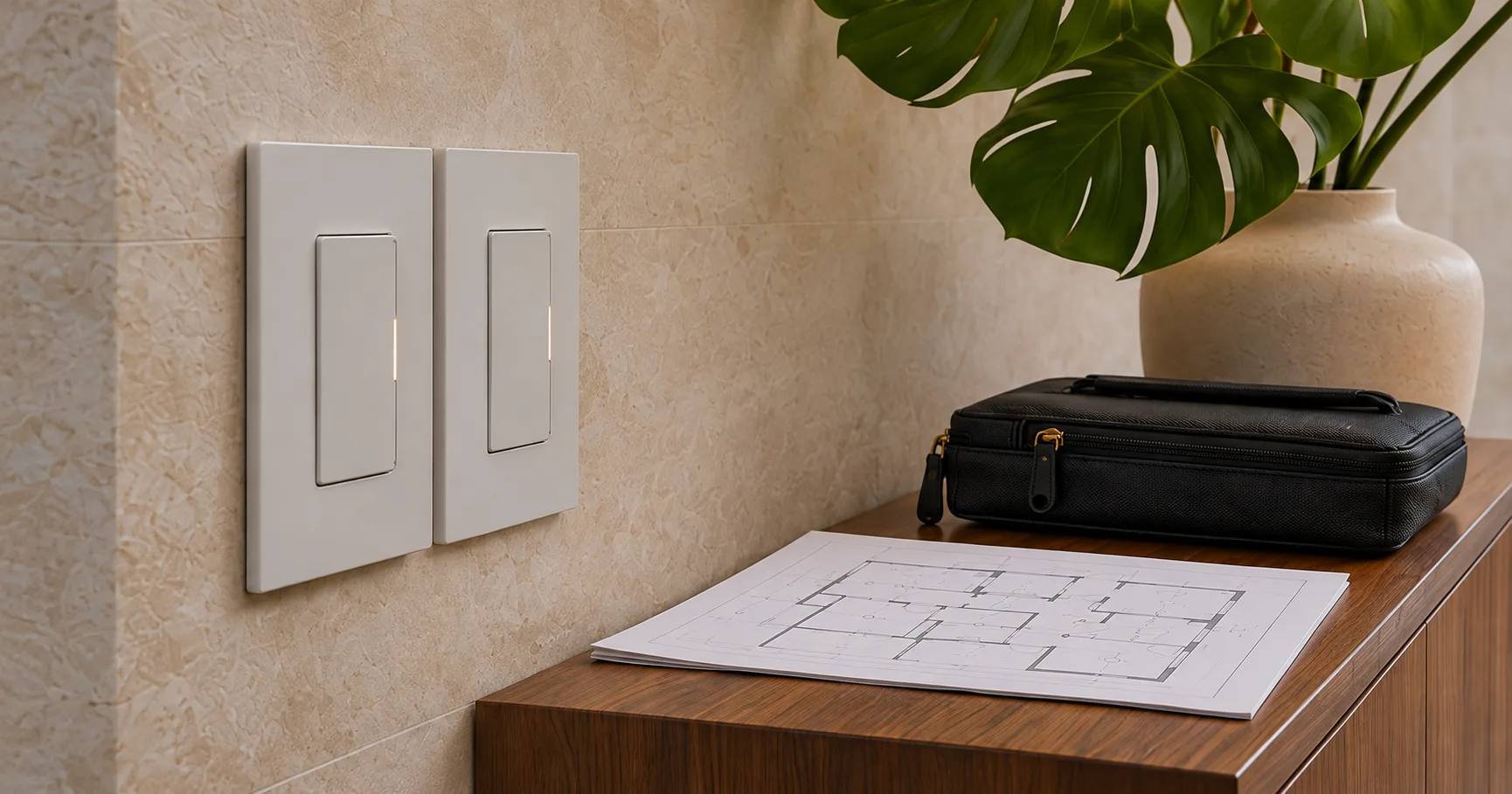
This matters in Boca Raton renovations where some rooms have been remodeled and others retain older electrical arrangements. Two matching wallplates can conceal different conditions. A qualified electrical professional should assess those conditions safely; homeowners should not open energized boxes or infer conductor function from color alone.
Specify a model, not just a lighting-system name
Lutron’s RadioRA 3 RF Sunnata specifications require a neutral for the listed primary dimmer and switch models. That is a model-family requirement, not a rule to generalize to every Lutron product ever sold. The proposal should identify the actual part numbers being considered.
Have the designer and electrician review those specifications together. If an alternative device is proposed for a difficult location, document why it is suitable for that circuit and what, if anything, changes for the user. Do not substitute an unfamiliar model simply because its faceplate looks similar.
Make the survey circuit-specific
A useful survey records the room, controlled lights, existing switch locations and proposed device. The electrician can then confirm the required conductors, available box space and other installation conditions against the selected equipment’s instructions and applicable requirements.
The resulting equipment schedule should distinguish verified locations from unresolved ones. This helps prevent ordering a full-house package before a small number of difficult circuits have been addressed. If access, rewiring or finish repair is needed, that work should appear in the project scope.
Review multi-location control separately
A light controlled from more than one wall location needs its own review. The main device and companion locations do not necessarily use identical parts. Lutron specifies companion controls for multi-location applications in the cited Sunnata family.
Ask which device goes at each position, what each button will do and whether the finished arrangement changes the way the family uses the room. Include hallways, stairs and large spaces where people naturally expect control from more than one entrance.
Neutral wiring is only one purchasing check
Confirm the actual lighting load as well. Record the fixture or driver model where available and identify which lights must dim together. A neutral conductor does not, by itself, prove that a particular dimmer and lighting load will perform satisfactorily.
For decorative fixtures or owner-supplied lighting, establish a process for substitutions. An attractive fixture chosen later can change the electrical and dimming review. Keep sample testing and fixture compatibility on the lighting design checklist rather than treating the original equipment order as blanket approval.
Frequently asked questions
Can the installer just use a wireless control?
The proposed device still needs its specified power and installation arrangement. Wireless communication is not permission to ignore its wiring instructions.
Does every room need rewiring?
Not necessarily. A location-by-location survey establishes which conditions already suit the design and which require an alternative or additional work.
Plan your Lutron lighting installation with Sentry Audio Video before finalizing the equipment order. The RadioRA 3 service guide explains the broader system; the circuit survey establishes how the selected controls fit your home.