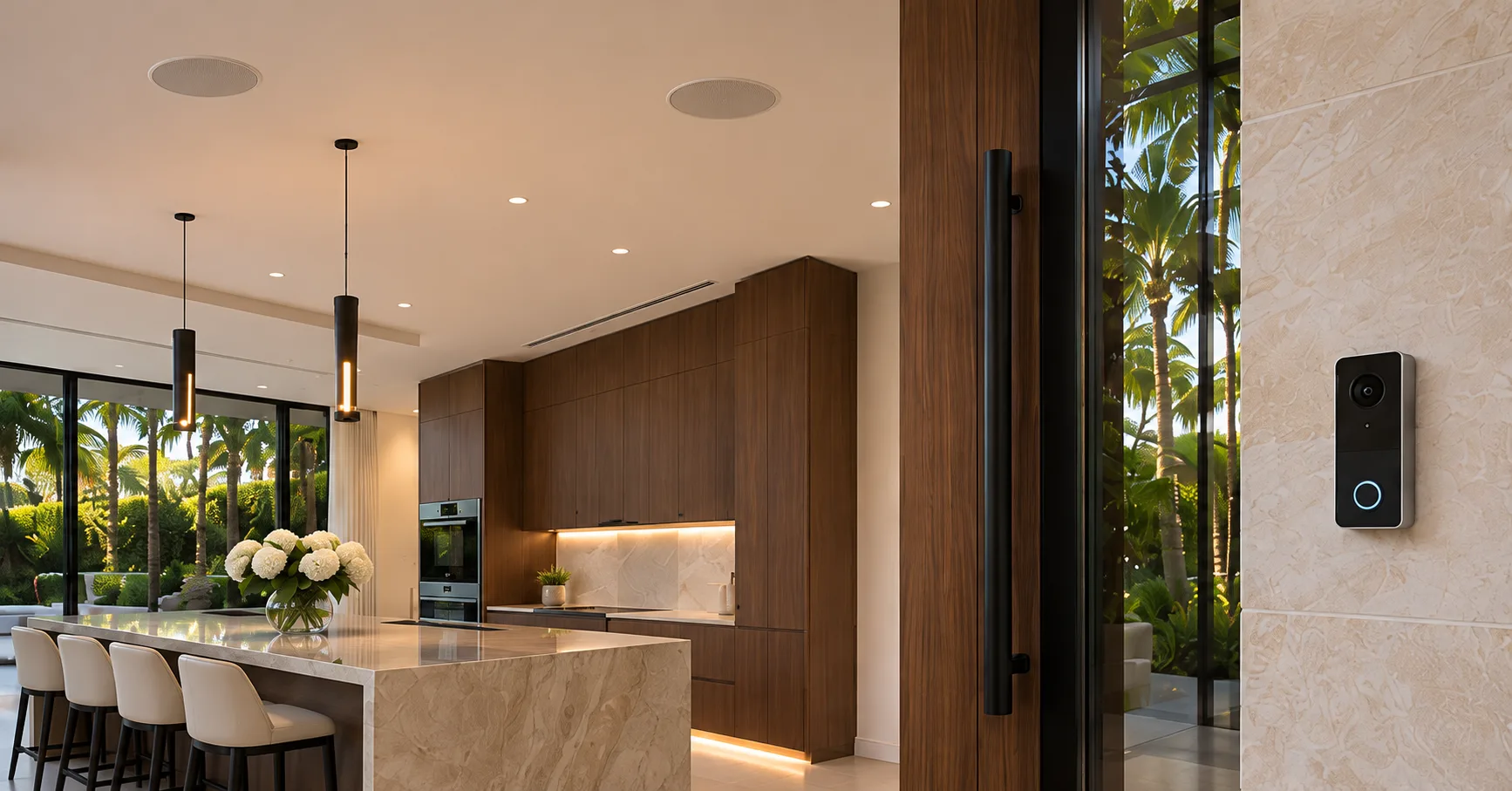
A doorbell announcement should tell you someone has arrived without creating an unpleasant surprise in every room. Before buying a new Control4 audio system, decide where the announcement belongs, how it should sound and what listeners should experience afterward. Those decisions are part of the installation scope, not a detail to leave until the last programming visit.
For a Miami Beach home with several entertaining areas, a useful starting question is whether a visitor alert should interrupt the kitchen, patio, theater and guest suite equally. The right answer depends on how the household lives. It should not be assumed from the number of speakers in the proposal.
Write a room-by-room announcement plan
Separate rooms that must hear the alert from rooms that should remain quiet. Include bedrooms, offices, outdoor areas and spaces used by guests. Then consider different times of day. A daytime arrival and a late-evening visitor may need different treatment.
Ask the designer to record the trigger, affected rooms, preferred sound and intended listening level. Decide whether an occupied room and an inactive room should behave differently. This gives the installer a clear acceptance checklist rather than an instruction simply to make the doorbell audible everywhere.
Check the actual audio path
Control4 documents an Announcements agent for audio and visual notifications. That capability does not establish identical interruption behavior across every amplifier, television, soundbar, source or software version. The proposed equipment and programmed routes still need review.
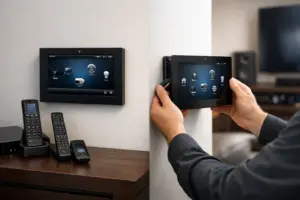
Ask which component will play the announcement in each room. If some rooms use a different audio system, identify that difference before ordering. A touchscreen notification and an announcement through architectural speakers are separate experiences and should be demonstrated separately.
Define what happens after the alert
“Return to normal” is not a precise specification. Should the room return to its previous source, previous level and previous power state? What should happen if a listener changes the volume or chooses another activity during the announcement? Record the expected result for those situations.
Do not accept a general promise that music will always mix, duck or resume perfectly. Have the dealer demonstrate the agreed behavior using the specified equipment. Where a route has a limitation, choose an acceptable alternative before it becomes a handover dispute.
Commission it during realistic listening
Test with music already playing, with a room turned off and with the household’s normal simultaneous activities running. Repeat at a comfortable listening level and at the louder level used for entertaining. The alert should be understandable without encouraging unnecessarily high volume.
Also review who can change the announcement schedule or room selection later. Keep a simple record of the final decisions so a future equipment change does not quietly undo the experience the family approved.
Frequently asked questions
Does this include gate release or intercom calling?
Not automatically. Announcement playback, two-way calling and access release are different functions. Entry permissions and hardware belong in a separate, explicit scope.
Can every room have the same behavior?
That depends on the selected endpoints and programming. Confirm the exact room list rather than relying on a brand-level promise.
Planning a new system or upgrading an existing installation? Ask Sentry Audio Video to design the Control4 installation and announcement acceptance plan. For entry hardware and calling decisions, keep the separate door-station and gate-release scope alongside it.
From our Google reviews
“They recently installed a Control4 system at both my home and my workplace, and the entire experience was flawless from start to finish.”
Control4 installation — home and workplace
Google review excerpt