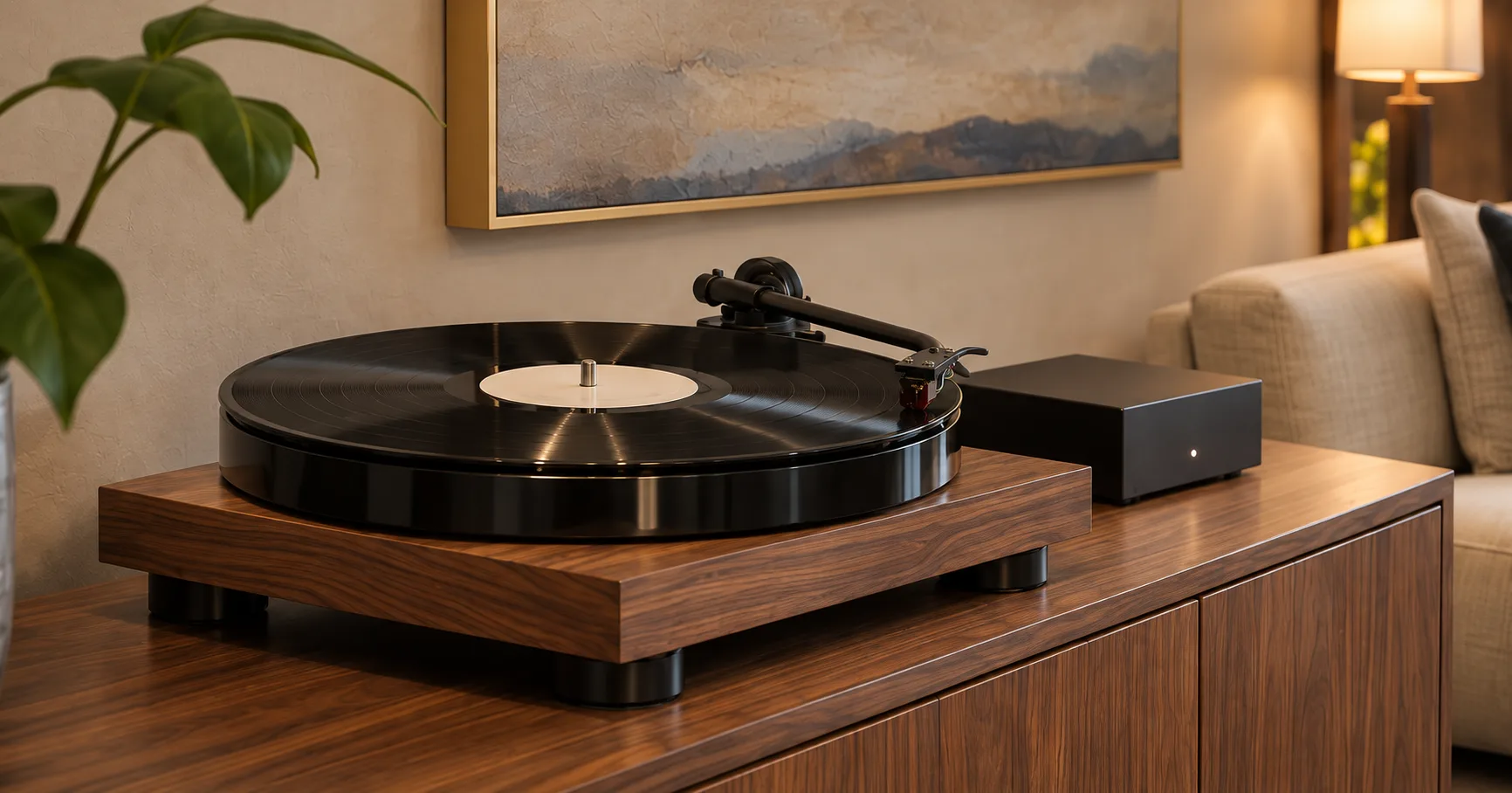
A turntable can be an important part of a new music system, but “include vinyl” is not a complete equipment specification. The design needs to account for the turntable’s output, any required phono stage, the audio interface and the rooms where you want to listen. These decisions are easier to resolve before cabinetry, wiring and equipment orders are finalized.
Start with the intended experience. Do you want dedicated listening beside the record collection, music in adjoining rooms or distribution throughout a Miami Beach home? Those are different requirements. A system that meets one should not be assumed to meet the others without review.
Establish whether the source is phono or line level
A cartridge’s phono signal and a line-level audio signal are not interchangeable. A suitable phono stage provides the required amplification and equalization. Some turntables include one; others require a separate unit or an appropriate phono input elsewhere in the system.
Record the turntable and cartridge models, the phono-stage arrangement and the output being supplied to the next device. This avoids buying an interface on the assumption that any analog connector will process the cartridge signal correctly. Follow the specific manufacturers’ instructions for the chosen combination.
Choose the Savant interface around the topology
Savant’s PAV-AIO1C reference guide describes an analog stereo line input and an AVB network requirement. It does not describe a phono preamplifier, and it expressly rules out routing its local input directly to its local output. It should not be treated as a universal adapter for every proposed listening arrangement.
The installer should select the appropriate current interface for the actual system and explain its role. If the project includes local amplification as well as distributed listening, show both paths on the design rather than leaving the second one implicit.
Settle physical placement before cabinetry
Identify where the records, turntable and associated electronics will live. Allow usable access for changing records, operating the equipment and servicing connections. Discuss equipment support, ventilation and cable routing with the designer before furniture or millwork is ordered.
Do not choose the phono-stage location solely because there is spare space in a distant rack. The proposed source arrangement and cabling should be reviewed as a complete signal path. The installer can then specify suitable equipment and connections rather than improvising after finishes are complete.
Demonstrate local and remote listening
Prepare a listening test for the rooms actually included in the purchase. Ask what happens when several rooms play the record together, when another room selects a different source and when the owner ends the listening session.
If nearby listening paths operate at the same time, evaluate the experience in person. Do not assume their timing will match simply because both are part of the same home. Record any agreed limitations and the preferred way to use those spaces.
Frequently asked questions
Will Savant automatically operate the turntable?
Audio distribution does not automatically provide transport control. Identify which actions remain manual and which, if any, the selected equipment supports through integration.
Can an existing turntable stay?
Possibly. Supply its exact model and associated equipment so the complete path can be assessed before replacing hardware unnecessarily.
Ask Sentry Audio Video to plan the Savant installation around your listening requirements. For broader architecture decisions, see centralized versus distributed audio.