Kaleidescape Certified Integrator: Brian Zeidman
Brian Zeidman has been a Kaleidescape dealer for over 10 years. Kaleidescape Dealer Certification is valid for two years and must be renewed every two years to remain current.
Sentry Audio Video is led by Brian Zeidman, who completed Kaleidescape Dealer Certification on October 13, 2026. His Certified Integrator credential is valid through October 12, 2028.
Sentry Audio Video · Kaleidescape Sales & Service
New Systems, Upgrades, Repairs & Takeovers
Sentry Audio Video sells, installs, upgrades, troubleshoots and takes over Kaleidescape movie systems in Boca Raton, Palm Beach County, Fort Lauderdale and Orlando. We welcome existing installations completed by other companies.
Kaleidescape Sales & New Installations
We prepare equipment and installation proposals for private cinemas, media rooms and multi-room homes. Your system plan coordinates the movie player, storage where required, network, display, audio system and theater controls. Equipment availability and the final configuration are confirmed for your project.
Kaleidescape Player, Server & System Upgrades
We assess your existing players, servers, storage, network and control integration before recommending a supported upgrade path. Useful equipment may remain where compatible. For legacy systems, we review content access, account requirements and migration options before recommending changes.
Kaleidescape Repair & Troubleshooting
Need help with no picture or sound, failed playback, an unreachable player or server, or theater controls that stopped working? Sentry diagnoses power, network, cabling, HDMI connections, equipment status and control programming. We resolve installation and integration issues on site and coordinate manufacturer support when hardware needs factory repair or replacement. Warranty eligibility and replacement options depend on the equipment and manufacturer assessment.
Kaleidescape System Takeovers
Bought a home with Kaleidescape or need a new service company? We inspect systems installed by other companies, verify authorized account access, review available documentation and test playback and theater integration. Your takeover plan identifies repairs, supported upgrades, equipment to retain and homeowner or house-manager training.
Boca Raton: (561) 717-3280 · Fort Lauderdale: (954) 859-6475 · Orlando: (407) 377-5360
Who This Kaleidescape Page Is For
This page is for homeowners who want a premium movie source designed into the room rather than added after the theater is finished. It is also for owners who inherited a Kaleidescape system, have older components, need more storage or players, or want an integrator to diagnose a system that no longer behaves predictably.
Common South Florida projects include:
- A dedicated private cinema in a Boca or Palm Beach estate.
- A family media room where simple operation matters as much as performance.
- Multiple viewing rooms sharing a centralized movie library.
- A waterfront property with a theater, club room and outdoor entertaining areas.
- A condominium installation that must work within space, ventilation and building-access limits.
- A seasonal home where downloaded movies should be ready even when internet performance is inconsistent.
- An existing theater being upgraded from conventional streaming or disc playback.
- A legacy Kaleidescape owner planning a careful migration to current players and servers.
The right question is not simply “Which Kaleidescape box should I buy?” It is “What source, storage, network, display and control architecture will let this room perform reliably for the people who use it?” That is the question we answer.
What Makes Kaleidescape Different From Ordinary Streaming
Streaming services are designed to deliver acceptable video to millions of devices across changing internet conditions. They adjust quality as bandwidth changes and compress audio and video aggressively enough to reach televisions, tablets and phones. That convenience is useful, but compression becomes visible and audible when a room has a large projection screen, high-output speakers, capable subwoofers and a well-calibrated surround system.
Kaleidescape downloads purchased movies to local storage. Current Strato movie players then play the file from that local system rather than depending on continuous internet delivery during the film. Kaleidescape describes its library as providing lossless audio and reference-quality video, including supported immersive formats such as Dolby Atmos and DTS:X. The practical benefit is a more stable high-performance source for a theater that can reveal softness, banding, noise and reduced audio dynamics in conventional streams.
Internet service is still required to browse, purchase and download titles, and download speed affects how quickly a movie becomes available. Playback after download is the important distinction. A brief neighborhood internet slowdown should not force the movie to lower its picture quality halfway through a screening.
What a Boca Raton Kaleidescape System Should Include
A current Strato movie player
The player delivers the movie to the display and audio system. Current Kaleidescape architecture includes Strato movie players, with model choice depending on system design, storage approach and room requirements. The player belongs in a properly ventilated rack or approved local location, with reliable network, power and HDMI connectivity.
We verify the complete signal path. A premium source does not help if the HDMI cable cannot carry the required format, an extender is marginal, the processor is configured incorrectly or the projector input is limited. Every device in the chain must agree on resolution, color, dynamic range, copy protection and audio format.
Local storage with Terra or Terra Prime
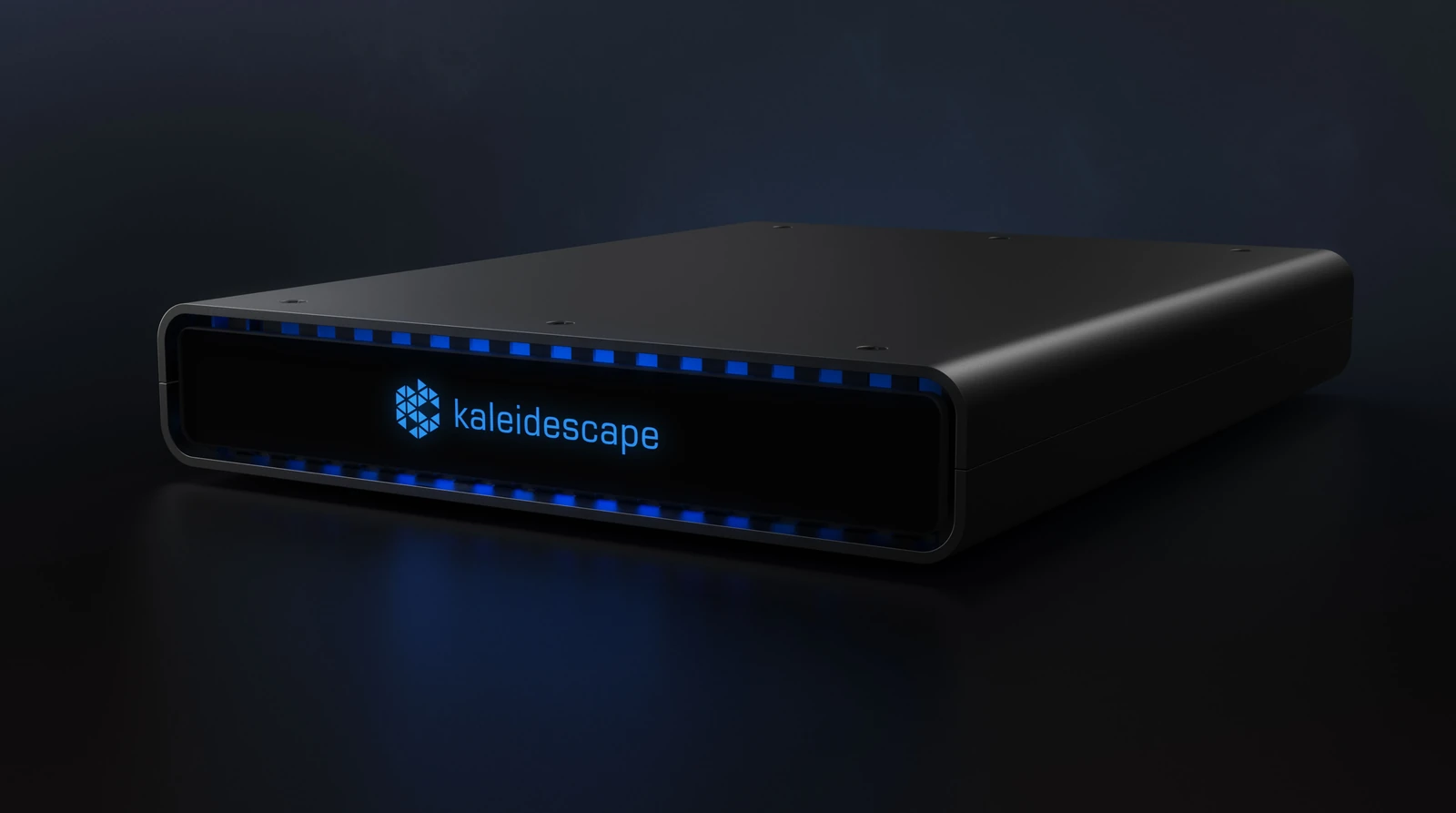
Terra and Terra Prime movie servers store movies, television series and concerts downloaded from the Kaleidescape movie store. Storage planning should reflect the owner’s collection, expected growth and number of players. A large estate with several movie rooms has different requirements from a single media room.
We discuss capacity in terms of use, not just terabytes. Does the owner keep a permanent curated library? Are new releases downloaded before family arrives for the season? Will children and guests use separate rooms at the same time? Is rack space available for future storage? Those answers shape the design.
A network sized for downloads and multi-room playback
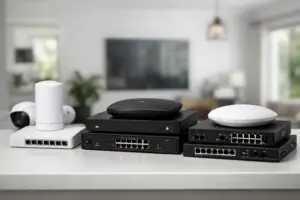
Kaleidescape is a networked system. Players and servers need stable wired connections and correctly configured switching. Large movie downloads can expose weak internet service, low-quality switches or a network that was designed only for phones and laptops. Multiple players also increase the importance of a clean wired backbone.
We prefer to place fixed high-performance AV devices on reliable wired infrastructure. Wi-Fi remains important for the homeowner’s control devices, but it should not be asked to replace cabling that could have been planned during construction.
Control-system integration
A private theater should not require a sequence of remotes. Kaleidescape can be integrated with systems such as Control4, Savant or Crestron so a movie command can prepare the room: turn on the projector or display, select the proper input, set the audio mode, lower shades, move lighting to a preshow scene and then fade the lights at playback.
Kaleidescape also provides movie metadata that can support theater automation, including aspect-ratio and cue information. The design may use those capabilities to coordinate screen masking, lighting or seating behavior where supported and appropriate. We keep automation understandable so the owner can still operate the room if a specialty feature is temporarily unavailable.
A display capable of showing the difference
Kaleidescape can feed an OLED television, a large direct-view display or a projection system. The selection depends on room light, viewing distance, screen size, architecture and expectations. A dedicated theater can control ambient light and support projection. A bright waterfront family room may need a high-output display and carefully planned shades.
We do not specify the source independently from the display. A video system must be designed as one chain and calibrated in the actual room.
An audio system with headroom
Lossless soundtracks are valuable when the processor, amplification, speakers, subwoofers and acoustics can reproduce them. Speaker count alone does not determine performance. Placement, matching, crossover design, bass management, room treatment and calibration matter. A theater should deliver dialogue clearly at the main seats, maintain impact without strain and control bass across more than one chair.
Kaleidescape in a Dedicated Private Cinema
A dedicated room lets the team control light, sightlines, speaker locations, acoustic treatment, screen size and equipment noise. That makes it the natural home for Kaleidescape, but the source still has to be coordinated early.
During design, we consider rack location, conduit to the projector, HDMI transport, control wiring, network, screen masking, lighting zones, shade requirements, seating layout and service access. We also plan how the owner will browse the library. Some clients prefer a handheld remote and on-screen interface; others use a control-system touchscreen or app. The system should start in a predictable state regardless of which family member enters the room.
Audio and video commissioning follow installation. We confirm signal formats, lip synchronization, projector or display modes, processor decoding, channel routing and control-system feedback. We then test familiar content rather than relying only on setup screens. A theater is finished when movies are easy to start and consistently look and sound right.
Kaleidescape in a Media Room or Great Room
Not every owner wants a dedicated cinema. A media room may share space with a bar, family area or club room. A great room may have substantial glass and changing daylight. Kaleidescape can still be useful, but the display and control design must reflect the environment.
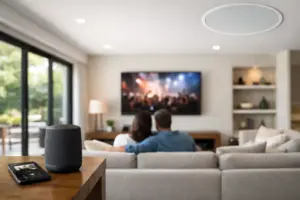
Motorized shades can control glare for serious viewing without making the room feel closed all day. Lighting scenes should preserve safe paths and avoid reflections. Speakers may be architectural, invisible or incorporated into millwork. The equipment may live in a central rack to keep heat and fan noise away from the seating area.
Simplicity matters in shared rooms. A “Movie” button can prepare the room while a separate “TV” or “Sports” activity retains the family’s familiar live-television workflow. Kaleidescape should be a premium choice inside an easy system, not a mode that only one person understands.
Multi-Room Kaleidescape for Large Estates
A Boca estate may have a theater, primary-bedroom display, family room and guest wing that all benefit from access to one movie library. A multi-room system can use network-connected players with shared server storage. The design must consider simultaneous use, network capacity, rack space, control consistency and who can purchase content.
Room names should match the automation system and owner documentation. Each player needs the right display and audio settings. Children’s or guest areas may need different purchase permissions. The owner should be able to start a movie in one room without changing another room’s source.
On multi-structure properties, the network backbone is especially important. Fiber may be appropriate between a main house and detached pavilion or guest house. We do not extend a high-value system across improvised wireless links when a durable pathway can be installed.
Movie Library, Purchasing and Household Access
The experience includes more than hardware. The owner needs a clear process for purchasing titles, managing the library and deciding who can buy content. The primary account should belong to the client, with contact and payment information controlled by the household rather than the integrator. Estate staff or guests may need playback access without unrestricted purchasing authority.
Before a holiday weekend or seasonal arrival, a large group of new movies can be downloaded in advance. The time required depends on title size and the property’s internet service. For a home with slower service, planning matters; local playback is stable after download, but the system cannot make the original download instantaneous.
Families also benefit from a library strategy. Some owners keep an extensive permanent collection. Others retain favorites and rotate recent releases as storage fills. We explain capacity and expansion choices in practical terms and avoid presenting storage as a one-time decision. The movie collection will grow, new rooms may be added and higher-quality titles can require substantial space.
If a property changes ownership, the equipment and the movie account are separate considerations. We confirm what transfers, what stays with the prior owner and which devices should be reset or reassigned. That protects both parties and prevents the new homeowner from assuming a library is included merely because a server remains in the rack.
South Florida Design Constraints
Heat and rack cooling
Movie servers, players, network switches, amplifiers and control processors all produce heat. A closed millwork cabinet or under-air-conditioned closet can create intermittent HDMI and network symptoms and shorten equipment life. We calculate ventilation needs, preserve service clearances and avoid stacking components in ways that block airflow.
Power interruptions and storms
South Florida properties experience utility disturbances and storm preparation cycles. Network, control and source equipment should be connected through a power strategy appropriate to the project. Battery backup can provide orderly continuity for critical rack components, while surge protection and grounding must be coordinated correctly. No device can make a property storm-proof, but disciplined power design reduces avoidable failures.
Salt air and waterfront exposure
Central equipment belongs in a conditioned environment. Terminations, outdoor displays and terrace components must be selected and protected for their exposure. Kaleidescape itself typically remains indoors; the broader system carrying its content to an outdoor entertaining area still has to withstand humidity and salt.
Glare and expansive glass
Waterfront views are part of the architecture, and they also create extreme daytime glare. We coordinate screen placement, display output and shading instead of trying to solve every problem with a brighter picture. A movie scene can lower the relevant shades and adjust lighting while preserving views in other areas.
Seasonal homes
Owners who divide time between Boca Raton and New York often want the system ready when they arrive. We can help organize remote management, network monitoring and pre-arrival service. Movie downloads may be scheduled or initiated before occupancy, but account access should remain with the homeowner. The system should restart cleanly after extended periods and should not depend on an undocumented installer account.
Network, Cabling, HDMI and Rack Infrastructure
Kaleidescape performance depends on a chain of infrastructure that visitors never see. Structured cabling connects players and servers. Managed switches move data reliably. The internet connection handles purchases and downloads. HDMI cabling or professional extension carries video and audio. Control wiring and network links coordinate the theater.
During an audit we may test:
- Network cable certification and link speed.
- Switch capacity, configuration and error history.
- Internet throughput at the rack rather than only over Wi-Fi.
- Available server storage and system architecture.
- HDMI cable or extender support for the required video format.
- Display, projector and processor firmware compatibility.
- EDID and copy-protection behavior across the signal path.
- Rack temperature, power, UPS condition and airflow.
- Control-system drivers, feedback and activity programming.
- Labels, documentation and account ownership.
Intermittent black screens are rarely solved by guessing. We isolate the source, cable, extender, processor and display to find where the handshake fails. A slow download may be an internet limitation, a network port negotiating at the wrong speed or an overloaded gateway. The diagnosis should identify the layer before equipment is replaced.
Existing-System Takeovers and Kaleidescape Service
Sentry AV can take over and service Kaleidescape installations completed by another company. We begin with a survey because legacy systems can contain multiple generations of hardware, old network arrangements and control programming that no longer matches the room.
Typical service requests include:
- A player or server no longer appears on the system.
- Movies download slowly or stall.
- The theater shows intermittent blank screens or format errors.
- Audio is missing, limited to the wrong format or out of sync.
- The control system starts the room but does not reliably control playback.
- A projector, television or audio processor was replaced and the system was never recommissioned.
- The owner needs more storage or another viewing room.
- An older system needs a migration plan.
- The rack has no labels and the original integrator is unavailable.
We document what is installed, confirm support status, test the network and signal path, and separate repairs from optional upgrades. If a legacy component can remain useful, we say so. If current integration requires replacement, we explain which dependency creates that need.
For cross-platform problems, our audio-video service and repair team can address the theater, automation and network as one system.
Upgrading a Theater to Kaleidescape
Adding Kaleidescape to an existing theater begins with compatibility. We review the display’s resolution and HDR capabilities, processor inputs and decoding, HDMI transport, rack space, network and control platform. The source may reveal weaknesses that were less obvious with compressed streaming.
An upgrade can be phased:
- Stabilize the network, HDMI path and rack.
- Install the selected player and storage architecture.
- Integrate control and confirm basic video and audio formats.
- Calibrate the display and sound system.
- Add lighting, shade or screen-masking automation where useful.
- Train the family and document operation.
Owners sometimes expect a source upgrade to fix every limitation. It will not correct a poorly placed center speaker, untreated echo, inadequate subwoofer coverage or a projector that is too dim for the screen. We identify those separate issues so the owner can decide whether to address them at the same time.
When Kaleidescape Is—and Is Not—the Right Upgrade
Kaleidescape is most compelling when the room has enough video and audio performance to reveal source quality, the household values a curated movie library and dependable playback matters. It is also useful when a multi-room estate needs one consistent premium source. The investment makes less sense if the owner watches only casual news and sports, the display is modest, or the theater has unresolved acoustic and projection problems that should be corrected first.
We do not recommend it as a replacement for every streaming service. Live programming, niche subscriptions and casual television still have their place. A strong system keeps those sources simple while adding Kaleidescape for the movies, concerts and series where presentation quality matters. The control interface should make the distinction clear without exposing the family to the technical architecture.
New Construction, Renovation and Retrofit
New construction
For a new theater, Sentry coordinates with the architect, builder, interior designer, electrician, HVAC contractor, millworker and theater specialists. Rack location and cooling are planned early. Conduit provides a replaceable path to the projector. Speaker, subwoofer and acoustic locations are tied to the seating plan. Lighting and shade circuits support the intended scenes.
We also plan service access. A projector should not require destructive ceiling work for replacement. A server should not be trapped behind fixed millwork. The equipment room needs enough working clearance for future changes.
Renovation
A renovation is the time to correct old cabling, move noisy equipment out of the room, add network capacity and improve speaker placement. We document what can remain and what should be replaced before finishes close. If the home stays occupied, we phase the work to preserve useful systems where possible.
Retrofit
In a finished home, we use existing conduits and structured wiring where suitable, create selective pathways with the contractor and avoid unnecessary damage. A retrofit still needs reliable infrastructure. We will not describe an improvised wireless path as equivalent to a planned wired connection.
How Sentry Audio Video Runs a Kaleidescape Project
Consultation
We discuss the rooms, collection, viewing habits and performance expectations. We ask who will use the system, whether multiple rooms play simultaneously, how content will be purchased and how the owner prefers to control the room.
System survey or design
For an existing home, we inspect the display, audio processor, rack, network, cabling and control system. For construction, we review plans, seating, screen, acoustics and infrastructure. We then select a player and storage approach that fits the actual use.
Installation
We install equipment with proper power, cooling, network and cable management. We label the system and preserve access to serial numbers and service connections. Fixed devices are wired wherever practical.
Integration and commissioning
We program the control activity, verify video and audio formats, test several titles and confirm room scenes. We check that the system behaves correctly from a cold start and that the owner is not left at a confusing input screen after another activity.
Training and support
We show the family how to browse, purchase, download and play content; how to switch among theater activities; and when to call for service. Documentation identifies the rack components, network dependencies and control paths.
Working With Architects, Builders and Interior Designers
Kaleidescape is one part of a room that includes architecture, acoustics, lighting, seating, HVAC and finishes. We coordinate equipment and pathways without asking the design team to compromise the room unnecessarily. Invisible speakers, acoustically transparent fabric, concealed racks and motorized shades can preserve the design when they are planned together.
The architect and designer need accurate dimensions and access requirements. The HVAC contractor needs equipment heat information. The electrician needs dedicated circuits and lighting-control coordination. The builder needs opening and inspection sequences. Sentry translates the technology into decisions each trade can act on.
One Scope for Theater, Automation, Lighting and Networking
Sentry AV can handle the broader residential integration around Kaleidescape: projection and direct-view displays, surround sound, acoustic coordination, Control4, Savant or Crestron control, Lutron lighting and shades, enterprise Wi-Fi, whole-home audio and outdoor entertainment. See our residential integration services and Boca Raton AV company overview.
One coordinated scope reduces the familiar argument in which the network vendor blames the source, the theater vendor blames the control system and the control programmer blames HDMI. We can test the full path and take responsibility for the experience.
License and Local Support
Sentry Audio Video is family-owned, led by Brian Zeidman and licensed in Florida for low-voltage work under EF20001874. We support new projects and systems installed by other companies. Local service is especially important for a theater because the cause of a failure may be physical: a hot rack, damaged cable, failing extender, power event or changed display.
Service Areas
Our Florida team serves Boca Raton, Delray Beach, Palm Beach, Gulf Stream, West Palm Beach, Fort Lauderdale, Miami and surrounding South Florida communities. Our New York division serves Massapequa, Long Island, Manhattan, the Hamptons, Sag Harbor and Montauk, plus Greenwich, Connecticut. Clients with homes in both markets can work with one company that understands the preferred operation and documentation.
Kaleidescape Frequently Asked Questions
Who installs and services Kaleidescape in Boca Raton?
Sentry Audio Video designs, installs, integrates and services Kaleidescape systems for Boca Raton theaters, media rooms and multi-room estates. We handle players, movie servers, network and rack requirements, control-system integration, display and audio commissioning, upgrades and takeovers of systems installed by other companies.
Is Kaleidescape better than streaming?
It serves a different purpose. Streaming is convenient and broad, while Kaleidescape is designed for high-performance playback from movies downloaded to local storage. The company provides lossless audio and reference-quality video for supported titles. The difference is most meaningful on a large, well-calibrated display with a capable theater audio system.
Does Kaleidescape require internet?
Internet service is needed to access the movie store, purchase content, download titles and support connected functions. Movies are stored locally and played from the Kaleidescape system after download. A strong internet connection improves download time, but playback does not rely on continuously adapting a stream during the movie.
What are Strato and Terra?
Strato refers to Kaleidescape movie players. Terra and Terra Prime are movie servers that store downloaded movies, television series and concerts for playback on network-connected players. The appropriate combination depends on the number of rooms, collection size, desired growth and current product architecture.
Can Kaleidescape work with Control4, Savant or Crestron?
Yes. Kaleidescape can be integrated into a professionally programmed control system so one activity starts the source, display, audio processor, lighting, shades and other theater functions. We verify driver support, feedback, input selection and shutdown behavior instead of treating playback control as the only requirement.
Can you add Kaleidescape to an existing theater?
Yes. We first inspect the network, rack, HDMI path, display and audio processor to confirm compatibility. We then install the selected player and storage, integrate control, verify audio and video formats, and commission the room. Existing infrastructure may remain if it supports the required performance reliably.
Can Sentry take over a Kaleidescape system another dealer installed?
Yes. We survey the hardware, network, account access, storage, HDMI chain and control system. We can stabilize the installation, correct rack and network issues, add players or storage and create a migration plan for legacy components. The initial survey defines what can be serviced and what requires replacement.
How much storage does a Kaleidescape system need?
That depends on collection size, the mix of 4K and other content, how much the owner keeps downloaded and the expected growth. We also consider multiple rooms and available rack space. Rather than selecting capacity from a generic household average, we size storage around the owner’s actual library habits.
Can one Kaleidescape library serve several rooms?
Yes. A properly designed system can use network-connected players in multiple viewing rooms with shared server storage. Each room still needs compatible display, audio, control and network infrastructure. We plan for simultaneous use and consistent room naming across the automation system.
Why is my Kaleidescape showing a black screen or no audio?
Possible causes include HDMI handshake or cable problems, an incompatible extender, display or processor settings, firmware changes, input configuration or network issues. We isolate each part of the signal path and confirm the exact formats being negotiated before recommending replacement equipment.
Do you design complete private theaters?
Yes. Sentry AV can coordinate the source, projection or display, surround sound, amplification, subwoofers, control, lighting, shades, network, rack and service access. We work with architects, builders, designers, electricians and acoustic specialists so the room functions as a complete cinema.
Can Kaleidescape be used in a seasonal Boca home?
Yes. Local movie storage is useful for a seasonal property, but the system still needs dependable internet for purchases and downloads plus a stable network and power strategy. We can prepare the system before occupancy, verify remote management and document client-owned accounts so the home is ready when the family arrives.
Schedule a Kaleidescape Consultation
Whether you are planning a new private cinema, upgrading a media room, expanding an existing movie library or taking over a system whose original installer is gone, Sentry Audio Video can design and support the entire AV chain.
South Florida: (561) 717-3280
New York: (516) 210-2120
Address: 1708 Costa Del Sol, Boca Raton, FL 33432