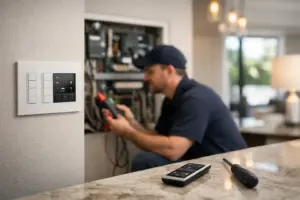
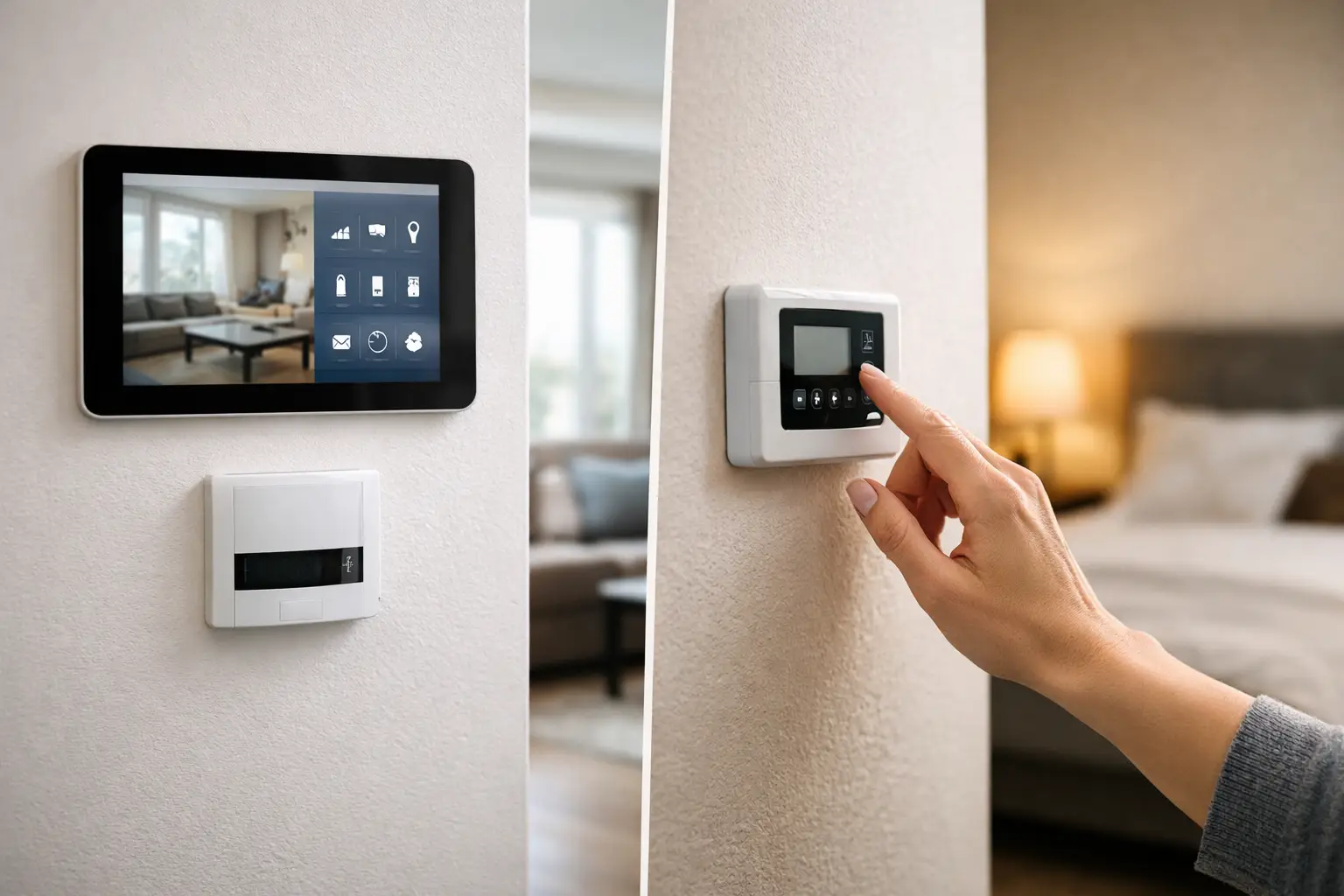
A home can have exceptional audio, lighting, shades, security, and climate systems yet still feel unnecessarily complicated if each one is controlled differently. The real question is not whether technology belongs in every room. It is how you want to interact with it. In the centralized vs room by room control decision, the right answer depends on the property, the systems involved, and the experience you expect every day.
For a waterfront residence with multiple entertainment areas, outdoor spaces, guest rooms, and motorized shades, a single, coordinated control experience can remove friction from the day. For a smaller property or a focused upgrade, dedicated room controls may provide everything the owner needs. The objective is not to add complexity. It is to make sophisticated technology feel natural, reliable, and ready when it is needed.
What Centralized Control Really Means
Centralized control brings multiple systems into one designed interface. That may be a wall keypad, a touch panel, a handheld remote, or a professionally configured mobile application. Instead of moving among separate remotes and apps, the user can manage entertainment, lighting scenes, shades, security viewing, pool features, and comfort settings from a consistent control platform.
The value is most apparent in the moments that involve more than one system. Selecting a “Movie” scene in a home theater can power up the display and audio system, set the appropriate lighting level, lower shades, and prepare the room without a sequence of individual commands. A “Goodnight” scene can turn off selected lights, secure common areas, close shades, and leave only the exterior lighting you choose.
Centralized does not have to mean that every function is exposed on every screen. A properly designed system is organized around how the household or staff actually uses the property. The primary bedroom does not need the same controls as the pool deck. A guest suite should remain intuitive without granting access to private or operational settings.
For commercial environments, centralized control can simplify opening and closing procedures, presentation spaces, background music zones, surveillance access, and common-area settings. It helps staff operate the environment consistently, even when they are not technical specialists.
When Room by Room Control Makes More Sense
Room by room control gives each space its own focused interface. A bedroom may have a keypad for lights and shades, a family room may have a dedicated entertainment remote, and a conference room may have a simple wall panel for presentations. These controls can still be professionally installed and integrated with the equipment in that room. They simply do not depend on a single whole-property experience for everyday operation.
This approach can be an excellent fit when a project is phased over time, when only a few rooms need advanced technology, or when the systems in each area serve distinct purposes. A formal dining room, for example, may need elegant lighting and music control but no reason to access the theater or security cameras. A conference room may need a dependable start-presentation control without the complexity of building-wide automation.
There is also a practical comfort factor. Many people appreciate direct, tactile controls for routine tasks. A well-placed keypad beside the bed or at an entryway is faster than searching for an app. Room-based control can deliver that simplicity while keeping the technology cleanly installed and easy to support.
The trade-off is that the experience may become fragmented as more systems and rooms are added. If each space has a separate interface, the owner may eventually manage several remotes, applications, or control conventions. That is manageable in a limited installation. In a large residence, it can become a daily inconvenience.
Centralized vs Room by Room Control: The Key Differences
The most meaningful difference is not the number of touch panels on the wall. It is the level of coordination between systems and spaces.
Centralized control is designed for property-wide awareness. It can create scenes that affect multiple rooms, provide remote access to appropriate functions, and present a unified way to operate complex technology. It is especially valuable when the home includes whole-house audio, distributed video, motorized shading, outdoor entertainment, security, and multiple living zones.
Room by room control is designed for local clarity. It keeps the controls immediately relevant to the space in front of the user. This can reduce the learning curve and make a targeted project feel polished without requiring a broad automation strategy from the start.
Reliability should be considered in both models. A premium control system is only as dependable as its design, network infrastructure, programming, equipment selection, and installation quality. Centralized systems require thoughtful engineering because many components work together. Room-based systems reduce the scope of any individual control point, but they can introduce inconsistency if different rooms are designed without a clear standard.
The strongest projects often use a hybrid approach. A homeowner may want centralized scenes, shared audio, and whole-property oversight while retaining simple local controls in every room. In that model, a bedside keypad still handles lights and shades immediately, while the central platform handles broader scenes and integrated experiences. The systems work together rather than forcing an either-or choice.
Start With Daily Routines, Not Devices
A control strategy should begin with conversations about how the property is lived in. Consider the first and last hour of the day, entertaining, travel, staff access, family routines, and how often different areas are used. These details reveal where centralization creates real value and where local controls are more appropriate.
For example, a family that frequently hosts outdoors may benefit from one entertaining scene that adjusts patio lighting, music, television viewing, shades, and selected pool features. A household with private guest wings may prefer straightforward local controls that guests can use without instruction. A business with multiple meeting spaces may need consistent room controls, with centralized oversight reserved for management and support.
It is equally important to plan for the people who will use the system most often. A sophisticated interface should never require a manual for basic tasks. The best programming uses clear labels, logical room groupings, restrained menus, and controls that respond predictably. Advanced capability belongs in the background until it is needed.
Design and Infrastructure Matter More Than the Screen
A beautiful touch panel cannot compensate for weak infrastructure or disconnected planning. Integrated control depends on properly designed wiring, network performance, equipment locations, power management, and service access. These elements are easiest to address during construction or renovation, but they can also be planned carefully in an existing property.
Professional design also protects the visual quality of the space. Equipment can be positioned in appropriate racks or cabinetry, wiring can remain concealed and organized, and wall controls can be placed where they make sense architecturally. The result should support the interior design rather than compete with it.
Future growth deserves attention as well. A room-by-room installation may be the correct starting point, but it should not prevent the addition of central control later. Likewise, a centralized system should be structured so new spaces, outdoor areas, or entertainment components can be incorporated without rebuilding the entire experience.
Choosing the Right Level of Control
Choose centralized control when the property has several connected systems, multiple entertainment zones, substantial outdoor living areas, or routines that benefit from scenes and shared operation. It is also the stronger choice when the owner wants one trusted interface across a large home or business environment.
Choose room by room control when the project is limited to select spaces, each room has a clearly separate function, or the priority is immediate local operation. This approach can be highly refined when it is designed with the same attention to equipment, wiring, interfaces, and long-term support.
For many South Florida residences, the answer is neither extreme. A thoughtfully integrated hybrid system combines intuitive local keypads and remotes with centralized scenes, monitoring, and control where they provide the most value. Sentry Audio Video designs around that lived experience, not around a one-size-fits-all equipment package.
The right control system is the one that disappears into the rhythm of the property. When a room is ready for guests, a theater is ready for a film, or the home is secured for the evening with a single natural action, the technology is doing exactly what it should.