A whole-house audio system should disappear into the experience, not dominate the room or complicate the way you listen. The Sonos vs. Architectural In-Ceiling Speakers: Which Whole-House Audio System Wins? question comes up often during renovations and new-home projects, but it presents a slightly misleading choice. Sonos is an audio platform, while architectural speakers are a speaker format. In many premium homes, the strongest answer is not one or the other. It is a carefully designed system that uses each where it performs best.
The right decision depends on how the home is used, how much visual impact is acceptable, the number of listening zones, the construction stage, and expectations for sound quality and long-term service. Here is how to evaluate the options with the full system in mind.
Sonos vs. Architectural In-Ceiling Speakers: The Core Difference
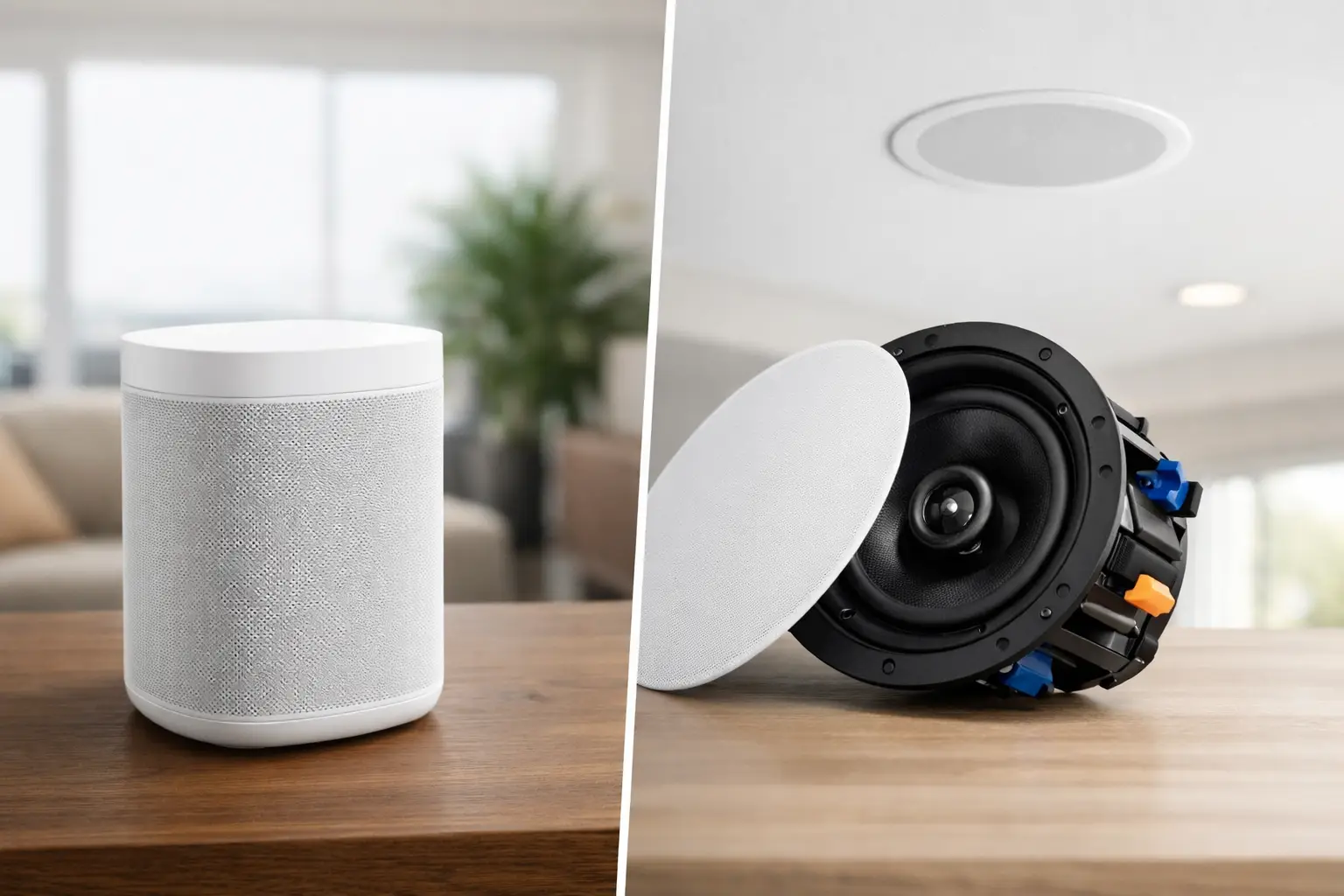
Sonos is known for simple, app-based access to music, streaming services, grouped rooms, and individual volume control. Standalone Sonos speakers can be placed in a room with minimal installation, making them practical for select spaces where flexibility matters. They are particularly useful in rooms that are already finished or where a fixed speaker installation is not desired.
Architectural in-ceiling speakers are permanently installed into the ceiling and powered by an amplifier. They can be connected to a dedicated multiroom audio system, an AV receiver, a network amplifier, or a Sonos Amp. Their value is rooted in discreet design, broader and more even coverage, and the ability to tailor performance to the room.
That distinction matters. Comparing a portable or tabletop Sonos speaker directly with a professionally installed in-ceiling system is not an equal comparison. One is a self-contained product. The other is part of an integrated audio infrastructure designed around the property.
When Sonos Is the Right Choice
A Sonos-based approach is an excellent fit when a homeowner wants strong streaming functionality with uncomplicated control in a limited number of areas. A kitchen, bedroom, office, or guest suite may benefit from a self-powered speaker that can be moved or replaced without altering the home.
Sonos also performs well as part of a broader entertainment system. Soundbars, subwoofers, and surrounds can create a polished media-room setup, while Sonos Amps can bring the same familiar control experience to installed speakers. This gives homeowners one app for music throughout the property while preserving the clean look of architectural audio where it matters most.
However, placement has consequences. A tabletop speaker may sound satisfying from one part of a room but leave other areas under-covered. In an open kitchen, large great room, or outdoor entertaining space, a single wireless speaker can struggle to deliver consistent sound without being turned up to an uncomfortable level near the device.
Why In-Ceiling Speakers Deliver a Different Experience
Architectural speakers are designed for distributed audio. Rather than concentrating sound in one corner, multiple speakers can be placed to create balanced coverage throughout a room. This is especially valuable in South Florida homes with open floor plans, high ceilings, expansive kitchens, covered patios, and pool areas where people naturally move around.
With the right speaker count, placement, and amplification, music remains present without becoming intrusive. You should be able to hear vocals clearly while preparing dinner, enjoy a playlist around the island, and continue the same listening experience on the patio without a dramatic jump in volume or quality.
They also protect the architecture of the home. Premium in-ceiling models can use paintable grilles, low-profile designs, and carefully planned locations that preserve clean sightlines. In spaces with custom millwork, stone finishes, or carefully considered interior design, eliminating visible speakers is often a significant advantage.
Sound quality can be exceptional, but it is not automatic. Ceiling height, room dimensions, reflective surfaces, insulation, speaker aiming, and amplifier quality all affect the result. A professional design accounts for these details before drywall is closed, rather than treating speakers as an afterthought.
The Hybrid System Is Often the Winner
For many properties, the best whole-house audio system combines Sonos control with architectural in-ceiling speakers. Sonos Amps can power pairs of installed speakers in individual zones, giving homeowners the intuitive Sonos experience while delivering the coverage and visual refinement of a custom installation.
This approach works particularly well for kitchens, dining rooms, primary bedrooms, bathrooms, hallways, outdoor living spaces, and other areas where music should be available without visible equipment. A standalone Sonos speaker may still make sense in a flex space, guest room, or temporary setup where permanent installation offers little benefit.
The hybrid approach also allows the system to grow intelligently. A home can begin with the most-used spaces and add zones later, provided the wiring and equipment plan anticipates expansion. During a renovation or new build, prewiring is a valuable opportunity to preserve future options without reopening finished surfaces.
Control, Reliability, and Daily Use
The best audio system is one every member of the household can operate. Sonos earns high marks for familiar app control, room grouping, favorites, playlists, and streaming-service access. Yet a phone should not be the only way to control a whole-home system.
For a fully integrated residence, keypads, touchscreens, handheld remotes, and smart-home control interfaces can provide dependable access to favorite sources and volume adjustment. A homeowner should be able to start music in the kitchen without searching for an app, or turn off the patio zone from a central control system when the evening ends.
Reliability also depends on the network and infrastructure behind the music. Whole-house audio places ongoing demands on Wi-Fi, network switching, equipment ventilation, power protection, and system configuration. In larger properties, those details separate a system that feels polished from one that intermittently drops rooms, loses control, or requires repeated troubleshooting.
Cost Should Be Evaluated as a System Decision
A standalone Sonos speaker generally has a lower initial installation requirement because it does not require speaker wiring, cutting, amplification, or architectural coordination. That can make it appropriate for finished rooms or targeted listening areas.
Installed in-ceiling audio requires more planning and labor, especially when paired with multiple zones, centralized equipment, outdoor speakers, and integrated controls. But the investment serves a different purpose: it becomes part of the home, supports consistent coverage, and preserves the visual quality of the space.
It is also worth comparing lifecycle value rather than only the first purchase. A well-designed wired speaker system can remain in place for many years while source components, control processors, or amplifiers are updated as technology changes. The speakers and cabling form a durable foundation for future upgrades.
How to Choose for Your Home
Start with the rooms, not the products. Consider where people gather, where music will be heard most often, whether the home has open or enclosed spaces, and how important invisible audio is to the design. Then determine whether each area needs background music, focused listening, television sound, outdoor coverage, or all of the above.
A kitchen and patio may need several architectural speakers for even coverage. A dedicated media room may call for a different surround-sound design. A bedroom may be perfectly served by a compact Sonos solution or a pair of ceiling speakers, depending on the desired aesthetic and control experience.
Sentry Audio Video designs whole-house audio around these real-world decisions, coordinating speaker layout, wiring, amplification, networking, and control before installation begins. The result is not simply music in more rooms. It is a system that looks intentional, performs reliably, and fits the way the property is lived in.
For homeowners who value clean design and refined performance, architectural speakers usually form the foundation of the strongest whole-house audio plan. Sonos can still play an important role, especially as the control layer or in flexible spaces. The most satisfying system is the one that gives every room the right sound, the right level of control, and no unnecessary technology in sight.