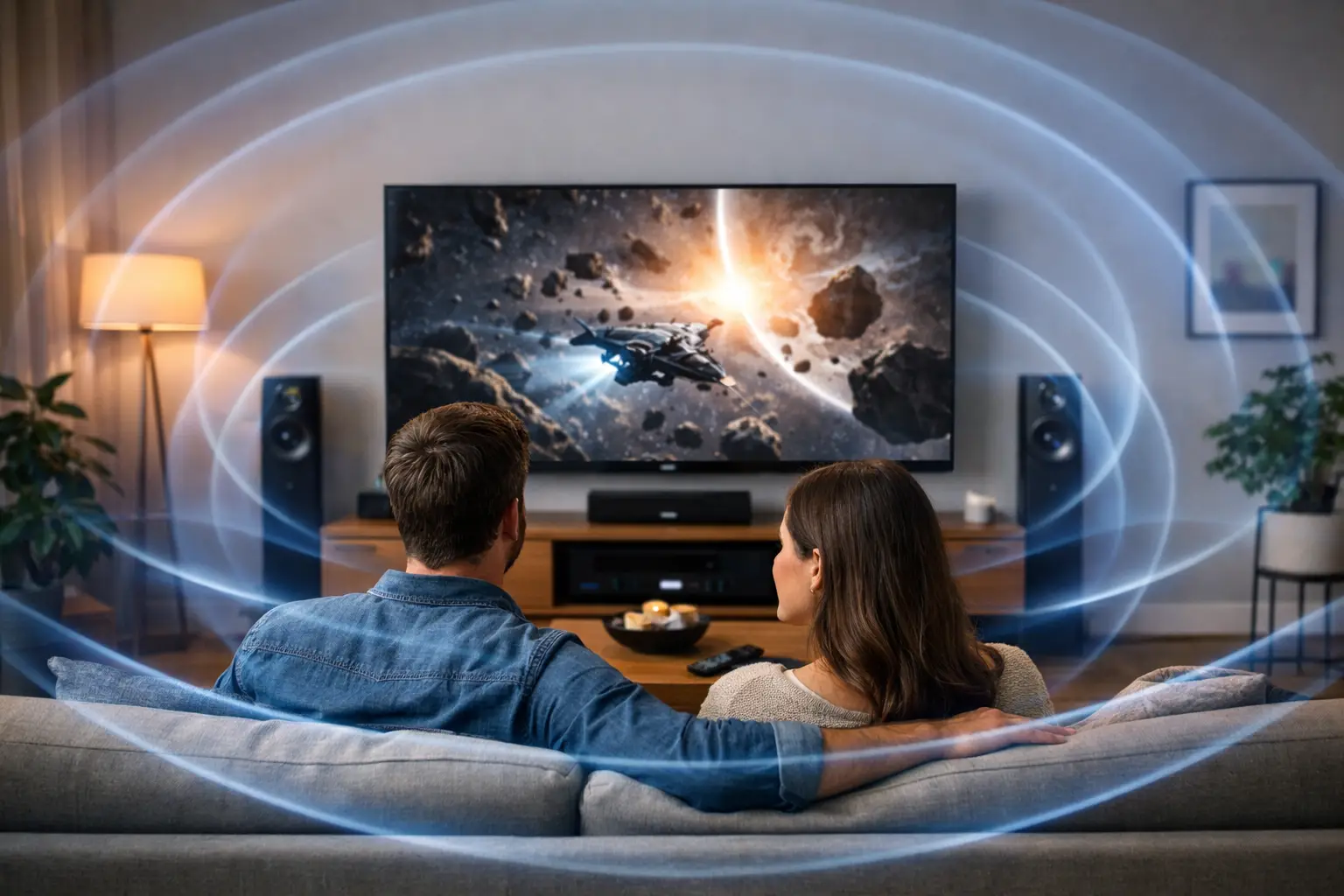
A larger display can make a movie feel more cinematic, but sound is what makes a room disappear. When a helicopter seems to pass overhead, dialogue stays locked to the screen, and rain fills the space rather than coming from one speaker, entertainment becomes an experience. The Rise of Spatial Audio: How Immersive Sound is Changing Home Entertainment is not simply about adding more speakers. It is about designing sound that has direction, height, depth, and control.
For homeowners investing in dedicated theaters, media rooms, and open-concept living spaces, spatial audio is quickly becoming a defining part of a premium audio/video system. It changes how films, concerts, and streamed programming are heard, while raising the standard for the room design, speaker placement, and calibration behind the scenes.
What Spatial Audio Actually Changes
Traditional surround sound places audio around the listener through assigned channels. A 5.1 system, for example, uses left, center, right, surround speakers, and a subwoofer. It remains an effective format, especially in a properly designed room.
Spatial audio expands that approach by treating many sounds as objects that can be placed and moved through a three-dimensional sound field. Formats such as Dolby Atmos and DTS:X add height information, allowing sound to travel above the audience as well as around it. A jet can move from the front of the room to the rear and overhead. A voice can remain clear at the screen while music and ambient effects occupy the surrounding space.
That added dimension has a practical benefit beyond spectacle: greater separation. When a soundtrack is busy, spatial mixing gives the system more places to put each element. The result can be cleaner dialogue, more convincing atmosphere, and less of the congested sound that makes viewers reach for the volume control during every conversation.
The Rise of Spatial Audio in Home Entertainment
Spatial audio has moved beyond a specialty feature because the content ecosystem has caught up. Major film releases, premium streaming libraries, live performances, and music recordings increasingly support immersive formats. Modern source equipment and AV processors can also decode these formats with far more sophistication than earlier generations of home theater equipment.
Still, support on a specification sheet is not the same as performance in a home. A system needs the right number of speakers, correctly positioned locations, compatible amplification, and careful tuning. The listening room matters just as much. Ceiling height, seating distance, room dimensions, open walls, glass surfaces, and furnishings all influence what the audience hears.
This is why a custom-designed system delivers a different result from a collection of components selected in isolation. The goal is not to fill every surface with speakers. The goal is to create a coherent sound field that feels natural, involving, and consistent from the primary seating area.
Why Height Speakers Make Such a Difference
The most noticeable change in a spatial audio system is often overhead sound. Height speakers give mixers a dedicated layer for weather, aircraft, crowd noise, musical ambience, and other effects intended to exist above the listener.
In a dedicated theater, these speakers may be installed in the ceiling at locations calculated around the seating plan. In rooms where ceiling installation is not appropriate, carefully selected speakers mounted high on the front and rear walls may provide an effective alternative. The correct approach depends on the room, construction conditions, and aesthetic priorities.
Height channels should not call attention to themselves as isolated speakers. If someone can constantly point to the ceiling and identify every sound source, the system may need adjustment. When the design is right, effects transition smoothly between the screen, side walls, rear area, and ceiling. The room sounds larger because the audio has room to move.
Immersive Sound Is Also a Dialogue Upgrade
Many homeowners initially ask for more impact from action scenes, then discover that improved dialogue is the more valuable everyday benefit. A well-designed center channel anchors voices to the image. Proper speaker matching and calibration help maintain consistent tonal character as sounds move across the front of the room.
Spatial audio also reduces the burden on the front speakers by distributing effects and ambience across the system. That can make dialogue easier to follow without pushing the overall volume to uncomfortable levels. It is particularly valuable in multipurpose media rooms, where family members may have different listening preferences.
The center channel deserves special attention. It should be selected and placed for the display type, furniture design, viewing height, and seating layout. Hiding a capable center speaker inside cabinetry without accounting for ventilation, grille design, and acoustic reflections can compromise one of the system’s most important channels.
The Room Is Part of the System
Premium equipment cannot overcome poor acoustic conditions by itself. South Florida homes often feature expansive glass, stone finishes, tall ceilings, and open floor plans that create beautiful spaces but challenging sound environments. Hard reflective surfaces can blur dialogue and make high frequencies feel overly aggressive. Large connected areas can also allow bass to build up in some seats and disappear in others.
Professional design addresses those conditions early. Speaker locations can be coordinated with lighting, motorized shades, architectural details, and ceiling treatments. Subwoofer placement can be evaluated for more even low-frequency performance. Acoustic treatments, when appropriate, can be integrated in a way that supports the room’s aesthetic rather than making it look like a recording studio.
There is no universal speaker layout that works equally well everywhere. A 7.1.4 configuration may be ideal for one theater, while a 5.1.2 system may be the more appropriate choice in a smaller room. The right answer comes from the room’s dimensions, seating arrangement, intended use, and available installation pathways.
Design Decisions That Protect the Experience
The most successful spatial audio installations are planned with the entire entertainment environment in mind. Display placement, speaker angles, seating geometry, rack location, network capacity, control options, and finish details should support one another.
For example, a projector theater requires careful coordination between the screen, projector, front speakers, and center channel. A media room with a large wall-mounted display may need in-wall, on-wall, or architectural speakers chosen to preserve both performance and visual balance. Outdoor entertainment areas follow different rules altogether, where coverage, weather-rated equipment, and ambient noise become central considerations.
Control should remain straightforward. A system with advanced processing should not require an advanced routine from the homeowner. A properly integrated control interface can bring the display, audio system, lighting, shades, and source selection into a clear set of commands. The technology should serve the experience, not interrupt it.
Calibration Is Where the System Becomes Cohesive
Speaker installation is only the beginning. Calibration determines how well the system performs as a complete whole. This includes setting speaker distances and levels, managing crossover points between speakers and subwoofers, applying room correction where it helps, and verifying that effects track correctly through the room.
Automated calibration tools are useful, but they are not a replacement for professional verification. Measurement results need to be interpreted in the context of the room and the client’s listening goals. Excessive correction can make a system sound unnatural, while insufficient adjustment can leave major performance issues unresolved.
A final listening session matters. It confirms that dialogue is clear, bass is controlled, surround effects are balanced, and the system responds reliably through its control platform. This level of commissioning is what turns a collection of premium components into a polished entertainment environment.
Planning for What Comes Next
Spatial audio is a strong reason to think ahead during a renovation or new construction project. Even if every speaker is not installed on day one, prewiring for future surround and height channels protects the property’s flexibility. It also keeps installation cleaner by avoiding visible wiring paths later.
Sentry Audio Video designs immersive audio systems around how each client lives in the space, whether that means a dedicated cinema, an elegant living room, or a fully integrated entertainment area that extends outdoors. The best system is not necessarily the one with the highest speaker count. It is the one engineered to make every seat feel connected to the action, while fitting the home with the finish quality and reliability its owners expect.
For a home entertainment upgrade, start with the room, the seating, and the experience you want to create. Those decisions will point the system in the right direction long before the first speaker is installed.