Sonos is simple when the home, network and speaker plan are simple. A large Boca Raton property is rarely simple. Sentry Audio Video designs, installs, integrates and services Sonos systems for custom homes, waterfront estates, condominiums, outdoor living areas, restaurants and commercial spaces throughout South Florida.
We use Sonos as a complete audio platform where it fits the project—not as a collection of wireless speakers placed room by room without a plan. A professional installation may include Sonos Amp for architectural speakers, Port for existing receivers or high-performance audio systems, soundbars and wireless surrounds for televisions, powered speakers for flexible rooms, subwoofers, outdoor zones and integration with Control4, Savant, Crestron, Lutron keypads or Josh.ai.
Sentry handles new Sonos systems, renovations, retrofits, additions, network corrections and takeovers of installations completed by other companies. We can diagnose disappearing rooms, delayed grouping, televisions with unreliable audio, outdoor areas with uneven coverage and centralized amplifiers that were never labeled. Call (561) 717-3280 or schedule a Sonos consultation.
Who This Sonos Page Is For
This page is for homeowners who want music and television audio to work throughout the property without living with visible equipment in every room. It is also for builders, designers and property managers who need speakers, wiring, network and control decisions made before ceilings and millwork are finished.
Typical projects include:
- A Boca estate with architectural speakers in the kitchen, primary suite, loggia, pool deck and guest house.
- A condominium needing premium television sound without a large equipment rack in the room.
- A renovation replacing old multi-zone amplifiers while preserving usable speaker wiring.
- A seasonal residence where the owner wants familiar operation in Boca and New York.
- An outdoor system that needs even coverage across the patio, pool, garden or dock.
- A family room using a Sonos soundbar, Sub and surrounds integrated with the television and control system.
- A home with older Sonos products, duplicate systems or unstable grouping after network changes.
- A restaurant, clubhouse or amenity room needing simple staff operation and multiple audio areas.
Sonos can serve a single television or dozens of rooms. The larger the system becomes, the more important infrastructure and documentation become. Speaker loads, amplifier locations, wired backhaul, wireless coverage, switching, ventilation and user permissions all affect whether the system remains easy to use.
What a Professionally Designed Sonos System Should Do
A homeowner should be able to choose music, select rooms and adjust volume without thinking about where the equipment is installed. Television sound should start with the television. Outdoor music should cover the space evenly at comfortable levels. Favorite scenes can be available from a keypad, touchscreen, remote or voice interface when the broader control system supports them.
Behind that simple experience, the design may include:
- Sonos Amp units powering in-ceiling, in-wall or outdoor speakers.
- Sonos Port units connecting existing receivers, processors or distributed-audio equipment.
- Soundbars with compatible Sub and surround products for television rooms.
- Powered Sonos speakers for rooms where architectural wiring is not appropriate.
- Architectural speakers selected and placed for the room rather than centered only on ceiling bays.
- Outdoor-rated speakers and subwoofers designed around coverage and exposure.
- A stable wired and wireless network with deliberate Sonos topology.
- Integration with automation, lighting scenes and physical controls.
- Labels, room names and account ownership that remain understandable after installation.
The equipment list is not the design. Two homes with the same number of rooms may need different speaker counts, amplifier locations, network paths and control methods because their architecture and use are different.
Sonos Amp for Architectural Speakers
Sonos Amp is frequently the center of a professionally installed whole-home Sonos system. It allows architectural speakers to participate as a Sonos room while keeping most electronics in a rack, closet or other serviceable location. It can also serve selected television and outdoor-audio applications.
The amplifier still has electrical and acoustic limits. We calculate the speaker load and confirm that the number and type of connected speakers are appropriate. Parallel wiring, impedance, cable length and volume requirements matter. Connecting more speakers because terminals are available can overwork the amplifier or create uneven sound.
A large kitchen and family room may need multiple speakers for even coverage. A primary bath generally needs less output but careful placement around stone, glass and exhaust noise. An outdoor zone loses the boundary reinforcement of an indoor room and may need more speakers plus a subwoofer. One amplifier configuration does not fit every area.
When several Sonos Amp units are centralized, the rack needs ventilation, electrical capacity, organized speaker wiring and reliable network connectivity. Each room, cable and amplifier is labeled. The owner sees clear room names in the app; the technician sees matching names at the rack.
Sonos Port and Existing Audio Systems
Sonos Port can bring the Sonos experience to an existing receiver, processor, amplifier or high-performance two-channel system. It is useful when the owner wants familiar streaming and grouping without discarding equipment that still serves the room well.
Integration needs choices. The output can behave at a fixed or variable level depending on which device should control volume. Triggering, input selection and automation programming may be required so the listening experience remains simple. An incorrectly configured Port can create two volume controls, weak signal level or dangerously high output.
Port also provides a path for selected external audio sources to enter the Sonos system. A turntable requires the correct phono stage before the line input. Television or media sources need attention to delay and format. We define which sources should be shared and whether the additional latency is acceptable for adjacent rooms.
For theaters and higher-performance audio rooms, Sonos may handle convenient music while a dedicated processor and amplification handle movies. Sentry can coordinate that division so the owner is not forced to choose between convenience and performance.
Sonos Home Theater in Boca Raton
Sonos soundbars are a strong fit for family rooms, bedrooms, secondary media rooms and condominiums where simple operation and minimal equipment are priorities. A compatible Sub and surround speakers can expand the experience without a traditional AV receiver in the room.
We begin by reviewing the television, room size, seating, mounting height, cabinetry, electrical location and cable path. The soundbar should align visually and acoustically with the display. A beautiful television installation is weakened when the soundbar blocks the screen, floats at an unrelated height or depends on an exposed power cable.
Television audio depends on HDMI ARC or eARC behavior, audio settings and control handshakes. We configure the television, connected sources and remote control so normal viewing does not require changing audio menus. If a cable box, Apple TV or matrix system is involved, the entire path is tested.
Surround speakers need power and appropriate locations. Wireless audio does not mean every component is wire-free. New construction should still plan outlets and optional network cable. Subwoofer placement is selected for response and practicality rather than hidden in the first available cabinet.
A Sonos soundbar system is not the same as a dedicated private theater. For a purpose-built room with multiple seating rows, projection, architectural speakers and high output requirements, Sentry may recommend a conventional processor, amplifiers and calibrated speaker system. Our job is to match the platform to the room.
Whole-Home Music for Boca Estates
Whole-home audio should feel consistent without making every room sound identical. The kitchen, formal dining room, primary suite, guest bedrooms, gym, loggia and pool each have different coverage and volume needs. We divide zones according to how the property is used.
Open spaces may use several speaker pairs so no single speaker is excessively loud. Bedrooms benefit from independent control and conservative startup volume. A guest house may need to operate separately from the main residence. Outdoor zones can be divided between covered seating, pool, landscape and dock areas.
Room naming matters. “Family Room,” “Kitchen,” “Loggia” and “Pool” are more useful than equipment model numbers or names left by the installer. Combined areas should be grouped intentionally. We remove abandoned rooms and duplicate entries so the app reflects the current property.
We also set reasonable volume limits and startup behavior. A room should not return at party volume after a power interruption. Children’s rooms, guest suites and outdoor areas can have limits appropriate to their use. These decisions protect speakers and make the system more comfortable.
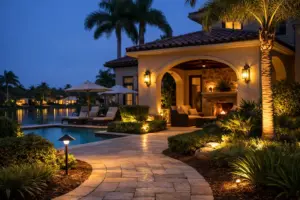
Outdoor Sonos for Patios, Pools and Waterfront Properties
Outdoor audio design begins with coverage. Two speakers mounted on the rear wall may be loud near the house and weak across the pool. The owner then raises the volume, which makes the system harsh for anyone seated nearby and more audible to neighbors.
We distribute appropriately selected outdoor speakers across the listening area and add subwoofers where fuller sound is desired. The goal is even, relaxed coverage. Zones may separate the covered loggia, pool deck, landscape and dock so each can operate at the right level.
Sonos Amp is generally installed in a conditioned interior rack or service area. Outdoor speakers, wire and connections must be rated and installed for the environment. Salt air, humidity, wind-driven rain, heat and irrigation all shorten the life of unsuitable equipment. Terminations should remain accessible for inspection and service.
Wi-Fi coverage is also part of outdoor audio. The owner’s phone or tablet must stay connected where music is controlled, and portable Sonos products need reliable coverage when used outside. An indoor access point behind impact glass may not provide dependable service to the pool.
Architectural Speakers With Sonos
Sonos offers architectural speaker options designed for use with Sonos Amp, and the platform can also be paired with many professionally selected passive speakers when the electrical load and application are appropriate. We choose speakers according to room size, dispersion, mounting depth, moisture exposure, finish requirements and listening expectations.
In-ceiling speakers keep walls clean but should not be placed only where framing leaves space. The layout should follow furniture and listening areas. In-wall speakers can provide better front-stage placement around a display. Invisible speakers such as Stealth Acoustics may suit rooms where the architecture should be seen and the audio system should not.
See our Stealth Acoustics pillar for invisible-speaker design, finish coordination and service considerations. For a comparison of approaches, review Sonos versus architectural in-ceiling speakers.
Speaker placement is coordinated with lighting, sprinklers, HVAC diffusers, millwork and ceiling details. On luxury projects, alignment is both an acoustic and architectural decision.
Networking for Sonos
Sonos depends on the network for setup, control, streaming, grouping and communication among rooms. A weak network can make an otherwise correct audio installation appear unreliable. Common symptoms include missing rooms, delayed volume changes, failed grouping, music interruptions and devices that return under the wrong connection after a reboot.
We design Sonos topology deliberately. Some products may be wired; others remain wireless. We avoid accidental network loops and undocumented combinations of consumer mesh equipment, unmanaged switches and extenders. Managed switching and Wi-Fi settings are reviewed for multicast and discovery behavior.
Fixed rack equipment receives reliable wired connections where practical. Phones and tablets need stable Wi-Fi throughout the control areas. Outdoor zones, guest houses and detached structures require their own network planning. A multi-room music system should not depend on one overloaded wireless hop.
For complete infrastructure, see our Ubiquiti UniFi network installation pillar and structured cabling services.
Sonos With Control4, Savant, Crestron and Josh.ai
Sonos can remain available through its own app while participating in a broader smart-home system. Control4, Savant and Crestron can provide room-level audio control, favorites, scenes and physical interface options depending on the project and supported integration. Josh.ai can add natural voice control where appropriate.
The best interface depends on the household. Some owners prefer the Sonos app for music browsing and the automation system for volume and room control. Others want favorites on keypads or touchscreens. We define those workflows rather than exposing every possible control in every interface.
Lutron keypads can trigger selected whole-home scenes through the control platform. A “Welcome” scene might turn on lighting and begin a favorite station in the kitchen. An “Away” scene can stop audio throughout the property. These actions should be predictable and easy to change.
For complete automation design, visit our Control4 dealer and service pillar, Savant pillar or Crestron pillar.
New Construction and Pre-Wire Planning
New construction is the right time to decide where speakers, amplifiers, soundbars, subwoofers, outlets and network connections belong. Even a system known for wireless products benefits from infrastructure. Architectural speakers need cable. Soundbars, surrounds and subwoofers need power. Centralized Sonos Amp units need rack space, ventilation and network.
Pre-wire planning can include:
- Speaker cable from the rack to each architectural audio zone.
- Home-run network cabling for Sonos Amp, Port and television locations.
- HDMI and conduit between displays and equipment locations.
- Power and backing for soundbars, surrounds and subwoofers.
- Outdoor speaker and subwoofer paths coordinated with landscape plans.
- Rack circuits, cooling, patching and future expansion space.
- Service loops and labels at both ends of every cable.
- Coordination with reflected ceiling plans and finish details.
We work with builders, architects, interior designers, electricians and millworkers. Equipment should not be placed after cabinetry is fabricated or ceiling finishes are complete. Early coordination protects both the design and the budget.
Renovation and Retrofit
Many South Florida homes already contain speaker wire and centralized audio equipment. We test the existing infrastructure before deciding whether it can remain. Usable cable may support a modern Sonos Amp system, while old impedance-matching controls or hidden speaker selectors may need to be removed.
Retrofit work uses accessible attic, crawlspace, conduit and millwork routes where available. In condominiums, access and association rules may limit pathways and work hours. We plan selective openings with the contractor rather than creating unnecessary damage.
A retrofit can be phased. We may begin with the family room, kitchen and outdoor areas, then add bedrooms and guest spaces later. The initial rack and network design should reserve capacity for those phases so the first installation does not need to be rebuilt.
Sonos Takeovers, Repairs and Cleanup
Sentry Audio Video services Sonos systems installed by other companies. We begin by documenting the account, household, room names, network, wired connections, amplifiers, speaker zones and television paths. We avoid resetting everything before preserving information that may be needed for recovery.
Common service problems include:
- Rooms disappear or reappear intermittently.
- Grouping starts slowly or audio drops in several areas.
- A Sonos Amp enters protection or one speaker pair is silent.
- A television no longer sends sound to the soundbar.
- Volume is inconsistent among sources or rooms.
- Outdoor audio is loud near the house and weak at the pool.
- Old products and new products are split across confusing systems.
- The Sonos account belongs to the installer or a former owner.
- The rack has no speaker-wire or network-port labels.
- A new router or mesh system disrupted a previously stable installation.
We isolate the layer causing the problem. A missing room may be a network issue, power issue, failed unit or account problem. Weak outdoor sound may be a speaker-layout issue rather than an amplifier failure. Television problems can originate in HDMI settings or source devices. Accurate diagnosis prevents unnecessary replacement.
For inherited or urgent AV problems, visit our service and repair page.
Moving, Expanding or Modernizing an Existing Sonos System
Sonos systems often grow over time. A homeowner adds a room, renovates the kitchen, builds an outdoor area or replaces a television. Expansion should preserve clear naming, network stability and electrical limits.
We review the existing product generations and current software support before combining old and new components. Some legacy products may belong on a different support path than the newest equipment. We explain whether equipment can remain, should be isolated or is better replaced as part of the project.
When an owner moves, the equipment, account and physical wiring require separate planning. Portable speakers and soundbars may move; architectural speakers and cable remain with the property. We document what stays and what leaves, then rebuild the system around the new home instead of reproducing the old room list blindly.
Sonos for Restaurants and Commercial Spaces
Sonos can suit selected restaurants, offices, club rooms and amenity areas where simple streaming and zoning are priorities. Commercial work still needs an operational plan. Staff should have access to the necessary controls without administrative ownership. Volume limits should protect the guest experience. The network should separate business and public traffic appropriately.
We divide spaces by use: dining room, bar, private room, terrace, lobby or fitness area. Speaker coverage is designed so staff do not compensate for dead areas by turning the nearest speakers too loud. Central equipment is installed where it can be cooled and serviced.
Some commercial projects need paging, microphones, scheduled content, 70-volt distribution or life-safety interfaces beyond the role Sonos should play. In those cases, we design a commercial audio platform and may use Sonos only as a source. We do not represent entertainment audio as an emergency communications system.
Comparing Sonos With a Traditional Distributed-Audio System
Sonos provides familiar streaming, flexible grouping and a strong user experience. A traditional matrix and multi-channel amplifier system can offer denser centralized channel counts, deeper control-system integration or specialized audio performance. Both approaches can use architectural speakers and professional networking.
The right choice depends on room count, sources, rack strategy, control preferences, performance goals and long-term support. A hybrid design is often appropriate. Sonos may serve bedrooms, kitchen and outdoor areas while a dedicated processor serves the theater and a higher-performance stereo system serves the listening room.
Sentry also installs AudioControl Pro amplification for whole-home and theater applications. We select the platform by function instead of forcing one brand into every room.
How Sentry Runs a Sonos Project
1. Consultation
We ask how the family listens, which rooms matter most, whether television audio should participate and how outdoor areas are used. We identify preferred control methods and any existing equipment worth preserving.
2. Survey or plan review
We inspect speakers, wiring, network, rack, televisions, construction and outdoor exposure. For new projects, we coordinate locations with the architectural and reflected ceiling plans.
3. Audio and network design
We define zones, speaker count, amplifier assignments, soundbar systems, network topology, rack requirements and integration. The proposal distinguishes equipment, infrastructure, programming and finish coordination.
4. Installation
Cable is tested and labeled. Speakers are installed with finish protection. Amplifiers and network devices are organized for cooling and service. Televisions and soundbars are aligned and wired cleanly.
5. Configuration and testing
Rooms are named, grouped and balanced. Television audio, streaming, line inputs, network behavior and automation commands are tested. Outdoor coverage is evaluated across the occupied area.
6. Training and support
We show the owner the everyday controls, account ownership and basic recovery steps. Documentation remains available for future service and expansion.
Why Local Service Matters
Sonos products are approachable, but a whole-home installation can involve dozens of speakers, multiple racks, outdoor zones, televisions and control-system interfaces. When something fails, the owner needs someone who understands the audio system and the network carrying it.
Sentry Audio Video is a family-owned integrator based at 1708 Costa Del Sol, Boca Raton, FL 33432. We hold Florida low-voltage license EF20001874. Our team works on new installations, renovations, service calls and takeovers throughout South Florida.
We also operate a New York division serving Massapequa, Long Island, Manhattan, the Hamptons, Sag Harbor, Montauk and Greenwich, Connecticut. Owners with residences in both markets can use familiar room naming, control patterns and support processes across properties.
Service Areas
South Florida service areas include Boca Raton, Delray Beach, Gulf Stream, Palm Beach, West Palm Beach, Palm Beach Gardens, Fort Lauderdale and Miami. Projects range from condominiums and single television rooms to private estates, restaurants and amenity properties.
For New York and Connecticut projects, Sentry serves Long Island, Manhattan, the Hamptons, Sag Harbor, Montauk and Greenwich. Project availability depends on scope and location; contact Sentry to review the property.
Sonos FAQs
Who installs and services Sonos in Boca Raton?
Sentry Audio Video designs, installs and services Sonos systems for Boca Raton homes, estates, condominiums and selected commercial properties. Work includes Sonos Amp, Port, soundbars, surrounds, subwoofers, architectural speakers, outdoor audio, network corrections, automation integration and takeovers.
Can you take over a Sonos system another company installed?
Yes. We document the account, household, room names, network connections, amplifiers, speaker wiring and television paths before making changes. We can clean up duplicate rooms, correct network problems, relabel the rack, add zones and explain which older products remain practical to support.
Should I use Sonos Amp or powered Sonos speakers?
Sonos Amp is generally appropriate when the room uses passive architectural or outdoor speakers. Powered Sonos speakers fit rooms where a visible speaker is acceptable and new in-wall wiring is unnecessary or impractical. A property can use both approaches within one system.
Can Sonos power in-ceiling speakers?
Yes. Sonos Amp can power compatible passive in-ceiling or in-wall speakers when the total electrical load and wiring are appropriate. We calculate speaker quantity and impedance, confirm cable condition and place speakers for even coverage rather than connecting the maximum possible number without a plan.
Does Sonos work with Control4, Savant, Crestron and Josh.ai?
Sonos can integrate with professional control systems for room control, favorites, scenes and voice workflows depending on the platform and supported drivers. The Sonos app can remain available for browsing. We design which interface controls which functions so the homeowner does not face duplicate or confusing commands.
Can Sonos work with Lutron keypads?
Lutron keypads can trigger audio scenes through a compatible automation system. For example, a keypad command can start a favorite in the kitchen or stop music throughout the home as part of an Away scene. The integration is planned and programmed rather than being a direct speaker-wire connection.
Why do Sonos rooms disappear or stop grouping?
Common causes include Wi-Fi weakness, mixed network paths, loops, unmanaged switches, router replacement, multicast problems, power interruptions and older unsupported equipment. We test the network and audio layers separately before resetting or replacing products.
Can Sonos cover a large outdoor pool area?
Yes, with a coverage-based design. Multiple outdoor-rated speakers and one or more subwoofers usually provide more even sound than one loud pair mounted near the house. Sonos Amp remains indoors in a conditioned location, while outdoor wiring and terminations are installed for South Florida exposure.
Is Sonos good enough for a dedicated home theater?
Sonos soundbar systems are excellent for many family rooms and media spaces. A dedicated theater with projection, multiple seating rows and reference-level performance usually benefits from a conventional processor, separate amplification, architectural speakers and professional calibration. Sentry recommends the system that fits the room.
Can I listen to different music in different rooms?
Yes. Each Sonos room or zone can play independently, and compatible rooms can be grouped for synchronized playback. We name and organize zones around the property so guests and family members can find the correct space quickly.
Can you reuse the speakers and wiring already in my home?
Often, yes. We test cable continuity, polarity and condition, identify hidden controls or selectors and verify the speakers and load. Existing infrastructure that passes testing can be relabeled and connected to a new Sonos Amp design. Damaged or unsuitable components are identified before installation.
Can Sonos be controlled while I am away from the house?
Some functions and service visibility may be available remotely, but the property’s network and account ownership must be correct. For a seasonal home, we also coordinate automation, cameras and network monitoring so the owner can understand whether a problem is local audio, internet or power.
Do wireless Sonos speakers still need power and Wi-Fi planning?
Yes. Wireless describes the network or audio connection, not the absence of electricity. Powered speakers, surrounds and subwoofers need outlets in appropriate locations. They also need reliable Wi-Fi or a planned wired connection. Those requirements should be coordinated before finishes are complete.
Can Sonos be used in a restaurant or clubhouse?
It can fit selected background-music and amenity applications. We define staff controls, volume limits, zones, network separation and equipment security. Projects requiring paging, microphones, life-safety interfaces or large 70-volt distribution may need a dedicated commercial platform with Sonos used only as a music source.
Schedule a Sonos Consultation
If you need a new Sonos system, architectural speakers, outdoor audio, television sound, network repair or a takeover of an inherited installation, Sentry Audio Video can survey the property and build a clear plan.
Call Florida at (561) 717-3280. For New York and Hamptons projects, call (516) 210-2120. You can also schedule a consultation and proposal online.