
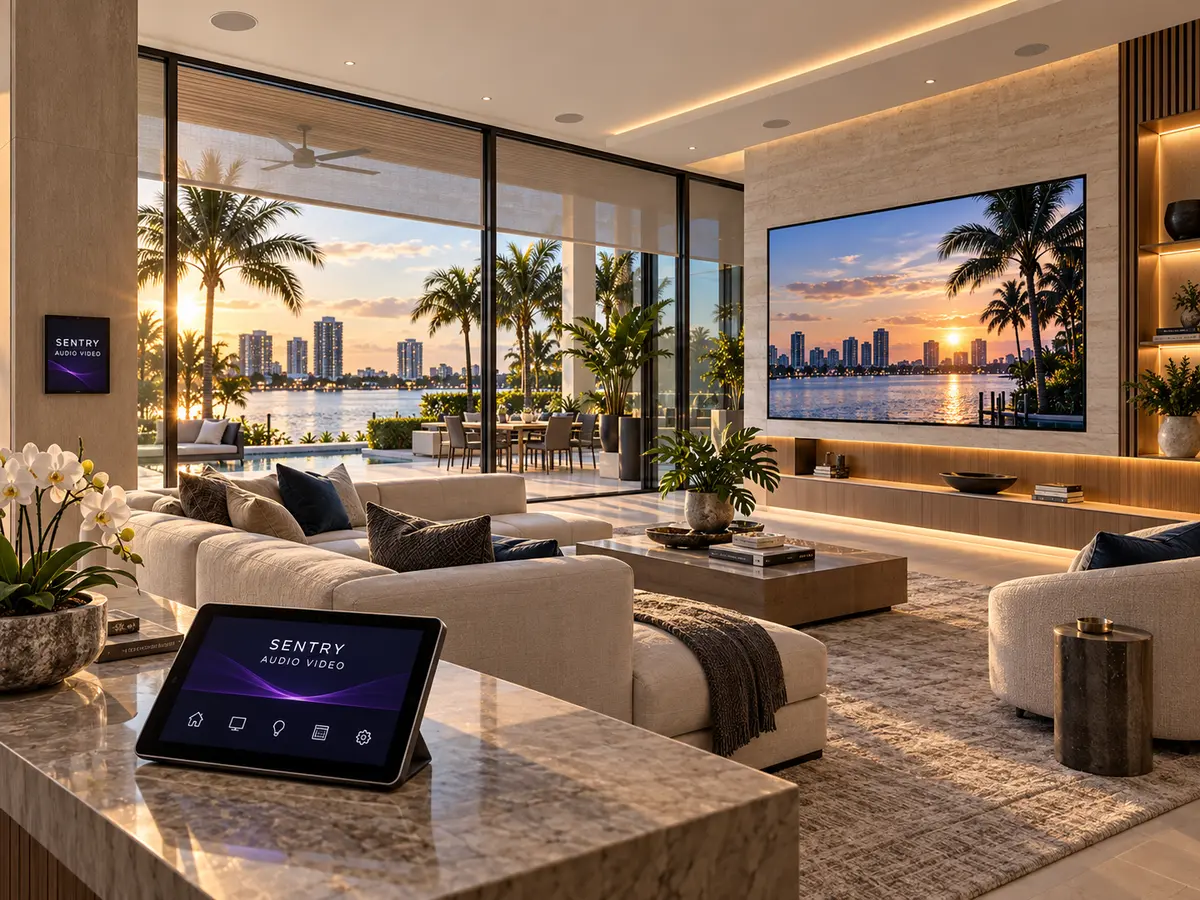
Stealth Acoustics is for rooms where the architecture should be seen and the audio system should not. Sentry Audio Video designs, installs, coordinates and services invisible-speaker systems for Boca Raton custom homes, waterfront estates, condominiums, private theaters and high-design commercial spaces.
Invisible speakers are installed into the wall or ceiling plane and finished over so the surface can visually disappear into the room. That does not make them a simple drywall accessory. Location, framing, back-box conditions, fastening, finishing materials, amplifier power, DSP, crossover design and calibration all affect performance. The AV integrator and finish contractor must work from the same installation requirements. A beautiful wall with weak sound is not a success, and neither is good sound surrounded by visible cracks or patches.
Sentry AV coordinates Stealth Acoustics systems during new construction and renovation, adds invisible audio to finished homes where practical, and diagnoses existing installations that sound uneven, buzz, distort or were never calibrated. We can also design outdoor systems using Stealth’s all-weather StingRay speakers and large-format Patio Theater products where appropriate. Call (561) 717-3280 or schedule a design consultation.
Who This Stealth Acoustics Page Is For
This page is for homeowners and design teams who do not want conventional speaker grilles interrupting Venetian plaster, millwork, wallpaper, stone-adjacent details or a carefully composed ceiling. It is also for owners who already have invisible speakers but need an integrator to determine why the system does not perform as expected.
Typical projects include:
- A new Boca estate where the interior designer wants clean ceilings and uninterrupted wall planes.
- A formal living room, primary suite or dining space where conventional speakers conflict with the finishes.
- A dedicated theater using an acoustically transparent front wall and concealed surround channels.
- A media room where audio must disappear around a large display or motorized screen.
- A condominium renovation with strict ceiling depths and coordination requirements.
- A gallery, conference room or hospitality space where technology should remain visually quiet.
- A covered terrace, pool deck or marine-adjacent area requiring an outdoor-rated Stealth solution.
- An existing invisible-speaker installation with cracks, rattles, weak bass or inconsistent coverage.
Invisible audio works best when it is selected early enough to coordinate with framing and finishes. It can also be retrofitted, but the owner should understand the access, patching and refinishing involved before work begins.
How Stealth Invisible Speakers Work
Stealth Acoustics invisible speakers mount into walls or ceilings and use a radiating surface that becomes part of the finished plane. After proper installation, the face can be finished to blend with the surrounding surface. The company’s current invisible-speaker family includes LineaRadiance models for different output, size and application requirements, along with subwoofer options and installation accessories.
Unlike a conventional speaker with an exposed cone and grille, the visible finish becomes part of the operating assembly. That is why installation discipline matters. Excessive or uneven finish material can change performance. Poor fastening or contact can produce buzzes. A speaker bridged by incompatible finish conditions can reveal its outline or crack. The wall contractor cannot treat the location like an ordinary patch, and the AV contractor cannot disappear after rough-in.
The speaker choice depends on room size, listening distance, required output, desired bass extension, available cavity and whether the system is background music, foreground listening or cinema. We do not use one invisible model in every room merely because the dimensions fit.
Where Invisible Speakers Make Sense
Formal entertaining spaces
Living rooms, dining rooms and salons often have the most carefully controlled sightlines and finishes. Invisible speakers can preserve those surfaces while supporting music at a level appropriate for conversation and events. Placement should distribute sound evenly so the owner does not raise one hidden pair excessively to cover a large area.
Primary suites and bathrooms
A primary suite can use invisible audio for television, music and voice feedback without adding visible ceiling grilles. Bathroom locations require appropriate environmental judgment and coordination with mirrors, stone, plumbing and waterproofing. The speaker itself should never be treated as permission to ignore the conditions of the installation space.
Kitchens and open great rooms
Open-plan rooms need coverage designed across activity areas. Kitchen appliances, tall ceilings, glass and stone increase background noise and reflections. Several carefully placed invisible speakers may provide a more comfortable result than one high-output pair. The control system can group kitchen, breakfast and family areas while preserving independent volume where helpful.
Private theaters and media rooms
Invisible speakers can support cinema applications when the correct models, locations, amplification and calibration are used. They are particularly useful where the design team wants surrounds and overhead channels to disappear. The front soundstage, subwoofer strategy and screen construction still need to follow acoustic requirements. A theater should not sacrifice dialogue anchoring or channel geometry solely to hide equipment.
Art walls and galleries
In rooms where artwork is the visual priority, invisible audio can reduce competition from grilles and cabinets. Speaker locations must be documented so future anchors, screws or artwork hardware do not damage the radiating surface. The homeowner and art installer should receive a location record after completion.
Commercial and hospitality interiors
Boardrooms, restaurants, lounges, lobbies and amenity spaces may use invisible speakers to preserve brand and interior-design goals. Coverage, speech intelligibility, zoning and service access remain important. A speaker that is hidden from guests still needs a known location for maintenance.
Where Conventional Speakers May Be the Better Choice
Invisible speakers are a design tool, not a universal answer. A visible architectural speaker, high-performance on-wall speaker or freestanding loudspeaker may be better when maximum output, a specific dispersion pattern, very deep bass, frequent service access or two-channel imaging is the priority. Outdoor environments also require purpose-built weatherized products rather than a concealed interior speaker.
We discuss the tradeoff honestly. Some rooms benefit from invisible surrounds paired with a more conventional front soundstage. A casual background-music zone may use standard in-ceiling speakers where the grille is not objectionable. A dedicated listening room may prioritize loudspeaker placement and acoustic treatment over concealment.
The objective is not to sell the same visual solution everywhere. It is to decide where invisible technology materially improves the architecture without compromising the owner’s performance expectations.
Finish Coordination: The Critical Part of the Installation
The handoff between AV installation and finishing is the point where many invisible-speaker projects succeed or fail. The speaker is mounted, tested and protected according to the installation sequence. The finisher then applies approved materials and techniques within the manufacturer’s limits. The system is tested again after finishing.
A typical coordination sequence includes:
- Confirm the model, opening, cavity, back-box condition and final speaker coordinates.
- Install cable with service length and label both ends.
- Install the speaker and verify secure, plane alignment with adjacent board.
- Test the speaker electrically and audibly before any finish is applied.
- Photograph and measure the location.
- Protect the assembly until the approved finish stage.
- Brief the drywall or specialty-finish contractor on product-specific requirements.
- Apply finish in controlled layers rather than burying the panel.
- Inspect the surface and retest the speaker.
- Calibrate the completed room after furnishings and treatments are present.
Responsibility should be explicit. The AV team does not decide the final decorative finish alone, and the finisher does not alter the speaker assembly without coordination. Mockups may be appropriate for unusual plaster, wallpaper or specialty coatings.
Paint, Wallpaper, Plaster and Specialty Finishes
Invisible speakers can work beneath compatible finishes, but every finish changes the surface to some degree. Standard paint conditions are different from thick Venetian plaster, textured coatings, fabric or wallcovering. The manufacturer’s current installation and finishing guidance must govern the selected product.
Before committing to a finish, the team should address:
- Total finish thickness and weight.
- Whether the finish remains flexible or becomes brittle.
- Primer, compound and adhesive compatibility.
- How seams and transitions will be handled.
- Whether sanding or future refinishing could damage the panel.
- How the speaker location will be documented after it disappears.
- Whether a sample or mockup should be approved first.
We do not promise that every decorative treatment can be applied over every invisible speaker. Where the finish is unusually heavy or rigid, another placement or speaker approach may protect both the design and the audio.
Framing, Back Boxes and Wall Construction
Invisible speakers need a stable mounting plane. Stud or joist spacing, board thickness, cavity depth, insulation, blocking and adjacent materials affect installation. Stealth offers accessories and back-box options for different construction conditions, including masonry-related applications. Selection should follow the actual wall assembly.
Concrete and masonry are common in South Florida. A speaker cannot simply be placed where the rendering looks best if the wall has no suitable cavity or conflicts with structure. During new construction we coordinate furring depth, framed pockets or alternative locations. During retrofit we use non-destructive inspection where possible and confirm conditions before cutting finished surfaces.
Back boxes can help define the acoustic environment, reduce sound transfer and protect the assembly, but they must fit the selected product and wall condition. Blocking should not introduce rattling contact. Cable entry points need to remain secure and serviceable.
Speaker Placement and Coverage
Because the speaker disappears, there is a temptation to place it wherever the architecture has open space. Acoustic placement still comes first. Listening distance, dispersion, room boundaries, seating and intended use determine locations.
For whole-home music, we plan overlapping coverage at comfortable levels. For television, the sound should relate to the picture. For cinema, left, center, right, surround and overhead channels follow the seating and screen geometry. For a long outdoor area, multiple sources can maintain consistent level without creating a loud end and quiet end.
We coordinate speaker locations with:
- Downlights and decorative fixtures.
- HVAC registers and returns.
- Sprinklers and life-safety devices.
- Shade pockets and curtain tracks.
- Millwork, art, mirrors and televisions.
- Framing, plumbing and structural elements.
- Acoustic treatments and reflective surfaces.
A coordinated reflected ceiling plan prevents the narrow, awkward spacing visible when each trade chooses locations independently.
Amplification, DSP and Protection
Invisible speakers must be paired with amplification appropriate to their impedance, sensitivity, power handling and application. Stealth Acoustics offers purpose-built amplifiers for parts of its product family, and other professional amplification may be used when correctly specified. We verify current manufacturer requirements for the exact model.
DSP can set crossover filters, equalization, delay, limiters and level matching. Protective filters are especially important when a speaker should not receive frequencies or power beyond its intended range. Equalization should refine the completed installation, not compensate aggressively for a poor location or excessive finish material.
Subwoofers remain important. Even an invisible full-range system benefits from a correctly integrated low-frequency design in larger rooms or theaters. Bass sources may be concealed in millwork, walls or architectural locations, but room behavior still controls the result. Multiple subwoofers may provide more even coverage across several seats.
Calibration After the Walls Are Finished
Final calibration happens after the speakers are finished and the room is substantially complete. Furnishings, rugs, drapery, glass and millwork change the sound. We verify every channel, polarity and level; set crossover and delay; measure representative seats; and listen with familiar content.
For distributed music, calibration focuses on even coverage and comfortable tonal balance. For theaters, it includes channel matching, bass integration, dialogue clarity and immersive steering. For commercial rooms, speech intelligibility and zone consistency may be more important than cinematic impact.
The location record and DSP configuration are saved. A future designer or homeowner should know where the speakers are before drilling, and a service technician should be able to restore the intended settings after equipment changes.
Documentation Protects the Finished Interior
Once an invisible speaker is finished, photographs and measurements become part of the property record. We reference stable architectural points rather than furniture that may move, note the model and cable destination, and identify the corresponding amplifier channel. For high-value finishes, drawings can also be shared with the estate manager or design team.
This record prevents expensive mistakes during later art installation, shade work, millwork changes or renovation. It also makes service less invasive. A technician who knows the exact speaker boundary can test intelligently instead of probing a finished wall. Documentation is therefore not administrative cleanup; it is part of protecting the interior.
Stealth StingRay Outdoor Speakers
Stealth’s StingRay family is designed for outdoor and marine-adjacent applications. The speakers use a sealed weather-resistant construction intended for patios, outdoor theaters and other exposed environments. Model and mounting choice depend on coverage, output, architecture and exposure.
For a Boca property, outdoor design must address more than a weather rating. Salt accumulation, direct sun, drainage, mounting hardware, wind exposure and cable terminations all matter. Speakers should be positioned to serve the listening area while limiting unnecessary spill toward neighbors. Central amplifiers remain in a conditioned rack where practical.
StingRay speakers can be useful when the owner wants a low-profile architectural form rather than landscape speakers throughout the planting. The choice should follow the design and coverage plan, not just appearance.
Stealth Patio Theater for Outdoor Entertainment
Stealth Acoustics also offers Patio Theater systems that combine a large-format retractable LED display with outdoor audio and a weatherized enclosure. This is a specialized solution for properties that want serious daytime and nighttime outdoor viewing beyond what a typical weatherproof television can provide.
A Patio Theater project requires structural, electrical, drainage, wind, service and viewing-distance coordination. The display location must avoid blocking circulation or views when deployed. Audio coverage should match the screen area. Control integration should make deployment, source selection, lighting and shutdown predictable.
This type of system is not an impulse television installation. We review site conditions with the builder, landscape architect, electrician and other responsible trades before a final scope.
South Florida Conditions That Change the Design
Concrete, masonry and limited cavities
Boca homes frequently use block, poured concrete and furring assemblies. Ceiling slabs in condominiums also limit depth. We confirm the available cavity and product installation requirements early. A rendering cannot override the physical wall.
Humidity and air conditioning
Interior humidity control protects finishes and electronics. Speakers near transitional indoor-outdoor areas may experience more environmental variation than those deep inside the home. Outdoor products must be used outdoors; interior invisible speakers are not converted into exterior devices by adding paint.
Salt air
Outdoor mounting hardware, terminations and cables need protection appropriate to waterfront exposure. Service inspections should include corrosion-prone points. Central electronics and DSP belong in conditioned spaces.
Large glass surfaces and hard finishes
Stone, glass and tall ceilings create reflections that can make any speaker system harsh or indistinct. Invisible speakers preserve the visual plane but do not remove the room’s acoustics. Placement, controlled dispersion, rugs, drapery, furnishings and discreet acoustic treatment may all contribute.
Seasonal ownership
A seasonal home needs stable network, control and amplification so the audio returns correctly after months away or a power interruption. Remote management helps identify offline components, but physical service remains necessary for speaker, wiring, finish or rack problems.
Takeovers, Repairs and Existing Invisible Speakers
Sentry AV can evaluate invisible-speaker systems installed by another company. The first step is locating and identifying the speakers, confirming amplifier and DSP settings, testing wiring and understanding the finish history. We avoid cutting into finished surfaces until non-destructive checks are exhausted and the owner understands the plan.
Common problems include:
- A buzz or rattle at particular notes.
- One hidden speaker is much quieter than the others.
- The system sounds thin because crossovers or subwoofers are incorrect.
- Cracks or outlines appear around a speaker location.
- Finish material was applied too heavily or unevenly.
- A later renovation damaged or covered a speaker.
- The amplifier clips or enters protection.
- No drawings show where the speakers are located.
- The control system routes the wrong source or zone.
A rattle may come from the speaker, fasteners, adjacent framing, loose trim or an object inside the cavity. A crack can be a finish-system issue rather than an audio failure. We isolate the cause and coordinate with the appropriate trade. For wider AV problems, see our service and repair work.
New Construction, Renovation and Retrofit
New construction
New construction is the ideal setting for invisible speakers because framing, wiring, back boxes and finish sequencing can be planned together. We review architectural elevations and reflected ceiling plans, mark coordinates, issue product requirements and attend field coordination before walls close.
Renovation
Renovation allows the team to open walls, add stable framing and select compatible finishes. We coordinate speaker installation with board and plaster schedules. The speakers are tested before and after finishing, and their final locations are photographed and measured.
Retrofit
Retrofit is possible when the wall or ceiling provides a suitable cavity and the owner accepts local cutting and refinishing. The finish contractor must be able to blend the repaired area. In some rooms, a conventional small-aperture or decorative speaker may be less disruptive and more serviceable. We make that recommendation when it is the better fit.
How Sentry Audio Video Runs a Stealth Acoustics Project
1. Define the visual and listening priorities
We ask which surfaces must remain uninterrupted, how the room will be used and what performance the owner expects. Background music, serious listening and theater demand different designs.
2. Survey or plan the construction
We inspect cavities and existing wiring or review architectural drawings. We coordinate with lighting, HVAC, sprinklers, millwork and structural conditions. Models and locations are selected only after those constraints are understood.
3. Install and test before finishing
We install wiring, back boxes or accessories where required, mount the speakers correctly and test every unit. Locations are photographed and documented before they disappear.
4. Coordinate the finish
We provide current product instructions to the responsible finish contractor and review unusual materials before application. The speaker is protected during surrounding work and retested after the finish is complete.
5. Install amplification and control
Amplifiers, DSP, sources, network and automation are installed in a serviceable rack. Channels and cables are labeled. Room and scene programming is tested from the owner’s interfaces.
6. Calibrate, train and document
We measure and listen in the completed room, save settings, train the owner and deliver a location record. Future contractors should know where not to drill.
Working With Architects, Interior Designers and Builders
Invisible audio is a collaborative construction detail. The architect defines the plane and assemblies. The interior designer selects finishes and visual priorities. The builder controls sequence and quality. The drywall or plaster contractor executes the final surface. The integrator is responsible for acoustic design, product installation, wiring, electronics and testing.
Sentry helps the team make decisions before they become field conflicts. We provide speaker dimensions, cavity needs, accessory requirements and finish guidance. We coordinate samples when appropriate and document installed locations. This process protects the design intent and gives each trade a defined responsibility.
One Scope for Invisible Audio, Automation and Lighting
Stealth Acoustics can be part of a complete Sentry system that includes Control4, Savant or Crestron automation; Lutron lighting and shades; Josh.ai voice control; Kaleidescape; whole-home audio; estate Wi-Fi; surveillance and outdoor entertainment. See our residential integration services and distributed audio planning guide.
Keeping the scope coordinated matters when the technology disappears. The owner should not need to guess whether a weak room is caused by a hidden speaker, amplifier setting, source, network stream or control route. One integrator can trace the complete chain.
License, Service Areas and Local Support
Sentry Audio Video is family-owned and led by Brian Zeidman. We hold Florida low-voltage license EF20001874. Our Florida team serves Boca Raton, Delray Beach, Palm Beach, Gulf Stream, West Palm Beach, Fort Lauderdale, Miami and surrounding South Florida communities.
Our New York division serves Massapequa, Long Island, Manhattan, the Hamptons, Sag Harbor and Montauk, along with Greenwich, Connecticut. Owners with homes in both markets can use shared documentation, naming and operating standards.
Stealth Acoustics Frequently Asked Questions
Who installs Stealth Acoustics invisible speakers in Boca Raton?
Sentry Audio Video designs, installs, coordinates and calibrates Stealth Acoustics systems for Boca Raton custom homes, estates, condominiums and theaters. We work with the builder and finish contractor on framing, mounting and surface requirements, then configure amplification, DSP and control after the room is complete.
Are Stealth Acoustics speakers completely invisible?
They are designed to be installed into the wall or ceiling plane and finished to blend with the surrounding surface. The visual result depends on correct installation and compatible finishing. The location should still be documented because the operating panel remains behind the surface and must be protected from future drilling or construction.
Do invisible speakers sound as good as regular speakers?
They can deliver strong performance when the model, placement, amplification, finish and calibration fit the application. A conventional high-performance loudspeaker may remain the better choice for some dedicated listening rooms or extreme output goals. We select between invisible and visible solutions according to the room rather than assuming one is always superior.
Can invisible speakers be used for a home theater?
Yes. Invisible speakers can serve front, surround or overhead roles when the models and placement meet the theater design. Subwoofer strategy, amplification, DSP, seating geometry and acoustic treatment remain essential. Some theaters use a hybrid approach with an acoustically transparent screen and invisible surrounds.
Can Stealth speakers go behind wallpaper or Venetian plaster?
Possibly, but the exact finish and thickness must be reviewed against current manufacturer requirements. Heavy, rigid or incompatible finishes can reduce performance or create cracking risk. We coordinate with the finish contractor and may recommend a sample or mockup before applying a specialty finish throughout the room.
What causes invisible speakers to buzz or rattle?
Possible causes include loose fasteners, contact with framing or trim, an object in the cavity, damaged wiring, excessive low-frequency energy, amplifier clipping or a problem with the finished surface. We reproduce the symptom and inspect the electrical, mechanical and finish layers before recommending invasive repair.
Can invisible speakers be installed in an existing finished home?
Yes, if the wall or ceiling has a suitable cavity and the finish can be repaired. Retrofit requires cutting, wiring, mounting, patching and refinishing. We survey the conditions first and compare the disruption with conventional architectural-speaker alternatives so the owner can make an informed choice.
Do Stealth Acoustics speakers need a special amplifier?
They need amplification and processing appropriate to the exact speaker model and application. That may include Stealth amplification or another correctly specified professional solution. Power, impedance, crossover filters, protection and DSP settings should follow current requirements and be commissioned after installation.
How do you find invisible speakers after the wall is finished?
We photograph and measure every location before finishing and retain a room-by-room record. That documentation is important for service, art installation and future renovation. Owners should give the location plan to any contractor who intends to drill or cut the relevant surfaces.
Are Stealth StingRay speakers suitable for waterfront homes?
StingRay is Stealth’s sealed all-weather outdoor speaker family and is intended for applications including patios and marine environments. A Boca waterfront installation still needs appropriate mounting hardware, protected cable terminations, drainage, sun and wind consideration, and periodic inspection for salt-related wear.
Can Stealth Acoustics work with Control4, Savant or Crestron?
Yes. The speakers and amplifiers can be part of a professionally controlled audio system. The automation platform handles source selection, room grouping, volume and scenes, while the audio electronics power and process the speakers. Sentry AV coordinates both sides and tests the full signal path.
How much does a Stealth Acoustics installation cost?
Cost depends on speaker model and quantity, room use, back boxes or construction accessories, wiring, finish coordination, amplification, DSP, control integration and calibration. Specialty finishes and retrofit repair can materially affect labor. After reviewing plans or surveying the property, we provide a defined scope and identify responsibilities for the finish work.
Schedule a Stealth Acoustics Consultation
If you are designing an interior where speakers should disappear, planning an outdoor Stealth system or trying to diagnose an existing invisible-speaker installation, Sentry Audio Video can coordinate the architecture, audio electronics, finish sequence and final calibration.
South Florida: (561) 717-3280
New York: (516) 210-2120
Address: 1708 Costa Del Sol, Boca Raton, FL 33432