
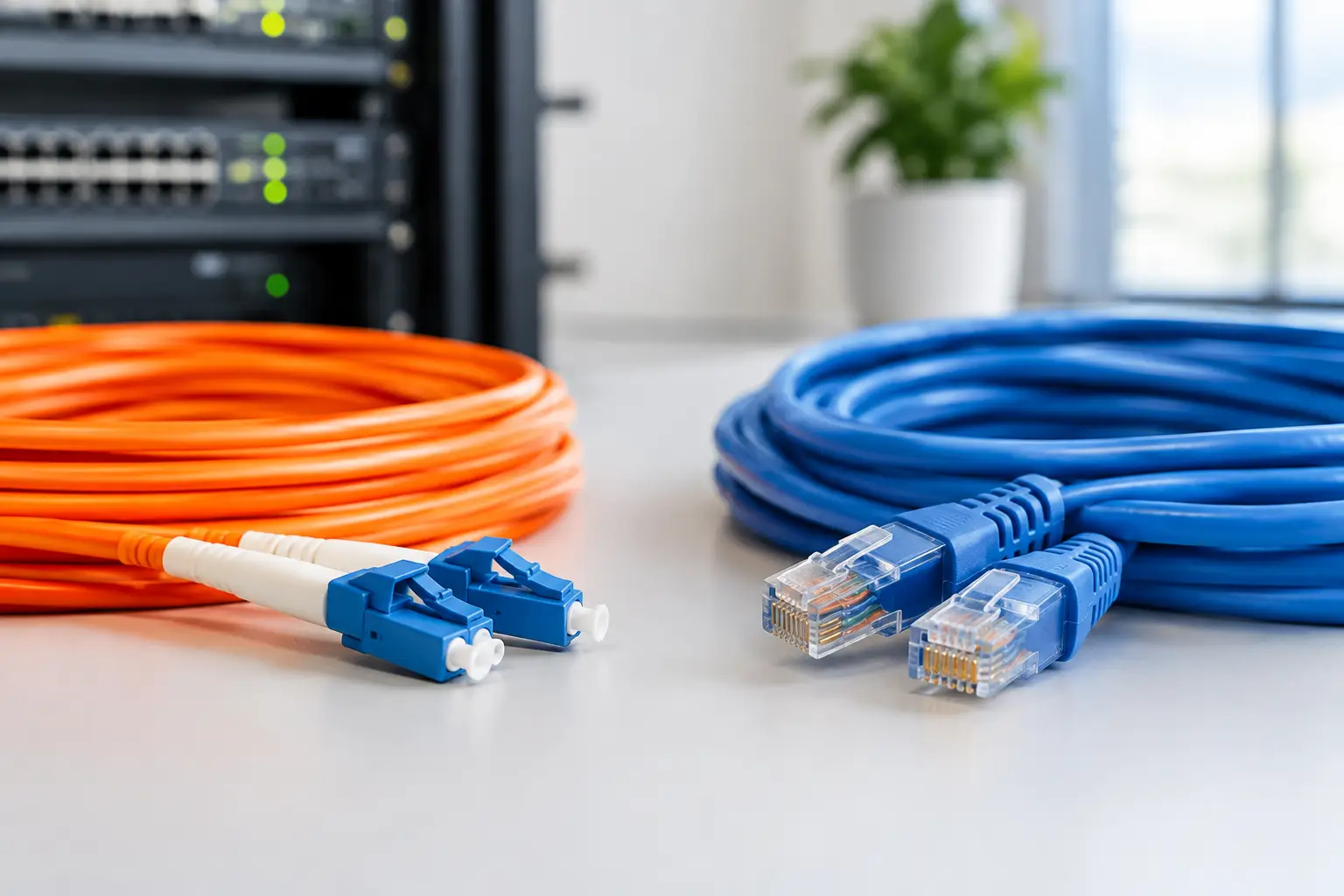
A beautifully designed theater, a whole-property surveillance system, and high-performance wireless all depend on something most owners never see: the cabling behind the walls. The decision around fiber versus copper cabling is not simply about choosing the newer material. It is about matching the infrastructure to the distance, bandwidth, power, environment, and long-term goals of the property.
For a custom home, office, hospitality space, or multi-building estate, the right answer is often a coordinated mix of both. Fiber provides extraordinary capacity over long distances. Copper remains indispensable for local connections, device power, and proven compatibility. A professional infrastructure design considers where each cable type belongs before finishes are installed and access becomes difficult.
Fiber Versus Copper Cabling at a Glance
Fiber optic cable carries data as pulses of light through strands of glass. Copper cable carries electrical signals through metal conductors. That fundamental difference affects how far the signal can travel, how much data it can carry, whether it can power equipment, and how it responds to electrical interference.
Fiber is typically selected for backbone pathways: connections between buildings, network closets, floors, detached guest houses, gatehouses, pool houses, and large equipment rooms. It is also a strong choice where exceptionally high bandwidth or substantial future expansion is expected.
Copper cabling, commonly Category 6 or Category 6A in professional installations, remains the workhorse for connections from a network switch to a wireless access point, surveillance camera, touch panel, networked television location, phone system, or other endpoint. It can deliver both data and power through Power over Ethernet, or PoE. That ability is a major reason copper remains essential in smart home, security, and commercial technology systems.
Where Fiber Has the Advantage
Distance Without Compromise
Standard Ethernet over twisted-pair copper is generally designed for channel lengths up to 100 meters, or approximately 328 feet. That is adequate for many rooms and offices, but properties are rarely as simple as a floor plan suggests. Cable paths must follow framing, ceilings, risers, conduits, and service areas, which can make the actual run much longer than the straight-line distance.
Fiber can carry data far beyond copper’s practical Ethernet distance limits. For a waterfront property with a separate dock structure, a large residence with a distant pool pavilion, or a commercial facility with multiple network rooms, fiber creates a dependable backbone without placing network electronics in inconvenient intermediate locations.
Capacity for High-Demand Systems
A properly specified fiber link supports very high data rates and can be upgraded by changing the electronics at each end rather than replacing the installed cable. This matters when a property includes numerous high-resolution cameras, centralized video distribution, multiple access points, digital signage, high-capacity storage, or critical business network traffic.
It also provides valuable breathing room. Infrastructure is one of the least visible parts of a project, yet it is among the most disruptive to replace after a property is complete. Installing fiber in appropriate backbone routes during construction or a major renovation helps preserve flexibility as system requirements grow.
Resistance to Electrical Interference
Because fiber transmits light rather than electrical current, it is not affected by electromagnetic interference in the same way copper can be. This can be particularly valuable near large motors, elevator equipment, electrical rooms, industrial equipment, and areas with substantial electrical infrastructure.
Fiber also avoids the grounding and potential-difference concerns that can arise when copper runs connect buildings with separate electrical services. For links between structures, this isolation is often a meaningful technical and reliability advantage.
Security and Environmental Considerations
Fiber does not radiate electrical signals in the same manner as copper, making unauthorized signal interception more difficult. It is also nonconductive, which can be beneficial where lightning exposure, electrical faults, or differing ground potentials deserve careful consideration.
That does not mean fiber is automatically the correct choice for every line. Fiber termination requires specialized components, proper handling, and precise testing. A quality installation accounts for bend radius, pathway protection, enclosure design, and labeling from the beginning.
Where Copper Still Belongs
Power and Data on One Cable
Copper’s defining advantage is PoE. A single Category cable can carry network data and low-voltage power to many connected devices. This supports clean installations for surveillance cameras, wireless access points, intercoms, access control hardware, VoIP phones, and select automation devices.
Fiber cannot provide PoE directly. A fiber-connected device requires local power or a media converter and power source at the endpoint. In many locations, especially camera and access point locations, that additional requirement makes copper the more practical design choice.
Efficient Connections to Endpoints
Most networked endpoints are designed around copper Ethernet ports. Running fiber to every camera, control interface, or television location may add equipment and complexity without improving the user experience. A more effective approach is often fiber from the main equipment rack to an outlying network closet, followed by copper runs from that closet to nearby devices.
This architecture keeps the network organized, supports serviceability, and avoids treating a high-capacity backbone solution as though it were a universal endpoint cable.
Familiar Standards and Practical Flexibility
Category 6 and Category 6A cabling are widely compatible with professional networking hardware and offer excellent performance for most in-room connections. Category 6A is especially valuable when 10 Gigabit Ethernet capability, higher PoE demands, or reduced crosstalk are priorities.
The choice between Cat6 and Cat6A should be based on the planned network, pathway availability, cable bundle size, heat considerations, and anticipated device load. Bigger cable is not always better if it compromises cable management or is unnecessary for the design. The goal is a system that performs as specified and can be maintained with confidence.
The Right Design Is Usually a Hybrid
For most premium residences and commercial spaces, the strongest answer is not fiber or copper. It is a layered infrastructure where each medium performs the role it handles best.
Fiber can connect the primary equipment room to a remote wing, a secondary rack, another floor, or a separate building. Copper can then extend from that local network point to cameras, displays, access points, automation controls, and communication devices. This reduces distance constraints while preserving PoE where it offers the greatest benefit.
Consider a large coastal property with a main residence, a detached guest suite, an entry gate, and outdoor entertainment areas. Fiber may be used to connect the main rack to remote distribution locations, protecting performance across longer pathways and electrically separate structures. Copper may serve the cameras, access points, door stations, and control devices in each zone. The result is a cleaner, more manageable system built for dependable daily operation.
Questions That Should Shape the Cabling Plan
Before selecting cabling, an integrator should understand how the property will operate now and how it may evolve. The most useful questions are practical: How far are the equipment locations from one another? Which devices need PoE? Will there be multiple buildings or electrically separate structures? How many surveillance cameras, access points, displays, and control points are planned? Is centralized video, high-capacity storage, or enterprise-grade network performance part of the vision?
Pathways deserve the same attention as cable type. Conduit, pull boxes, accessible routes, proper separation from electrical cabling, and clearly labeled terminations can determine whether future upgrades are straightforward or highly disruptive. Extra capacity in key conduits is often as valuable as choosing a higher-capacity cable.
The installation standard matters as well. Cables should be protected from excessive tension, sharp bends, moisture exposure, and overcrowded pathways. Every run should be tested, documented, and labeled at both ends. When an issue occurs years later, that documentation turns troubleshooting from guesswork into a controlled service process.
Make the Infrastructure Serve the Experience
Cabling is not a standalone purchase. It is the foundation for the experiences owners and teams rely on: responsive controls, clear communications, consistent wireless coverage, dependable surveillance, and entertainment that works as intended. A cable choice that appears minor during construction can define the ceiling of system performance for years.
Sentry Audio Video designs structured cabling around the complete property, not a one-size-fits-all diagram. For projects in South Florida, a thoughtful consultation before walls close can establish the right mix of fiber, copper, pathways, and network locations – giving every connected system the reliable foundation it deserves.