A dated Honeywell keypad does not necessarily mean your property needs new wires behind finished walls, ceilings, millwork, and custom interiors. Can You Upgrade an Existing Wired Honeywell Alarm Without Rewiring? In many cases, yes – provided the existing wiring, field devices, power supply, and panel configuration pass a careful professional evaluation.
That distinction matters. Reusing sound infrastructure can preserve clean finishes and reduce disruption, but an alarm upgrade should never be treated as a simple keypad swap. The goal is not merely to make an old system look newer. It is to create a dependable security platform that protects the property, communicates reliably, and supports the way you live or operate today.
When a Wired Honeywell Alarm Can Stay Wired
Many established homes and commercial properties were built with hardwired door contacts, motion detectors, glass-break sensors, sirens, keypads, and smoke or life-safety devices connected back to a centralized alarm panel. If those cable runs remain intact and properly terminated, they can often continue serving a modern alarm system.
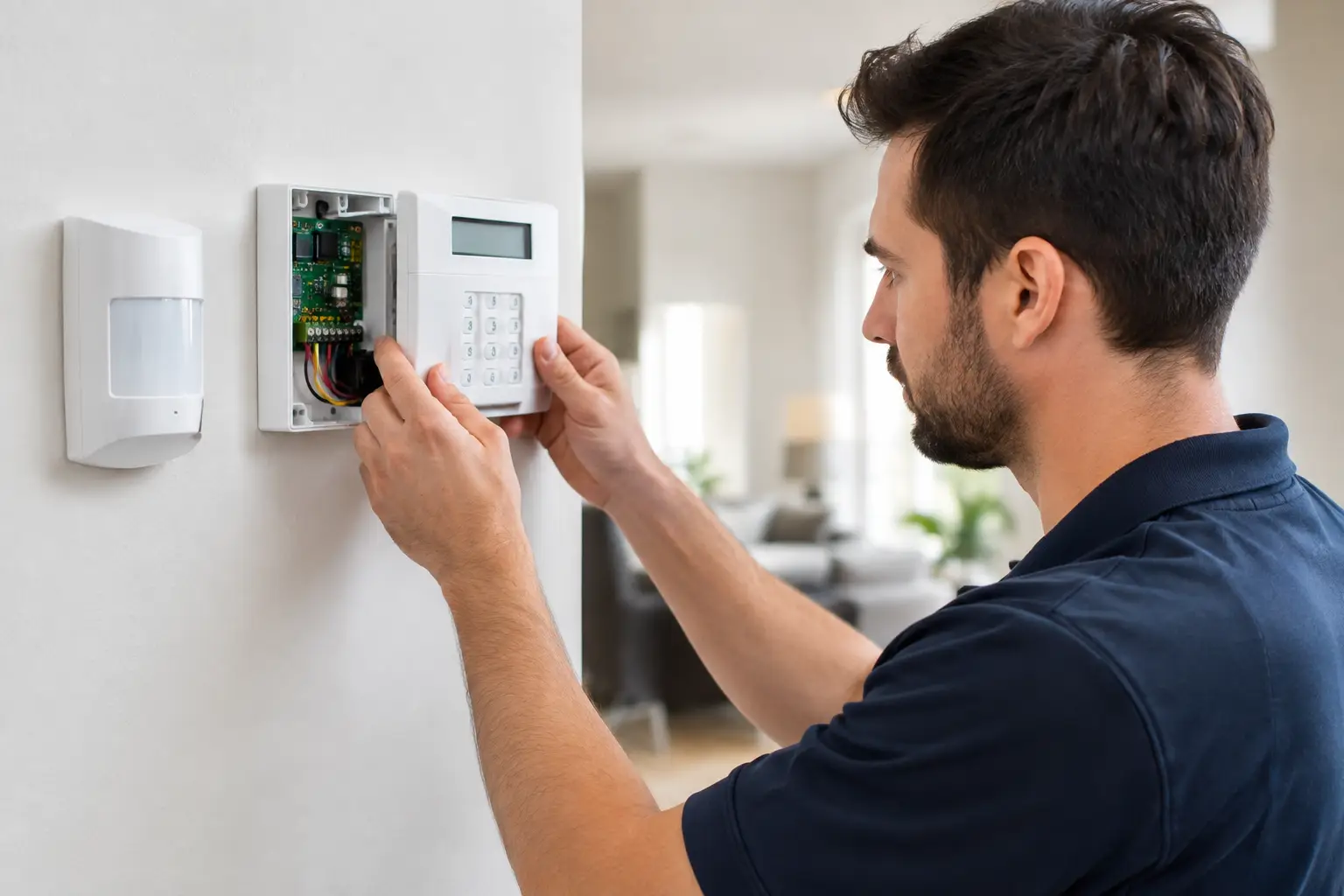
A professional upgrade typically begins at the control panel. Older Honeywell systems may use panels, keypads, communicators, or battery backups that no longer meet current expectations for remote access, event notifications, or monitored communication. Depending on the system and the condition of the installation, the panel may be replaced while the existing zones and wires are retained.
This approach can be especially valuable in finished residences, coastal properties, offices, and retail environments where opening walls would affect carefully completed spaces. It also preserves one of the strongest aspects of a traditional alarm installation: hardwired detection devices are not dependent on individual sensor batteries or wireless signal conditions.
Still, the presence of wires alone does not guarantee they should be reused. Age, moisture exposure, renovations, pest damage, undocumented splices, and previous service work can all affect performance. A clean-looking keypad is not proof that every protective zone is healthy.
What Must Be Evaluated Before an Upgrade
A proper assessment looks beyond the panel enclosure. Each existing zone should be identified, tested, and matched to its purpose. A contact marked as a “window” years ago may now protect a door after a renovation. A motion detector may cover a room that has been reconfigured. An unmarked cable may lead to an abandoned device or a sensor no longer appropriate for the space.
The inspection should confirm the continuity and condition of the wiring, the end-of-line supervision method, power availability, siren operation, transformer condition, and battery backup. It should also verify whether the existing devices are compatible with the selected panel and whether their placement still supports meaningful protection.
For example, an older hardwired motion detector may technically function but deliver inferior detection compared with a newer model designed to reduce false alarms in active living areas. Likewise, older smoke detectors and other life-safety components have service-life considerations that should be addressed independently of whether the alarm panel can read their wiring.
An experienced integrator will also review the system’s communication path. Traditional phone-line reporting is increasingly impractical for many properties. Current systems can use cellular and internet-based communication, often with dual-path options for added resilience. The right configuration depends on the property, monitoring requirements, network design, and the level of notification and control the owner expects.
Can You Upgrade an Existing Wired Honeywell Alarm Without Rewiring Every Device?
Usually, no full rewiring is needed when the original cabling and devices test properly. However, “without rewiring” does not always mean “without any new wire.” A quality upgrade may require a new run for a relocated keypad, an added sensor, a communication module, a new siren location, or equipment added as part of a larger security plan.
It may also make sense to retain hardwired perimeter contacts while adding select wireless devices where wiring is not practical. That hybrid approach is common when a renovation has introduced new openings, a detached structure needs coverage, or the property owner wants to expand protection without disturbing a finished area.
The best decision is based on performance, not on a rigid rule that every old component must remain in place. Retaining reliable cable and proven devices can be smart. Reusing questionable devices simply because they are already installed can create future service calls, nuisance alarms, or security gaps.
What a Modernized Alarm System Can Add
An alarm upgrade is an opportunity to improve how the system fits into the property. Modern capabilities may include professional monitoring, remote arming and disarming, real-time alarm notifications, user codes with activity tracking, and status visibility for protected doors, windows, and common areas.
For a residence, this can mean knowing when a service entrance is opened, receiving a notification if the system is disarmed unexpectedly, or checking alarm status while traveling. For a business, it can support more controlled access management and clearer accountability around openings, closings, and alarm events.
Where appropriate, the alarm platform can also be coordinated with surveillance, access control, lighting, shades, and broader smart home automation. Integration should have a purpose. A security system should remain intuitive during a stressful event, and every connected feature should support reliability rather than introduce unnecessary complexity.
The Honeywell and Resideo Compatibility Question
Honeywell-branded security systems have a long history, and product generations can vary considerably. Some legacy panels and wired devices can transition easily to newer compatible platforms. Others may be limited by proprietary components, outdated programming, discontinued communication options, or the condition of the equipment itself.
This is why model numbers matter. The panel, keypads, communicators, expanders, and zone devices should be documented before a replacement path is proposed. In some installations, a takeover module or compatible upgrade path can preserve much of the existing system. In others, replacing the panel and selected devices produces a more stable long-term result.
A professional recommendation should explain what will be retained, what will be replaced, and why. It should also address programming, user training, testing, documentation, and ongoing service. Those details are what turn equipment installation into a system you can trust.
Warning Signs That Rewiring May Be Necessary
Complete rewiring is not the first choice when a property already has usable structured cabling, but it becomes appropriate in certain situations. Repeated trouble conditions, intermittent zone faults, water-damaged cables, poorly labeled terminations, inaccessible splices, and wires that no longer reach newly planned equipment can all justify replacement work.
Major renovations can change the equation as well. If walls are already open, it may be the right time to improve cable pathways, add protection to overlooked openings, or create a better centralized equipment location. A future-ready plan can support alarm, surveillance, networking, access control, and automation needs without compromising the finished design later.
The same applies to a property that has grown beyond its original security plan. An alarm system designed for a smaller home or office may not account for a guest house, expanded outdoor entertaining area, additional suites, inventory storage, or new entry points. Preserving old wiring is useful only when it supports current coverage requirements.
Why Professional Design Makes the Difference
Security upgrades involve more than selecting a panel. Proper execution requires careful zone mapping, clean terminations, code-aware life-safety coordination, reliable network and cellular communication, disciplined programming, and full testing before the system is placed into service.
For homeowners and businesses in South Florida, environmental conditions deserve special attention. Humidity, coastal exposure, storm-season communication resilience, and properties that may sit vacant for part of the year all influence equipment selection and system design. A dependable solution accounts for the property’s real operating conditions, not just a product specification sheet.
Sentry Audio Video approaches security upgrades as part of the complete technology environment. That means evaluating the existing infrastructure honestly, preserving what performs well, and upgrading what will improve protection, control, and long-term reliability.
Before deciding that an aging wired Honeywell system must be removed, have its wiring and devices professionally assessed. A well-planned upgrade may preserve the infrastructure already hidden within your walls while giving you a security system built for the property you own now.