A camera can record an incident. A Virtual Guard can help stop one while it is unfolding. For property owners who expect more than footage to review after the fact, virtual guarding adds trained human oversight to a professionally designed surveillance system.
This approach is especially valuable for high-value homes, commercial properties, construction sites, gated entries, and locations that may be unoccupied after hours. Rather than relying solely on motion alerts or recorded video, a remote monitoring team can assess activity in real time and follow a defined response plan when something requires attention.
What Is a Virtual Guard?
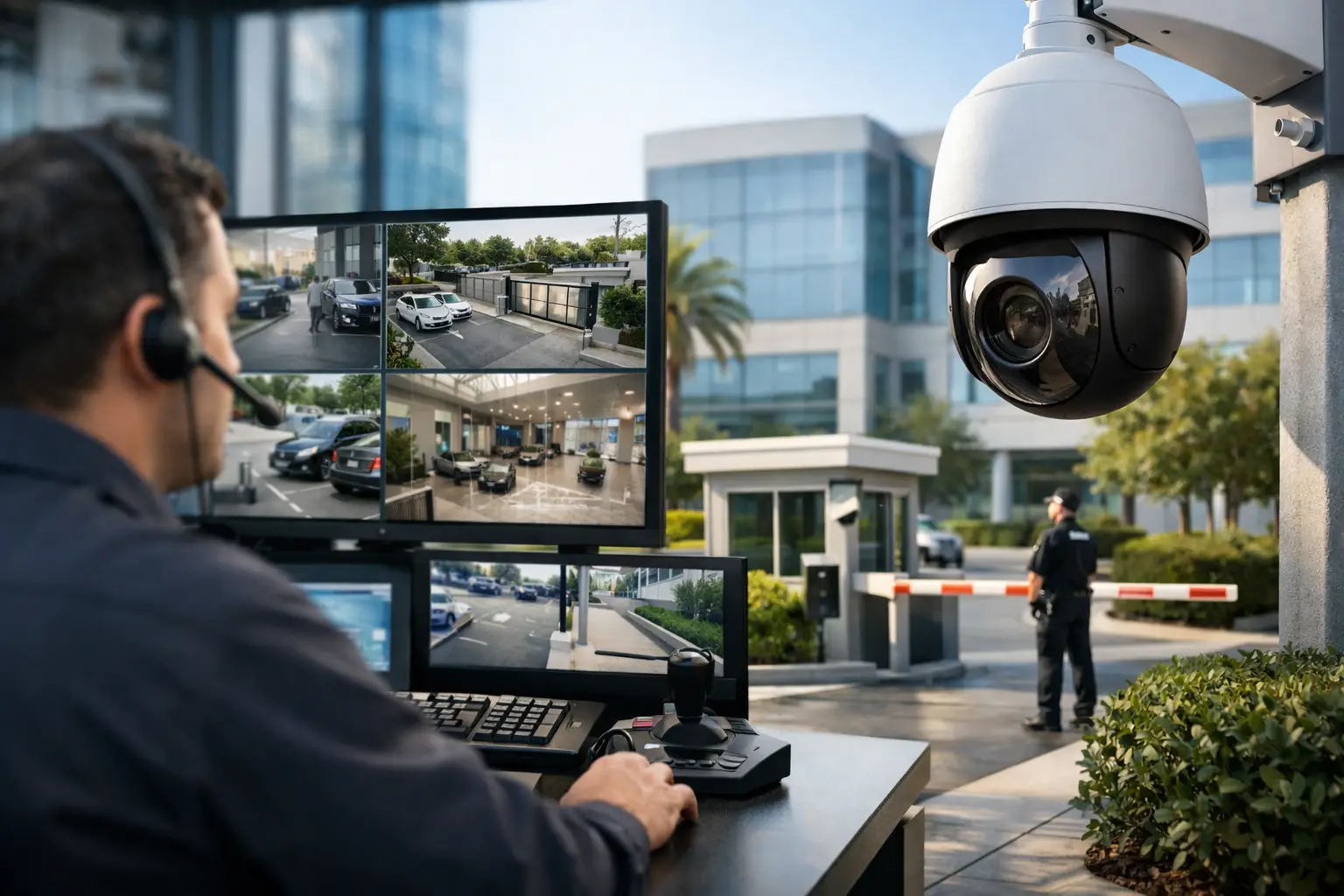
A virtual guard is a trained remote security professional who monitors connected video cameras from a central monitoring center. When analytics or a camera event identifies unusual movement, the operator can review the live video feed, determine whether there is a legitimate concern, and take the appropriate next step.
Depending on the system design and monitoring plan, that response may include issuing a live audio warning through on-site speakers, notifying a designated contact, documenting the event, or contacting local authorities when a verified threat warrants escalation. The key difference is verification. Not every motion event is a security event, and a qualified person can distinguish a delivery, employee, resident, or vendor from activity that calls for intervention.
Virtual guarding does not replace every on-site security need. Some properties require a physical guard because of their size, traffic patterns, liability requirements, or access-control responsibilities. But for many residential and commercial applications, remote monitoring creates meaningful coverage without placing a person at every location around the clock.
Why Virtual Guard Monitoring Changes the Value of Cameras
Traditional surveillance is often reactive. It provides valuable evidence, but its greatest use may come after damage, trespassing, or theft has already occurred. Virtual guard monitoring changes that equation by creating an opportunity for real-time action.
A properly integrated system can pair high-resolution cameras with intelligent analytics, perimeter awareness, two-way audio, lighting control, and access control. When an event occurs, the monitoring team needs a clear view, dependable connectivity, and a response method that fits the property. A live audio warning can be far more effective when it is delivered through well-placed speakers and tailored to what the operator sees on camera.
This is why equipment selection and installation quality matter. A camera positioned too high, too wide, or directly into glare may capture very little usable detail. An unreliable network connection can delay alerts or interrupt live viewing. Systems should be designed around the actual risks of the site, including entry points, blind areas, vehicle access, outdoor gathering spaces, restricted rooms, and hours of operation.
Where Remote Guarding Delivers the Most Value
For homeowners, virtual guarding can add another layer of confidence around driveways, gates, pool areas, side yards, guest houses, and perimeter doors. It can be particularly useful for seasonal residences and properties that remain vacant for extended periods. The goal is not to create a complicated security experience. It is to ensure that the right people have visibility and that suspicious activity receives informed attention.
For businesses, virtual monitoring can support properties where staffing levels change after hours. Office buildings, warehouses, retail locations, medical facilities, private communities, and hospitality environments often need coverage at entrances, delivery areas, parking lots, and secure interior zones. Remote operators can help filter nuisance alerts while escalating situations that deserve a faster response.
The value also extends to property management. Clear event documentation and verified incident reporting can help owners and managers make decisions based on what occurred, not assumptions. That visibility is useful when addressing repeated access issues, tenant concerns, vendor activity, or recurring perimeter vulnerabilities.
Design Comes Before Monitoring
Virtual guard service is only as effective as the system supporting it. Before monitoring begins, a security professional should evaluate camera coverage, lighting conditions, network reliability, backup power, audio capability, and the precise response procedures for each type of event.
A strong design also respects privacy. Cameras should focus on appropriate exterior and common-area locations, while access to live and recorded video should be controlled through secure user permissions. Residential properties may need different notification rules than a commercial facility, and every system should account for who is authorized to receive alerts and make decisions.
At Sentry Audio Video, security systems are designed as integrated environments, not isolated devices. That means surveillance, networking, access control, automation, and audio can work together with a clear purpose and a clean professional installation.
Choosing the Right Level of Protection
The right virtual guard plan depends on the property. Some clients need overnight perimeter monitoring. Others need coverage during closing hours, while away from home, or during construction and renovation activity. The most effective solution begins with a site assessment and a conversation about where risk actually exists.
A well-designed virtual guard system gives your property more than a record of what happened. It gives you a trained set of eyes, a defined response process, and a security strategy built to perform when attention matters most.