Adding patio speakers to an existing Savant system starts with the amplifier and zone schedule. Empty terminals or a desire for more outdoor coverage do not establish that the retained amplifier can safely power additional speakers. Before buying, verify the actual channel allocation, speaker loads and intended control behavior.
The useful buying question is whether the patio will be an independent listening zone, an extension of an existing zone or a separately amplified addition. Each choice has different equipment and operating consequences.
Inventory the equipment before adding speakers
Record the amplifier model, channels in use, connected speaker models and available system documentation. Establish which room or outdoor area each channel serves. Do not infer that an unused room name in the app corresponds to spare physical amplification.
Where records are incomplete, the assessment should identify what must be traced and verified. Photos of accessible equipment labels can help prepare the visit, but the owner should not disconnect an operating system simply to investigate terminals.
Confirm the desired patio behavior
Ask whether the patio needs its own volume, mute and music selection. If it is joined to an existing zone, explain which controls will affect both areas. If independent listening is required, identify the additional source and routing capacity as well as amplification.
Separate music selection from speaker power. An available music stream does not create a spare amplifier channel, and spare amplification does not guarantee an additional independent program. The quotation should identify both dependencies for the proposed expansion.
Match speaker loads to the exact amplifier
Speaker impedance, connection arrangement and amplifier operating limits need a model-specific design. Do not assume an additional pair can be connected in parallel with an existing pair. The permitted load, channel mode and output configuration must be checked against the selected amplifier and speaker documentation.
Some projects use low-impedance speakers; others use a compatible constant-voltage distribution design. Those approaches are not interchangeable. Any transformer settings, channel bridging or protective configuration should be specified and performed by the responsible installer using the manufacturer’s instructions.
- Exact amplifier and speaker models.
- Existing and proposed speakers on each channel.
- Connection method and calculated design load.
- Applicable channel mode and manufacturer limits.
- Expected listening use, coverage and agreed operating level.
Verify outdoor suitability and the cable path
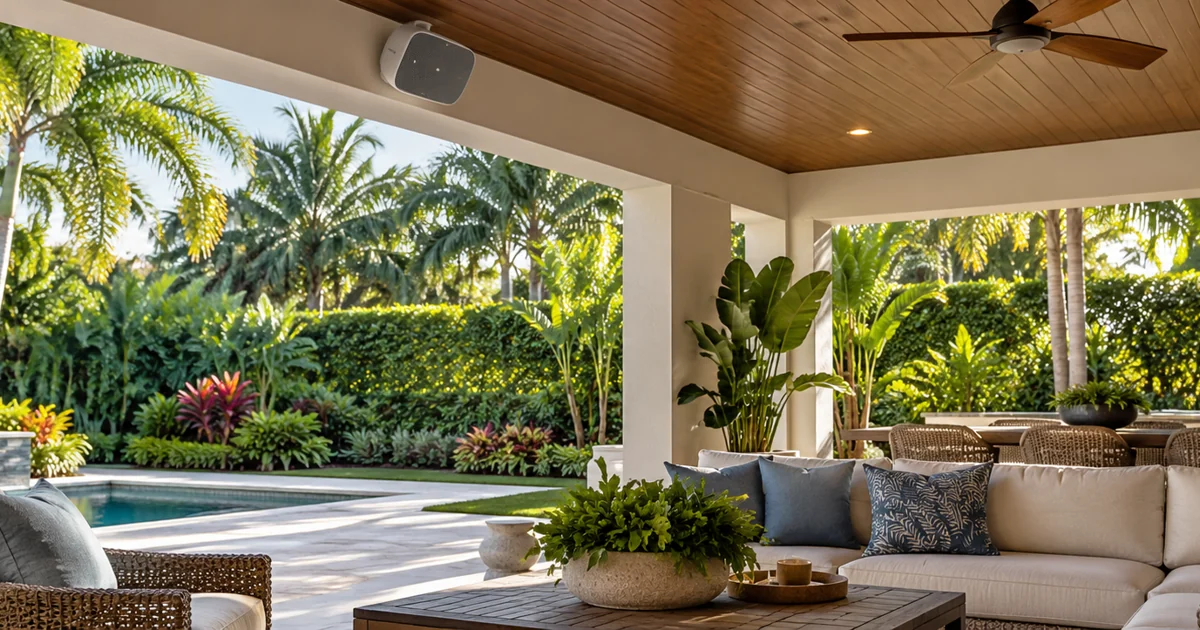
Choose speakers and mounting accessories suitable for the actual exposure. A covered patio is not the same environment as a fully exposed landscape location. Review moisture, coastal conditions, mounting surfaces and access for future service using the selected product’s documentation.
Document the retained cable route, condition and suitability before promising reuse. Include any new cable, termination or mounting work in the scope. Outdoor equipment selection and installation details should be decided for the property rather than inferred from a generic weather-resistant label.
Confirm supported Savant control
Identify how the amplifier or audio endpoint integrates with the installed Savant host and distribution system. Check the exact hardware and software combination, then explain what programming and user-interface changes are included. New patio hardware should appear in the agreed location with understandable controls.
Savant publishes model-specific audio output and performance information. Use the relevant documentation for the actual retained or proposed unit. A published output rating for one Savant amplifier should not be applied to another model or interpreted as permission for an unspecified speaker load.
Test the expansion under normal use
- Verify the agreed music source reaches the patio.
- Check each installed speaker and the intended coverage.
- Test volume, mute and off behavior from the household’s usual controls.
- Confirm whether indoor and patio controls remain independent as designed.
- Check the installed system at the agreed operating level and follow manufacturer commissioning requirements.
- Document channels, speaker models, connections and any operating limitations.
Give the owner a final zone schedule. That record makes future upgrades easier and helps prevent a later speaker addition from being based on assumptions about what is connected inside the equipment cabinet.
Compare an independent patio zone with a shared zone
Suppose the owner wants background music outdoors while the family watches television inside. Ask the designer to show whether the patio can select its own source and volume without changing the interior room. If the quotation instead extends an existing speaker zone, explain which actions will be shared. This hypothetical example defines a control requirement; it does not establish that the retained amplifier has the necessary outputs.
Now ask for a channel-by-channel equipment schedule. Each proposed speaker should have a specified connection path to the actual amplifier, with the installer responsible for verifying the supported load and configuration. Avoid a quotation that simply adds a speaker quantity while leaving the retained channel assignments unresolved. A larger speaker count is not a substitute for a documented amplifier design.
For a new Savant property installation, make the outdoor listening brief part of the initial audio plan. Decide where people listen, which areas need independent control and how future service will reach the equipment. For a takeover, establish what the present system can support before deciding whether to retain amplification, add a supported unit or redesign the affected zone. Price any new wiring and programming responsibilities explicitly.
Acceptance should include a normal indoor activity while the patio is used as agreed. Confirm which controls can change the patio and whether the other areas continue operating independently where promised. Keep the final equipment and connection schedule with the owner handoff. That record supports a considered installation purchase and helps the next expansion begin with evidence rather than assumptions about spare terminals.
Plan the addition before buying the speakers
Sentry Audio Video provides Savant system design and expansion services in South Florida. Request a patio-audio assessment or call (561) 717-3280 with your equipment models and the patio behavior you want.
Technical references
Reviewed October 30, 2026: Savant’s IP Audio 125 product information and IP Audio 50 product information. The final design must use the installation and load specifications of the actual amplifier and speakers.
Featured image: AI-generated illustration, not a photograph of a Sentry Audio Video project.