
A property can have exceptional displays, speakers, shades, surveillance, and network equipment, yet still feel complicated to use. That is the difference between adding devices and investing in Tech and Automation designed as one coordinated system. When every component is selected, programmed, and installed with the full property in mind, technology stops demanding attention and starts supporting the way people live and work.
For a luxury residence, that may mean one touch sets the lighting, motorized shades, climate settings, and entertainment for an evening at home. For a business, it may mean employees can start a presentation, manage audio, monitor key areas, and communicate across the property without juggling remotes, apps, or unreliable connections. The goal is not more technology. It is better control, dependable performance, and a finished result that belongs in the space.
Tech and Automation Starts With System Design
The most valuable decision happens before equipment is ordered: determining how the property should function. A professional integrator looks beyond individual rooms and considers the complete experience. Where will people enter? Which spaces are used daily? What needs to be accessible remotely? How should systems behave when the property is vacant, occupied, entertaining guests, or closing for the evening?
This planning stage brings entertainment, security, communications, networking, shading, and environmental controls into a single strategy. It also accounts for the details that are easy to overlook later, including equipment locations, wireless coverage, wiring routes, rack ventilation, service access, and the visual impact of keypads, speakers, cameras, and displays.
A well-designed system should feel intentional from the beginning. Equipment can be concealed where appropriate, controls can be placed where they are useful, and every room can receive the performance it requires without visual clutter. That level of planning is especially important during a new build or renovation, when structured cabling and infrastructure can be installed cleanly before walls and ceilings are complete.
One Control Experience, Not a Collection of Apps
Most properties accumulate technology over time. A television may have one remote, the audio system another, shades use a wall control, cameras live in a separate app, and the thermostat relies on yet another interface. Each piece may work independently, but the experience becomes fragmented.
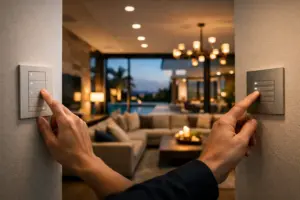
Integrated control brings those functions together through intuitive touch panels, keypads, handheld remotes, and secure mobile access. The homeowner or staff member does not need to know which component is handling the command. They simply select the room, activity, or setting they want.
For example, an “Entertain” setting might illuminate key living areas, lower shades to reduce glare, activate outdoor audio, and prepare the media room. A “Goodnight” command can turn off selected entertainment zones, adjust shades, set preferred temperatures, and confirm the property is secured. In a commercial setting, opening and closing routines can simplify recurring tasks while helping staff operate the building consistently.
The right control experience is not necessarily the one with the most buttons or features. It is the one that makes common actions immediate while keeping deeper settings available when they are needed. Families, guests, and employees should be able to use the system confidently without a manual nearby.
Entertainment Should Match the Space
Custom audio/video is more than placing a display on a wall. Room dimensions, natural light, ceiling height, seating, acoustics, and architectural finishes all affect the result. A dedicated theater calls for a different design than a bright family room, a waterfront outdoor area, or a restaurant dining space.
In a home, integrated entertainment can provide high-performance audio in primary living spaces, selected music throughout the property, and video distribution where it makes sense. Outdoor areas can be planned for poolside gatherings, patios, and covered living spaces, with equipment selected and positioned for the environment. Speakers, displays, and controls should complement the architecture rather than compete with it.
For businesses, audio/video design can shape the guest and employee experience. Clear audio, properly positioned displays, reliable conferencing, and simple source control help restaurants, offices, amenity spaces, and retail environments operate at a higher level. The system must also be practical for the people using it every day. If staff cannot operate it quickly, its capabilities will go underused.
There are trade-offs. Concealing equipment can preserve a clean aesthetic, but access for maintenance still needs to be considered. Larger displays can create stronger visual impact, but viewing distance and ambient light determine whether that size is actually appropriate. A professional design resolves these questions before installation rather than after the room is finished.
Security and Convenience Belong in the Same Plan
Security systems are most effective when they are not isolated from the rest of the property. Video surveillance, access control, intrusion detection, fire alarm systems, gates, intercoms, and alerts can be planned alongside daily automation instead of added as disconnected layers.
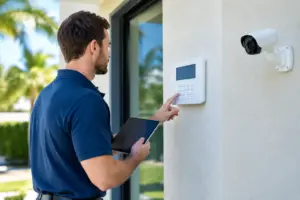
A resident may want to view cameras from a dedicated panel, receive a verified alert while away, or speak with a visitor at an entry point. A business owner may need controlled access, camera coverage for critical areas, and dependable notification protocols. The right design depends on the property’s layout, operating hours, privacy requirements, and risk profile.
Automation can support security without making the property feel overly technical. Exterior and pathway lighting can follow schedules or selected events. Shades can be programmed around occupancy patterns. Entry systems can provide controlled, auditable access for family members, employees, vendors, or property managers. Remote access should be secure, carefully configured, and limited to the people who need it.
Reliability matters more here than novelty. A camera system is only useful when coverage is properly planned, images are clear enough for their purpose, recording is configured correctly, and the underlying network can support it. The same principle applies to every connected system: performance begins with thoughtful engineering.
The Network Is the Foundation of Tech and Automation
Modern integrated environments depend on a well-built network. Audio distribution, video streaming, surveillance, control systems, wireless devices, communications, and remote service all rely on that foundation. When the network is treated as an afterthought, intermittent performance often follows.
Professional IT-enabled infrastructure considers coverage, capacity, segmentation, equipment placement, wired connections, and future expansion. Large homes and commercial properties may require multiple wireless access points, managed switches, secure network separation, and centralized equipment racks. The objective is consistent connectivity where it is needed, not a signal that is strong only near one router.
Wired infrastructure remains particularly valuable for fixed, high-demand equipment. It provides a stable connection for critical components and keeps wireless resources available for mobile devices. During construction, installing the right cabling can preserve options for future upgrades without reopening finished walls.
This is also where an experienced integrator provides meaningful accountability. When audio, video, control, surveillance, and networking are designed as one system, there is a clear partner responsible for diagnosing issues and maintaining performance. That is far more effective than being directed from one manufacturer to another when a problem crosses multiple categories.
What Professional Installation Changes
Premium technology deserves workmanship that protects both performance and the property. Clean cable management, properly labeled connections, well-organized racks, precise mounting, calibrated audio/video settings, and careful finish work are not minor details. They determine how dependable the system is, how easy it is to service, and how well it complements a refined interior.
Professional installation also includes programming and testing. Control interfaces should be tailored to the client’s routines, not left with generic labels and confusing menus. Every zone, source, camera view, scene, and scheduled event should be tested in real conditions. The final walkthrough should leave the owner and staff comfortable using the technology from day one.
Ongoing support has equal value. Properties change. A family may renovate a room, a business may expand operations, or an owner may want a new outdoor zone added later. A documented, professionally installed system makes those changes more manageable and protects the original investment.
Choosing the Right Technology Partner
When evaluating a technology integration company, ask how it approaches design, installation, programming, and long-term service. A proposal should explain the intended experience, not simply list equipment. The integrator should be able to coordinate with architects, builders, designers, and other trades while maintaining responsibility for its own scope.
It is also worth discussing how the system will be supported after installation. Ask who handles service requests, how remote diagnostics are used, and how future additions will be approached. For homeowners and businesses in South Florida, a partner with experience across both lifestyle and security systems can reduce complexity and create a more consistent result.
Sentry Audio Video approaches each project as a complete environment, from the infrastructure behind the walls to the controls used every day. The strongest integrated systems are not defined by how much equipment they contain. They are defined by how naturally they perform when the room is full, the property is quiet, or a critical moment requires everything to work exactly as intended.