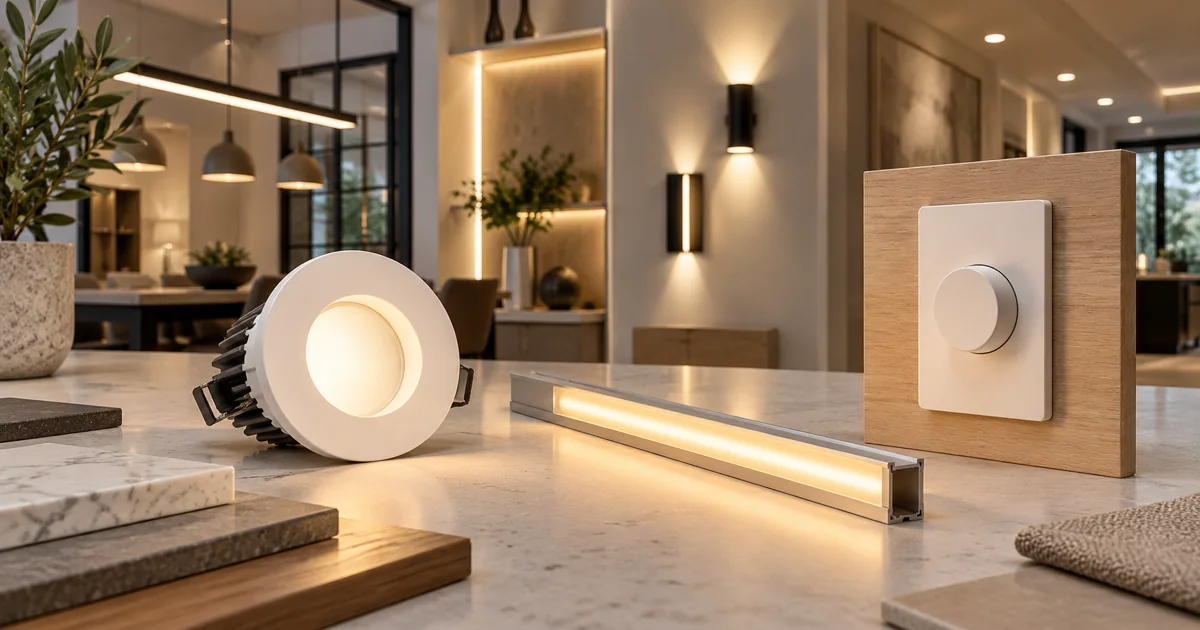
Before ordering a house full of LED fixtures for a Lutron lighting project, test a representative sample of the exact fixture, driver and control combination. A fixture being described as “dimmable” does not prove that it will deliver the dimming range, startup behavior or visual quality the owner expects in the completed room.
Plan your Lutron lighting project
Share the fixture and driver schedule, construction stage and the low-light result you want. We can coordinate the sample-control review with the lighting supplier and responsible electrical professionals.
Request a Sentry Audio Video consultation Call (561) 717-3280
A short mockup can help separate a fixture-selection problem from a programming problem before finishes are complete. It is particularly useful for decorative lighting, low-level evening scenes and renovations that mix retained fixtures with new controls.
Test the complete fixture and driver combination
Identify the exact fixture model, driver, lamp where applicable, quantity and proposed control. Similar product names can conceal different electronics or revisions. The test sample should represent the equipment being ordered, not merely something from the same product family.
Use the manufacturer’s current compatibility information and electrical requirements as the starting point. Confirm the specified control method and any applicable load limits with the responsible installer. Do not assume that every LED load can be handled by every dimmer.
Where the design uses a dedicated digital or tunable-lighting arrangement, review the corresponding system requirements. A test intended for an ordinary phase-controlled fixture should not be presented as proof of compatibility for a different control architecture.
Define the results the homeowner cares about
Ask how the room will be used. A bright kitchen work scene and a low evening dining scene create different expectations. Decorative lamps that look acceptable at mid-level may still be distracting if they cannot dim comfortably at night.
Agree on the desired behavior in plain language: smooth adjustment, dependable starting, no objectionable visible flicker, no distracting audible noise and a useful minimum light level. Do not substitute a theoretical percentage for observing the actual fixture in the intended setting.
Color appearance also deserves attention. Different fixture types can look inconsistent even when their nominal color-temperature descriptions match. Evaluate samples with the room finishes and other light sources rather than selecting from specifications alone.
Observe starting, fading and low-level operation
Run the sample from off to the intended low setting, adjust it through the usable range and turn it off again. Test the planned fade behavior and repeat the sequence. A fixture that dims down successfully after being bright may behave differently when starting directly at a low level.
Review manufacturer-approved adjustments available for the selected control and load. Settings can improve certain combinations, but programming cannot make an incompatible driver suitable. If the desired result cannot be achieved, revisit the equipment choice rather than hiding the limitation in a scene.
Assess the sample at the times and brightness levels that matter. Daylight can mask low-level problems that become obvious in a quiet evening room. Where multiple samples are available, compare them under the same conditions.
Use a representative load and appropriate installation
A single fixture on a temporary demonstration may not represent a circuit containing many fixtures. The responsible professionals should confirm the planned quantity, electrical loading and other applicable limits for the actual installation.
Keep the test arrangement safe and appropriate. Owners should not assemble exposed line-voltage test wiring or experiment with unfamiliar electrical equipment. Coordinate the mockup through the integrator, lighting supplier and qualified electrical contractor as required by the project.
Record whether the test used the final control model and intended driver. If a substituted component was used, treat the result as provisional. Changes during procurement should trigger a compatibility review rather than inheriting approval automatically.
Document the accepted combination before ordering
The approved record should identify the exact components, quantity assumptions, relevant settings, observed minimum useful level and any limitations. Photographs and a short video can help communicate the result, but they do not replace the equipment schedule.
Have the owner or design team approve the visible result before a large order is released. Coordinate that approval with the supplier’s current availability, return terms and product details. Do not promise that every custom or special-order item can be returned if the final appearance is disliked.
Where the home uses several fixture types, build a small set of representative tests. Recessed downlights, decorative pendants and linear lighting may require separate reviews. One successful mockup does not certify every lighting circuit in the property.
Carry the decisions into installation and commissioning
Verify that delivered equipment matches the approved schedule. If the fixture or driver changes, revisit the test before installation spreads across the house. An early substitution can otherwise become a costly problem after ceilings and trim are complete.
At commissioning, check the installed rooms at the agreed scenes and levels. Confirm startup, fade and shutoff behavior, then train the owner on the intended controls. Record adjustments so later service starts from the actual accepted configuration.
For renovations, separate faults in retained wiring or fixtures from the new control scope. A thorough review may identify equipment that can stay and a small number of loads requiring replacement or another approved control solution.
Plan Lutron lighting around verified fixture performance
Sentry Audio Video is an authorized Lutron dealer providing lighting-control design, equipment sales, installation and programming. We coordinate fixture compatibility, controls and scenes with the project team. For new construction or a renovation, review when to involve the lighting-control team. Call (561) 717-3280 for Boca Raton or Palm Beach, (954) 859-6475 for Fort Lauderdale, or request a lighting consultation.