A beautifully designed property should not disappear when the sun goes down. Landscape Lighting Boca Raton homeowners choose should do more than illuminate a walkway. It should bring architectural detail into view, make arrivals feel safer, extend the use of patios and pool areas, and give the entire property a composed, welcoming presence after dark.
For a custom home, outdoor lighting is not a collection of fixtures placed around the yard. It is a planned system that balances appearance, visibility, comfort, durability, and control. The difference is immediately noticeable: controlled pools of light, properly highlighted landscaping, clean sightlines, and no harsh glare spilling into living spaces or neighboring properties.
Why Professional Landscape Lighting Matters in Boca Raton
Boca Raton homes are designed for outdoor living. Courtyards, covered patios, summer kitchens, pools, guest areas, waterfront spaces, and detailed façades all deserve the same level of attention given to the interior. Without a lighting plan, however, even an exceptional exterior can look flat, disconnected, or overly dark at night.
A professionally designed system creates hierarchy. It shows guests where to enter, makes steps and changes in elevation easier to see, draws attention to a mature palm or statement tree, and adds depth to the home’s architecture. Just as importantly, it avoids the common mistakes that undermine a premium property: fixtures visible from every angle, overly bright pathways, inconsistent light color, and beams aimed directly at windows.
South Florida also places real demands on outdoor equipment. Heat, humidity, heavy rain, salt exposure near the coast, irrigation, and dense landscaping all affect long-term performance. Fixture construction, connection methods, placement, drainage, and service access should be considered before installation, not after a system begins to show wear.
Start With the Experience, Not the Fixture
The strongest lighting plans begin with a simple question: how should the property feel and function after dark? A front approach has different priorities than a pool deck. A waterfront entertaining area needs a different level of ambient light than a private garden path. The goal is not to make every part of the property equally bright. It is to make each area useful, attractive, and comfortable for its intended purpose.
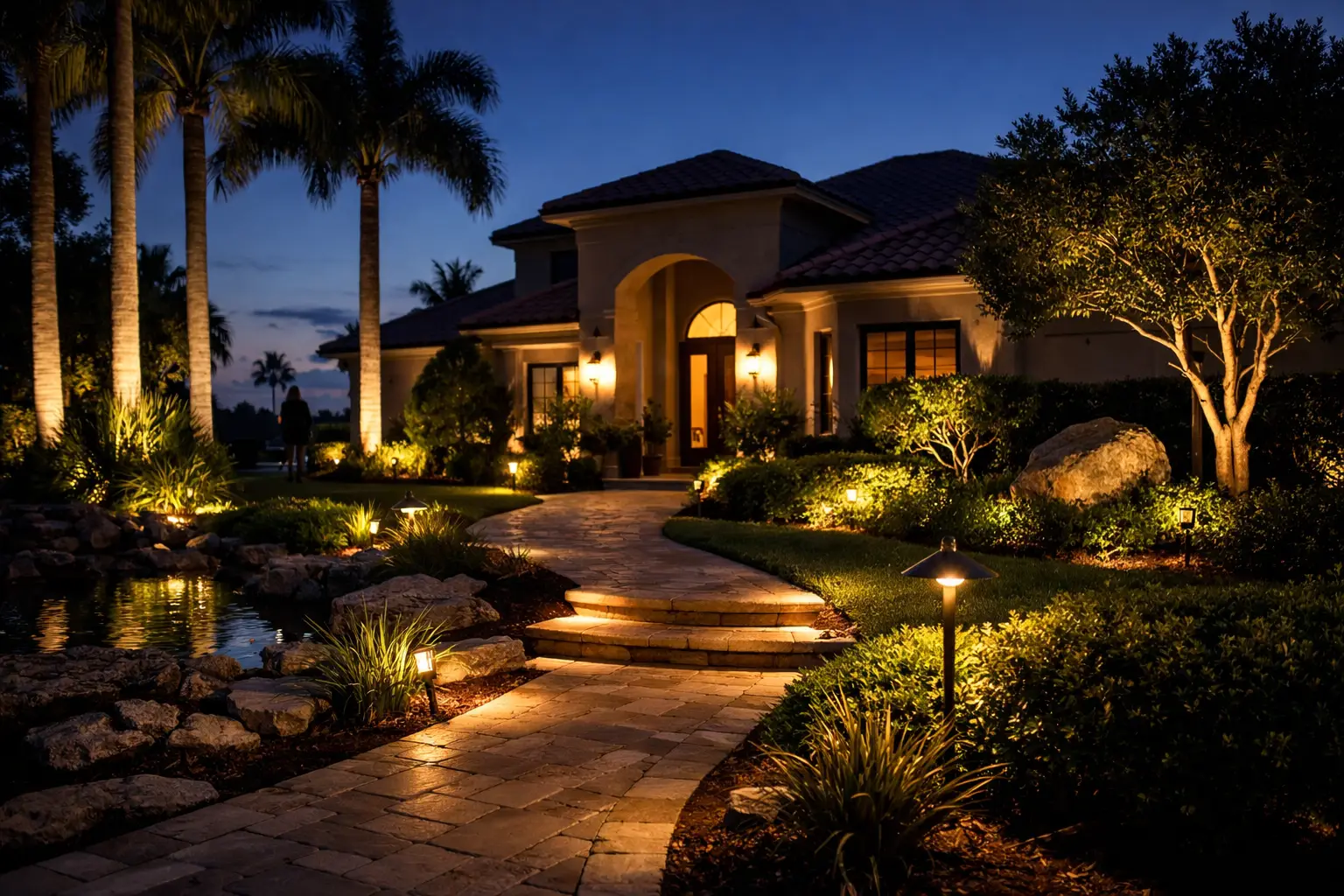
At the front of the home, lighting often focuses on curb appeal and confident arrival. Softly illuminated walks, carefully placed lighting at the entry, and selective accent lighting on columns, textured walls, or landscape features can create a polished first impression without making the façade look washed out.
In the backyard, the focus shifts toward hospitality. The right plan makes it easier to move between the home, patio, pool, and seating areas while preserving a relaxed evening atmosphere. Lighting can define the edge of a deck, provide safe navigation around stairs, add subtle dimension to planting beds, and support outdoor dining without overpowering the night sky.
The Layers That Create a Finished Look
Landscape lighting works best when several types of light are coordinated rather than treated as separate additions. The most effective plans usually combine functional light with architectural and landscape accents.
Path and step lighting provides orientation. It should identify the route and reveal changes in elevation without creating a runway effect. A series of softly overlapping pools of light is generally more refined than a line of bright fixtures placed at identical intervals.
Uplighting gives dimension to palms, specimen trees, walls, and architectural details. The beam spread and fixture location matter as much as the brightness. A narrow beam may emphasize the height and form of a palm, while a wider wash can reveal the texture of a stone wall or hedge.
Downlighting can create a more natural effect when mounted thoughtfully in trees, structures, or covered areas. It is particularly useful for patios, paths, and gathering spaces because it provides practical light from above while maintaining a softer visual result than a visible ground fixture.
Finally, accent lighting helps establish focal points. It may highlight a water feature, sculpture, gate, planting bed, or distinctive façade element. Used selectively, these accents create depth. Used everywhere, they compete with one another and make the property feel busy.
Control Is What Makes the System Feel Effortless
A lighting system should fit the way the property is used, not require someone to manage multiple switches every evening. Centralized control can allow exterior lighting to follow an astronomical schedule, turn on at sunset, adjust for seasonal changes, and operate through clearly defined scenes.
For example, an “Arrival” scene may activate the entry, driveway, and pathway lighting. An “Entertain” scene can add patio, pool, and landscape accents while keeping the front elevation more subdued. A late-night setting may preserve key pathways and security-focused areas while turning off decorative zones that are no longer needed.
Integrated control becomes especially valuable when landscape lighting is part of a larger smart property system. It can work alongside motorized shades, whole-home audio, pool features, surveillance, and outdoor entertainment without adding unnecessary complexity. The goal is simple control from a wall keypad, touchscreen, or trusted mobile interface, backed by a system designed to operate reliably.
Color Temperature and Brightness Require Restraint
Not all white light looks the same, and the wrong color temperature can change the character of a home. Warmer tones are often preferred for residential landscape applications because they complement natural stone, wood, planting materials, and traditional or transitional architecture. They also create a more inviting environment for outdoor entertaining.
Cooler light can have a place in certain contemporary designs or security-focused areas, but it should be specified intentionally. Mixing fixture colors across a property is one of the fastest ways to make a finished installation look uncoordinated.
Brightness should be designed around the task and the viewing angle. More output is not automatically better. An overly bright fixture can create glare, flatten architectural textures, and reduce visual comfort for people seated on a patio or looking out from inside the home. Proper aiming, shielding, and zoning are what allow a lighting system to feel elevated rather than intrusive.
What to Expect From a Custom Lighting Design
A quality installation starts with a site review and a conversation about how the property is used. The design team should consider the architecture, established landscaping, pathways, pool areas, views from inside the home, existing infrastructure, and future outdoor plans. If a renovation or landscaping project is underway, early coordination can protect the design intent and reduce visible disruption later.
The proposal should make clear which areas will be illuminated, the fixture types being considered, the control approach, and how the system will be supported over time. For larger properties, zoning is particularly important. Separating the front elevation, side access, backyard entertaining areas, and feature lighting makes the system more flexible and more efficient to operate.
Installation quality matters just as much as the equipment selection. Wiring should be routed cleanly and protected appropriately. Fixtures should be placed for effect, not merely for convenience. Connections need to withstand the outdoor environment, and access should remain practical for future adjustments as trees and plantings mature.
Landscape Lighting Boca Raton Property Owners Can Rely On
The right lighting system adds more than nighttime beauty. It helps residents and guests move through the property with confidence, supports exterior security awareness, and makes outdoor spaces feel like a true extension of the home. It also protects the investment in architecture, hardscaping, and landscaping by ensuring those details remain visible long after sunset.
Sentry Audio Video approaches outdoor lighting as part of the complete property experience. That means considering how lighting will interact with smart controls, backyard entertainment, surveillance, pool environments, and the daily routines of the people using the space. The result is a professionally executed system with clean installation standards and dependable long-term performance.
Whether the priority is a more welcoming front elevation, a safer path to the dock or pool, or a fully integrated outdoor entertaining environment, the most successful project begins with a thoughtful on-site design conversation. A lighting plan tailored to the property will look better on the first evening and continue to serve the home as the landscape grows and the way it is used evolves.