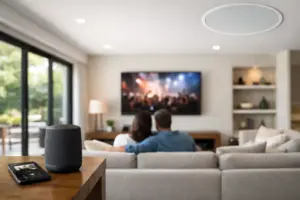
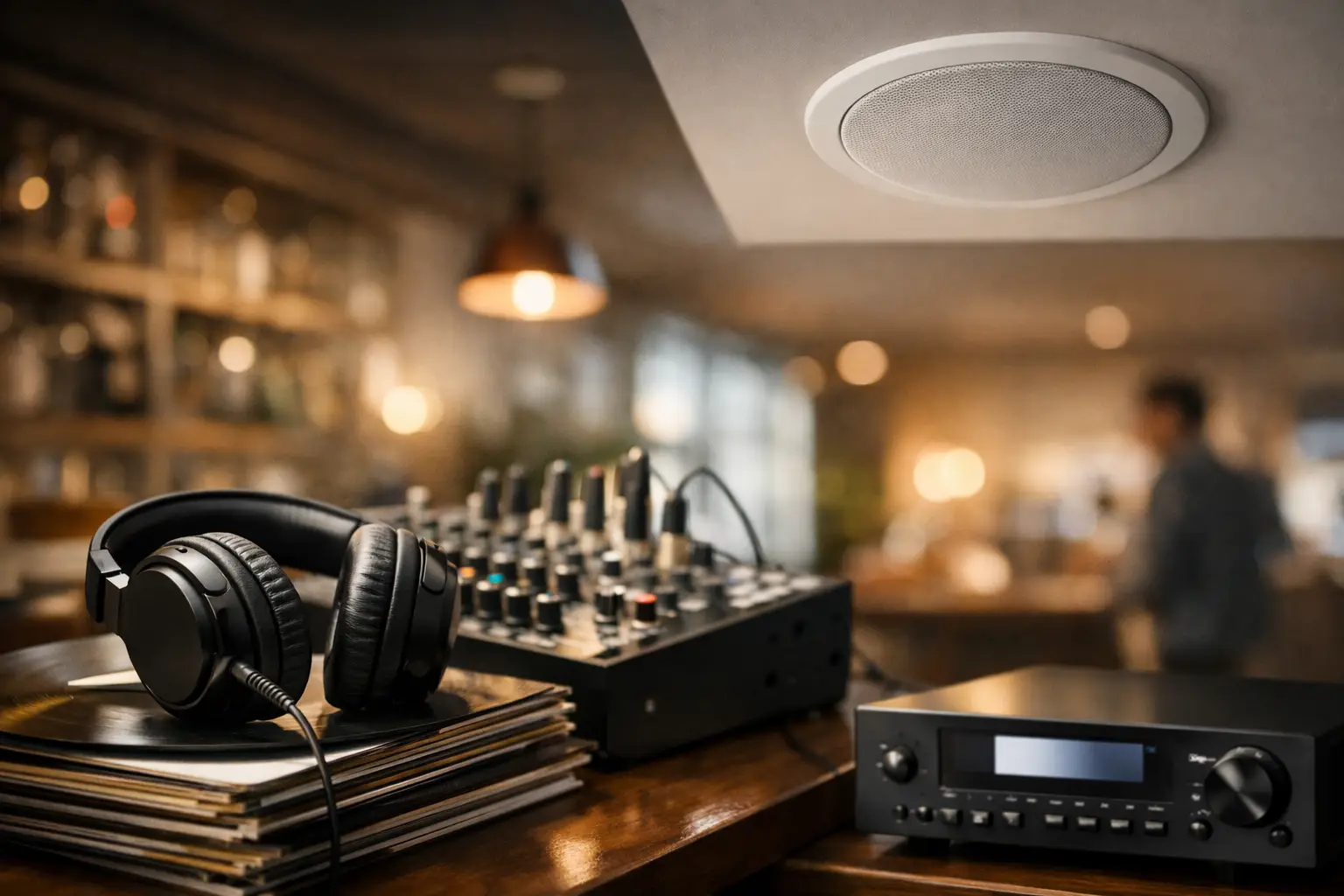
A polished background music program can make a restaurant feel more inviting, a retail space feel more intentional, and a lobby feel more complete. But what business owners need to know about background music licensing and sound systems is that music is not simply another playlist and speakers are not simply another fixture. Both require thoughtful planning to protect the business, support the guest experience, and perform reliably every day.
For a hospitality venue, boutique, office, fitness studio, medical practice, or multi-use commercial property, the right approach combines two separate responsibilities: securing the appropriate rights to play music publicly and designing an audio system that delivers the right sound in the right places. Overlooking either one can create avoidable exposure, frustrating staff workarounds, and an experience that feels far below the standard of the space.
Background Music Licensing: What Business Owners Need to Know
When music is played in a business open to customers, clients, members, or employees, it is generally considered a public performance. That is true whether the music comes from a streaming platform, satellite service, television programming, a digital jukebox, or a carefully curated playlist.
Purchasing a song, subscribing to a personal streaming account, or owning an album does not automatically grant the business the right to play that music in a commercial setting. Personal-use streaming plans commonly restrict public or commercial playback in their terms of service. A business may need licenses that cover the public performance rights held by songwriters, publishers, and rights administrators.
In the United States, those rights are commonly administered by performing rights organizations, including ASCAP, BMI, SESAC, and GMR. Because music catalogs differ, a venue may need coverage from more than one organization. The exact requirements depend on the type of music played, the source of the music, the business model, the size and nature of the venue, and whether music is central to the customer experience.
This is one area where assumptions can become costly. A restaurant that plays popular recorded music, a hotel that distributes music into public areas, and a retailer using a standard consumer streaming login may face very different licensing considerations, but none should assume that a personal subscription is sufficient.
Commercial music services can simplify compliance
A commercial background music provider can be a practical choice because its service may package music delivery and relevant licensing coverage for the intended business use. However, business owners should still confirm what the agreement includes. Coverage may vary by location, music source, video content, live performances, special events, or separately operated areas within the property.
For example, a service that covers programmed background music in a retail showroom may not automatically cover a DJ at an after-hours event. Likewise, television content in a bar or restaurant can involve rights considerations separate from audio-only music. The contract, not the assumption, should guide the decision.
Keep records of licenses, service agreements, and renewal dates in a central location. If the business has multiple locations, confirm that each address is properly covered. A clear paper trail makes compliance easier to manage as the business grows, changes its hours, or expands into new areas.
Sound Systems Should Be Designed Around the Experience
Licensing answers whether the business may play the music. System design determines whether people can enjoy it.
A professionally designed commercial sound system begins with the purpose of each area. A fine-dining room needs controlled, even coverage that supports conversation. A high-energy fitness environment may need greater output and more impact. A spa, medical office, or luxury retail setting often benefits from unobtrusive sound that feels present without calling attention to the speakers themselves.
The goal is not maximum volume. It is intelligibility, consistency, and control.
Speaker placement has a major effect on the result. Too few speakers can create loud spots directly below each unit and weak coverage elsewhere. Overly powerful speakers in the wrong locations can make guests feel as though music is being directed at them rather than distributed through the room. Ceiling height, hard surfaces, open layouts, glass walls, outdoor areas, and furniture all affect how sound travels.
An experienced integrator evaluates the space before selecting equipment. That includes the room dimensions, ceiling construction, expected occupancy, ambient noise, intended music style, and how the business operates during its busiest hours. Equipment selection should follow the design, not lead it.
Zone Control Is a Business Advantage
Most commercial properties do not have one universal audio need. The front entrance, reception area, dining room, restroom corridor, patio, private event space, and staff area may all require different volume levels, music sources, or schedules.
Audio zoning gives management control without asking employees to adjust amplifiers, move cables, or rely on improvised solutions. A restaurant may want lower volume during lunch, a more energetic setting during dinner, and independent control for the bar or outdoor seating. A professional office may want music in client-facing spaces while keeping conference rooms and work areas quiet.
Well-planned zoning also prevents a common operational problem: one person changing the volume for an entire building because one part of the property feels too loud. Each zone can be tuned to its purpose, then accessed through a simple wall control, touchscreen, tablet, or approved management interface.
For larger properties, scheduling can further improve consistency. Music can begin before opening, change automatically by time of day, and stop after closing. That supports a polished environment while reducing reliance on daily staff intervention.
Do Not Treat Paging and Background Music as the Same Job
Background music, paging, and emergency communications may share speakers or pathways in certain commercial designs, but they serve different purposes and must be planned accordingly.
Paging requires speech to remain clear in real-world conditions. Music systems prioritize tonal quality and comfortable coverage. In facilities where announcements are needed, the system may require priority override so a page can temporarily lower or mute music in the relevant zone. The design should account for reception desks, office areas, waiting rooms, warehouses, patios, and other locations where staff or visitors need to hear important messages.
Life-safety and fire alarm communications are even more specialized. These systems are governed by applicable codes and should be coordinated with the appropriate licensed professionals. A properly integrated commercial technology plan considers how audio, paging, communications, and life-safety functions coexist without compromising any of them.
Reliability Lives Behind the Walls and in the Rack
The visible speakers are only one part of a dependable sound system. Amplification, signal processing, source equipment, networking, wiring, power protection, ventilation, and control hardware all influence performance.
A system built around scattered components may work at first but become difficult to support when a source changes, a connection fails, or staff cannot determine which device controls which area. A centralized equipment rack, clearly labeled wiring, commercial-grade amplification, and organized cable management make future service far more efficient. They also preserve the clean appearance expected in premium commercial environments.
Network-connected audio can add flexibility, especially across large properties or multiple zones, but it must be designed with the business network in mind. Music delivery, control interfaces, surveillance, point-of-sale systems, guest Wi-Fi, and business operations all compete for dependable connectivity. Proper network planning helps prevent an audio issue from becoming an operational issue.
There is also a maintenance consideration. Speakers in outdoor spaces face humidity, salt air, heat, and weather exposure. South Florida properties, particularly those near the coast, benefit from equipment selected and installed for those conditions. Indoors, access for future service should be considered before ceilings are closed and finishes are completed.
Questions to Resolve Before Installation
Before approving a background music and sound system project, business owners should be able to answer a few practical questions:
- What music source will the business use, and does its agreement cover commercial public performance?
- Which spaces need independent volume, source, or scheduling control?
- Is the system for ambiance only, or must it also support paging, presentations, or events?
- Who can make daily adjustments, and how will controls remain simple for staff?
- How will the system be serviced, updated, and supported after opening?
These answers shape the design more effectively than choosing speakers based on appearance alone. They also help avoid adding equipment later to solve issues that could have been addressed during the initial planning stage.
A Better Standard for Commercial Audio
Background music should feel effortless to guests and manageable to staff. That outcome comes from licensed content, purposeful acoustical design, intuitive controls, and infrastructure built for long-term performance.
For businesses planning a new location, renovation, or upgraded customer environment, Sentry Audio Video can coordinate commercial audio with broader AV, communications, networking, surveillance, and control requirements. The result is a system designed to complement the property, support the operation, and deliver the consistent experience customers remember.