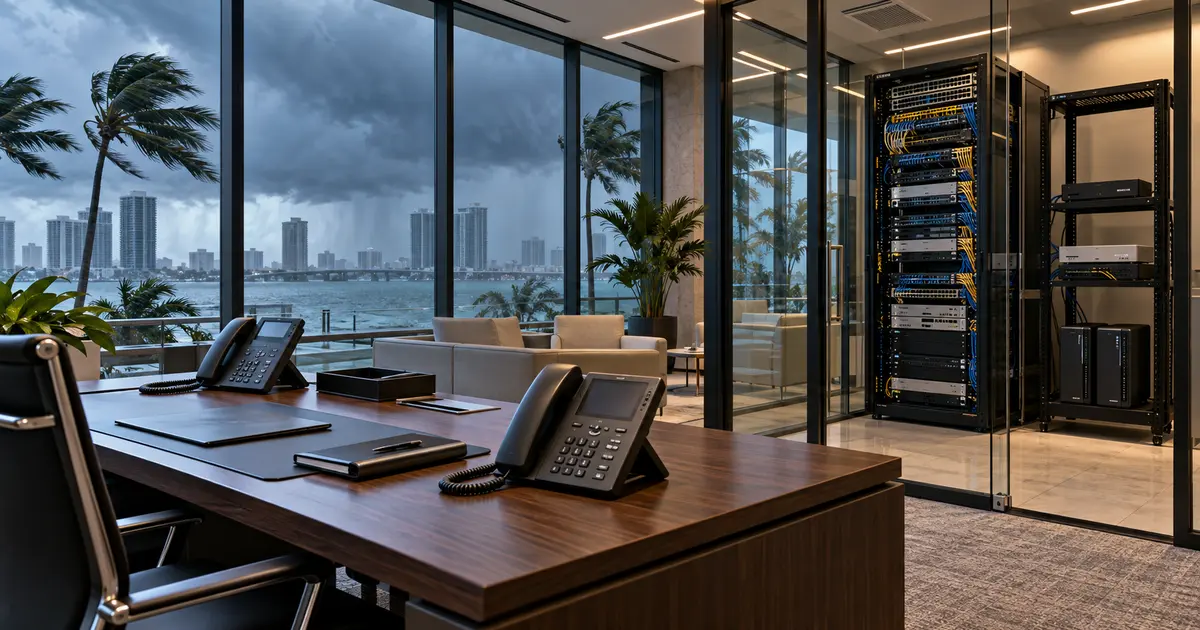
When a South Florida business loses internet service, power or access to its primary office, the phone system can fail at the exact moment customers need answers. A resilient business phone plan is not just a backup handset. It is a documented way to keep the company reachable, route urgent calls and restore normal operations without guessing.
This guide explains the decisions to make before the next storm, carrier outage or building emergency. For help assessing an existing platform or planning a replacement, visit Sentry Audio Video’s business phone systems page or call (561) 717-3280.
Start with the calls the business cannot afford to miss
Failover should be designed around business consequences, not around a list of hardware. Identify the numbers customers already know, the departments that receive urgent calls and the people who must remain reachable if the office closes. A law firm, medical practice, property manager, construction company and hospitality business will not share the same priorities.
Document the main published number, direct inward dial numbers, after-hours lines, elevator or gate call boxes, fax services that still matter and any alarm or entry systems that rely on telephone connectivity. Decide which calls should ring a mobile app, alternate office, answering service or recorded emergency message. That routing plan becomes the foundation of the technical design.
Separate internet failure from power failure
Cloud and VoIP phone systems depend on a working data path, while every phone, switch, router and firewall still needs power. A second internet connection does not help if the network rack shuts down. A battery backup does not help for long if both internet circuits use the same damaged outside path.
A useful assessment therefore treats power and connectivity as separate risks. The network may need an appropriately sized UPS, surge protection, generator-backed circuits and automatic shutdown planning. Connectivity may need a secondary carrier, cellular failover or a geographically diverse path. The design should state which devices stay online, for how long and what happens when the primary connection returns.
Confirm whether the backup connection is truly independent
Two providers do not always mean two independent routes. Services can share poles, conduits, building entrances or upstream infrastructure. Ask each carrier where practical whether its service enters the property differently and whether the handoff depends on the same power source. In a multitenant building, coordinate with management before assuming a second circuit can follow a separate path.
Cellular failover can be valuable, but it should be tested inside the actual equipment room. Construction materials, low floors and interior closets can weaken reception. The plan should also prioritize voice and essential applications so a backup connection is not overwhelmed by ordinary guest Wi-Fi, video streaming or large cloud backups.
Design call routing for people, not just extensions
During an outage, employees may be working from home, traveling between sites or operating from mobile phones. Confirm that users can sign into the approved mobile or desktop application, that caller ID presents the business number when appropriate and that voicemail remains accessible. Avoid publishing personal numbers as the emergency solution unless the company has explicitly accepted the privacy and continuity tradeoffs.
Build routing in layers. The first layer may send calls to the normal team. The second can reach designated mobile users. The third can go to an answering service or an emergency recording. Assign an owner who is allowed to activate each mode and a second person who can do it if the first is unavailable.
Protect 911 information and physical-location records
Remote work and cloud calling make emergency-location management especially important. A failover plan should not casually move phones or users without checking how emergency calling information is maintained. Confirm the provider’s process for registering locations, updating users and testing permitted emergency-notification features. Requirements and carrier workflows vary, so the business should keep its records current and follow provider guidance.
The same discipline applies to door stations, elevators, gates and other devices that may use a phone service. Do not assume they can be moved to a new carrier or adapter without compatibility testing and any required coordination.
Create a short outage runbook
A good runbook fits on a few pages and answers practical questions: Who declares an outage? Which carrier numbers and account identifiers are needed? How are calls rerouted? Which staff members receive status updates? Who checks that the website, Google Business Profile and customer messages contain accurate information? How is normal routing restored?
Store the document somewhere accessible even when the main network is down. Include a current diagram, vendor contacts, device locations and the date of the last test. Broader network and support responsibilities can be coordinated through business IT and network support and business communications planning.
Test failover before hurricane season and after changes
A design is only credible after a controlled test. Disconnect the primary internet path at an agreed time and confirm that calling, voicemail, mobile applications and essential cloud tools continue as expected. Verify that inbound calls reach the right people, outbound caller ID is correct and the backup connection has enough capacity.
Repeat the test after carrier changes, firewall replacements, office moves or major staff changes. Record what failed and update the runbook. A short scheduled test is far less disruptive than discovering an expired cellular plan or incorrect call route during an actual emergency.
Questions to ask before approving a phone-system failover plan
- Which published numbers and departments must remain reachable?
- What fails if the internet is down but power remains on?
- What stays online if the building loses power?
- Are the primary and backup connections physically diverse?
- Who can change routing, and how will that person authenticate?
- How are emergency-location records maintained?
- When was the complete process last tested?
Plan continuity before the outage
Sentry Audio Video helps South Florida businesses evaluate business phone systems, networks and communications infrastructure as one operating system. The goal is a practical continuity plan with documented routing, appropriate redundancy and a clear support path—not complexity for its own sake.
Schedule a business phone and network assessment: call (561) 717-3280 or request a consultation with Sentry Audio Video.