A camera that misses a critical moment because its signal dropped or its battery ran down is not providing meaningful protection. That is why the decision behind Wired vs. Wireless Sentry Video Systems: Pros, Cons, and Installation Costs deserves more attention than simply choosing a camera model. The right design depends on the property, the level of coverage required, the available infrastructure, and how the system will be monitored and maintained.
For luxury residences, multifamily properties, offices, hospitality spaces, and retail environments, video surveillance should operate as part of a larger security and technology plan. A professionally designed system can provide clear identification, dependable recording, convenient remote access, and a clean installation that respects the architecture of the property.
Wired vs. Wireless Sentry Video Systems: The Core Difference
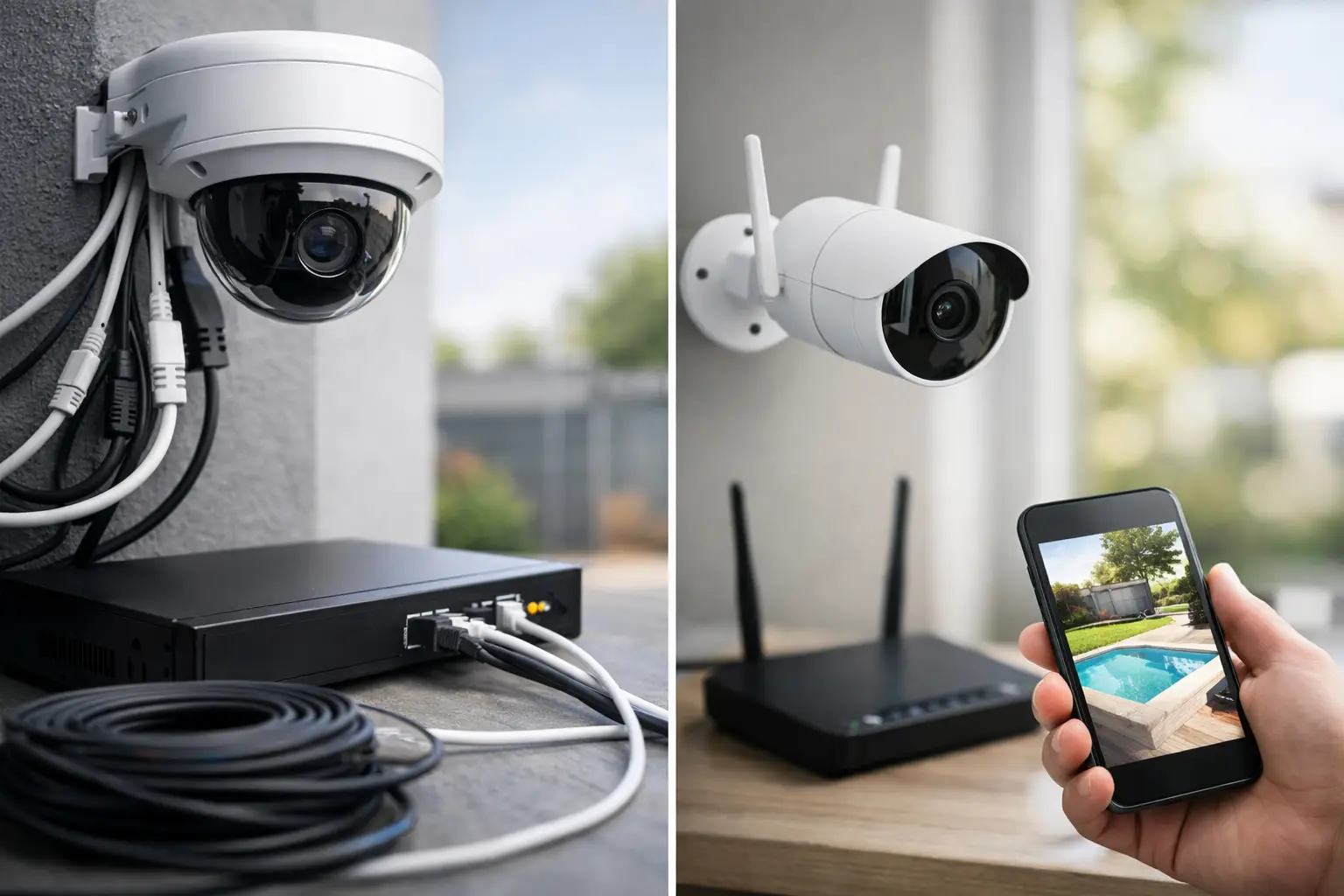
A wired video system connects cameras to the network and usually to power through physical cabling. In many professional installations, Power over Ethernet, or PoE, carries both data and power on a single Category cable. Cameras record to a network video recorder, server, or other managed storage platform connected to the property network.
A wireless system sends video data over Wi-Fi or another wireless connection. Some wireless cameras still require a nearby power outlet, while battery-operated models avoid a permanent power connection. The term “wireless” often refers to the data connection, not necessarily the entire installation.
The distinction matters because video surveillance is not a low-demand application. High-resolution cameras, multiple simultaneous streams, night recording, motion alerts, and remote viewing all place demands on the connection and recording system. A camera can have excellent specifications on paper, but its real-world performance is only as dependable as the infrastructure supporting it.
Why Wired Systems Remain the Standard for High-Performance Security
A wired system is usually the preferred choice when reliability, image quality, continuous recording, and long-term scalability matter most. Each camera has a dedicated physical pathway back to the network equipment, which reduces dependence on wireless conditions that can change throughout the day.
For a home, that can mean consistent coverage at entry gates, driveways, pool areas, perimeter doors, and exterior entertaining spaces. For a business, it can support 24/7 recording at entrances, registers, loading areas, parking lots, corridors, and sensitive operational spaces.
PoE cameras are particularly valuable because one cable supports both power and network communication. There are no batteries to monitor and no individual wireless signal conditions to troubleshoot at each camera location. A properly designed recorder can retain footage for the intended period, while a managed network helps protect video traffic from competing demands.
Wired systems also offer greater flexibility for larger projects. More cameras can be added with thoughtful planning, and higher-resolution or specialized camera types are easier to accommodate. Pan-tilt-zoom cameras, multi-sensor cameras, long-range coverage, analytics, and continuous recording are all more practical when the system has dedicated cabling and professional network design behind it.
The trade-off is installation complexity. Running low-voltage cabling through finished walls, ceilings, exterior structures, or landscaped areas requires planning and skilled workmanship. On a renovation or new construction project, this is often straightforward when structured cabling is incorporated early. In a completed property, the design must account for access paths, architectural finishes, waterproofing, and visual discretion.
Where Wireless Video Systems Make Sense
Wireless cameras can be a strong fit for specific coverage gaps, finished spaces where cable access is limited, or locations where a permanent cable route would be unusually disruptive. They can also be useful as an extension of an existing surveillance plan, provided the wireless network has been evaluated for capacity and signal strength.
The primary advantage is placement flexibility. A camera may be installed in a location that would otherwise require opening walls, crossing hardscape, or navigating challenging construction details. In the right setting, that can shorten the installation timeline and preserve finished surfaces.
However, wireless reliability is highly site-specific. Thick concrete walls, metal framing, impact-rated glass, dense landscaping, neighboring networks, and distance from access points can all affect performance. This is especially relevant in South Florida properties, where concrete construction and expansive outdoor living areas can create difficult Wi-Fi conditions.
Wireless cameras also share network capacity with other connected systems. Video traffic can compete with streaming, smart home controls, guest devices, and business operations if the network has not been designed to separate and prioritize critical services. A professional assessment should determine whether additional access points, network segmentation, or dedicated infrastructure is necessary before relying on wireless cameras for essential coverage.
Battery-powered wireless cameras add another consideration: maintenance. Battery life varies based on recording frequency, temperature, motion activity, settings, and signal quality. They may be appropriate for occasional-use locations, but they are generally not the first choice for a primary access point or a location that requires uninterrupted recording.
Pros and Cons at a Glance
Wired surveillance systems provide the strongest foundation for permanent, high-priority coverage. Their major advantages are stable connectivity, continuous power, consistent recording, higher scalability, and fewer ongoing maintenance demands. Their limitations are the greater planning and labor required to route cables cleanly.
Wireless surveillance systems provide flexibility where cabling is impractical or where selective coverage is needed after construction is complete. Their limitations include dependence on Wi-Fi performance, potential signal interference, power considerations, and reduced suitability for extensive 24/7 surveillance deployments.
Neither approach is automatically right for every property. Many well-designed projects use a hybrid approach: wired cameras at critical perimeter and operational locations, with wireless cameras used selectively where they add value without compromising the overall security plan.
Installation Costs: What Actually Drives the Investment
Installation cost is driven far more by the property and system design than by the camera count alone. Two projects with the same number of cameras can differ substantially depending on cable routes, construction materials, recording requirements, network readiness, and desired image quality.
A wired installation commonly includes cameras, PoE switching, a recorder and storage drives, equipment rack or enclosure space, Category cabling, terminations, mounting hardware, surge protection where appropriate, network configuration, programming, testing, and client training. Labor is influenced by the distance between cameras and the equipment location, whether pathways already exist, and the level of finish work required.
For example, a residence under renovation may allow cables to be routed before drywall and finishes are completed. That typically creates a cleaner, more efficient path to a high-performance system. Retrofitting a fully finished waterfront home may require more detailed routing, specialized exterior work, access coordination, and careful protection of premium finishes.
Wireless installations may reduce cabling labor at individual camera locations, but they are not automatically lower-cost once the full system is considered. If the property needs upgraded Wi-Fi coverage, outdoor access points, managed switching, secure network configuration, additional power outlets, or battery service planning, those requirements affect the total scope.
Recording retention also has a meaningful impact. Continuous recording for multiple high-resolution cameras requires substantially more storage than event-based recording. Businesses may need longer retention periods, user permissions, remote monitoring capabilities, or integration with access control and alarm systems. Those requirements should be defined at the beginning, not after equipment has been selected.
Questions to Resolve Before Selecting a System
The most productive starting point is not “wired or wireless?” It is: what must the system reliably capture, and what happens if it does not? Identify the areas requiring facial identification, vehicle detail, broad situational awareness, or after-hours monitoring. Then consider lighting conditions, camera mounting height, privacy considerations, internet reliability, and the desired retention period.
For commercial properties, clarify who needs access to live and recorded video, whether multiple locations require centralized viewing, and whether surveillance should coordinate with door access, intercoms, alarms, or IT infrastructure. For residences, consider how cameras will fit with gate control, lighting, smart home scenes, and remote oversight while traveling.
A site survey brings these decisions into focus. It reveals cable pathways, Wi-Fi limitations, exterior exposure, camera angles, potential blind spots, and the most appropriate location for recording equipment. It also prevents a common failure point: installing cameras first and discovering later that the network or storage platform cannot support the intended performance.
Build the System Around the Property
The strongest video surveillance systems are designed around risk, architecture, and daily use rather than a one-size-fits-all package. Wired infrastructure is usually the right long-term investment for mission-critical coverage, while wireless solutions can solve selective placement challenges when supported by a properly engineered network.
Sentry Audio Video designs surveillance systems with the same attention to clean workmanship, dependable performance, and integrated control expected throughout a premium home or business. A professional consultation can turn a broad security concern into a clear coverage plan that protects the property without compromising its appearance or usability.