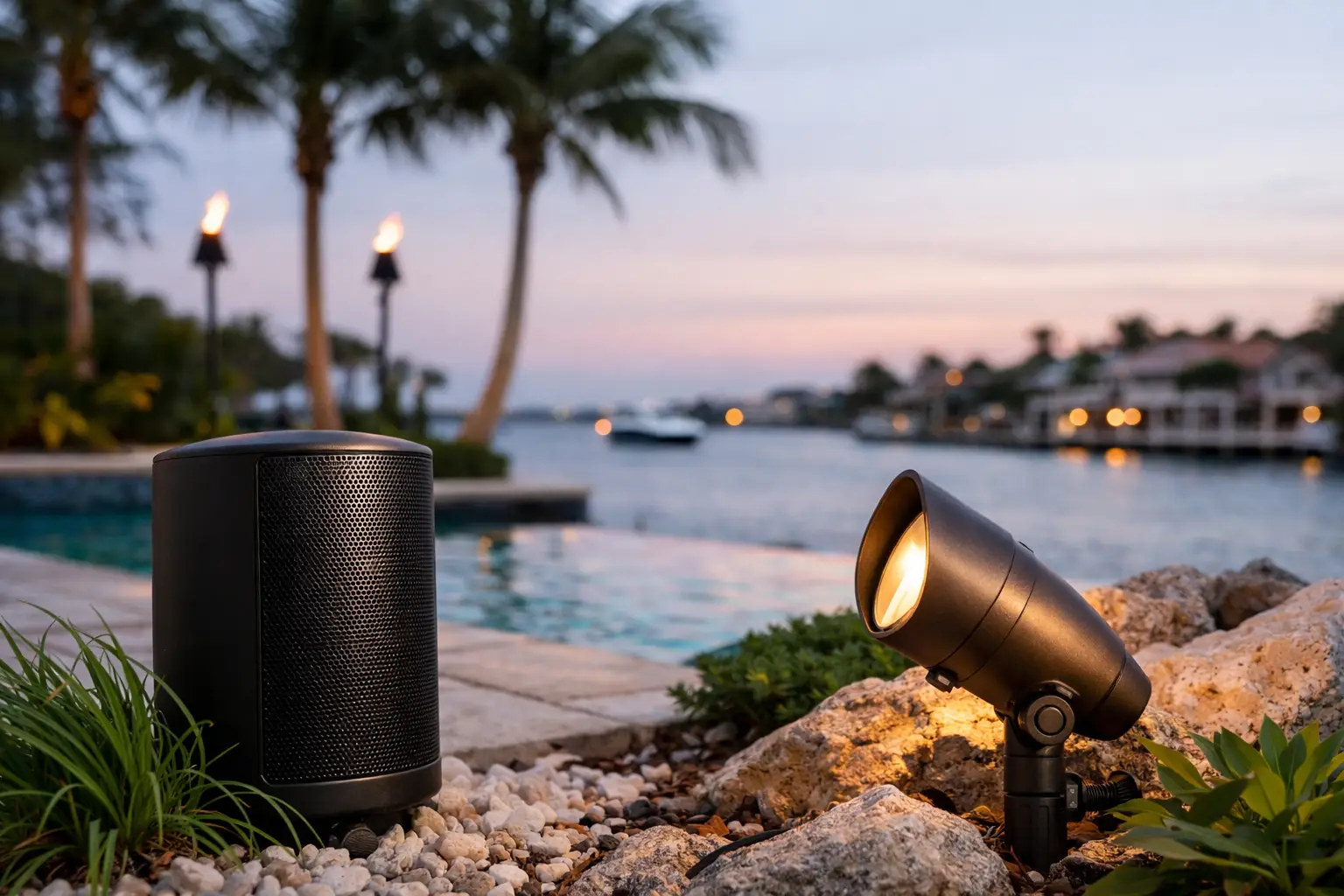
Salt air can damage a beautifully designed outdoor entertainment space long before the equipment appears to fail. In Boca Raton, wind carries microscopic salt particles well beyond the shoreline, where they settle on speaker grilles, landscape fixtures, mounting hardware, control enclosures, and connections. Knowing How to Protect Outdoor Audio & Lighting from Salt Air Corrosion in Coastal Boca Raton is essential when you expect premium performance from a patio, pool deck, terrace, restaurant courtyard, or waterfront property.
Corrosion is not simply a cosmetic issue. Salt attracts moisture, accelerates oxidation, and can create resistance at terminals and connections. That may show up as intermittent audio, dimming or flickering fixtures, discolored hardware, failed controls, or premature equipment replacement. A properly designed system accounts for the coastal environment from the first equipment selection through ongoing maintenance.
Why Salt Air Is So Hard on Outdoor Systems
Boca Raton’s climate creates a demanding combination of humidity, heat, rain, ultraviolet exposure, and airborne salt. Salt deposits do not need direct ocean spray to cause trouble. A property several blocks inland can still experience significant exposure, particularly when prevailing winds move in from the coast.
The problem becomes more severe when salt residue remains damp. Metal components begin to corrode, protective finishes break down, and dissimilar metals can react with each other. This process, called galvanic corrosion, often affects fasteners, brackets, terminals, and mounting points before the visible portions of a system receive attention.
Outdoor audio and lighting also have openings by design. Speakers need acoustic movement. Fixtures need proper heat dissipation. Enclosures need cable entry points. The goal is not to trap every component in an airtight box. It is to select equipment and installation methods that manage moisture, salt exposure, drainage, and ventilation without compromising system performance.
Start With Coastal-Appropriate Equipment
The strongest protection begins with selecting products intended for harsh outdoor environments. An outdoor rating alone is not always enough for a coastal property. Some equipment is suitable for occasional rain but is not built to withstand continuous humid, salt-laden air.
Look for outdoor speakers and lighting fixtures with corrosion-resistant housings, sealed cable connections, and durable finishes designed for prolonged exterior exposure. Marine-grade components are often appropriate for waterfront homes, beachfront properties, and exposed rooftop spaces. They typically use materials and finishes that tolerate salt exposure more effectively than standard outdoor products.
For brackets, screws, anchors, and other mounting hardware, 316 stainless steel is generally preferable in coastal applications because it provides stronger corrosion resistance than common stainless alternatives. Powder-coated aluminum can perform very well when the finish is high quality and remains intact. Brass and certain composite materials may also be useful in the right application.
Material compatibility matters as much as the material itself. Pairing different metals without planning for separation can accelerate corrosion where they meet. A professional design considers the fixture, bracket, fastener, mounting surface, and any isolation materials as one complete assembly.
Choose Ratings That Match the Actual Exposure
An IP rating helps describe protection against dust and water intrusion, while enclosure ratings can identify equipment suited to wet or corrosive conditions. These ratings are useful, but they should not be treated as a complete coastal specification.
A covered patio speaker under a deep soffit faces a different exposure level than a speaker mounted on an open dockside wall. Likewise, pathway lighting near a protected entry does not endure the same conditions as fixtures surrounding an ocean-facing pool. Equipment should be selected according to its exact location, not simply labeled “outdoor” across the entire property.
Protect Outdoor Audio With Better Placement and Connections
Speaker placement is often driven by sound coverage, but in coastal Boca Raton, exposure control should be part of the conversation. Position speakers where they can deliver even coverage while avoiding the most direct rain, salt spray, and afternoon sun whenever possible. Mounting beneath substantial overhangs can reduce exposure, although it does not eliminate the need for coastal-rated hardware.
A clean installation also protects the system. Speaker cable should enter equipment from below where practical, creating a drip loop that directs water away from the connection. Penetrations must be properly sealed, and connections should be housed in weather-resistant junction points rather than left exposed behind a speaker or fixture.
Exterior-rated cable with appropriate insulation helps prevent jacket deterioration and moisture intrusion. Connections should use corrosion-resistant terminals and be installed with service access in mind. When a technician can inspect and maintain a connection without removing finished surfaces or disturbing landscaping, small issues are easier to address before they affect the entire system.
For larger outdoor entertainment areas, centralizing amplifiers, network equipment, and control hardware inside a conditioned interior space is usually the smart approach. This keeps the most sensitive electronics away from heat, humidity, and salt air while leaving only purpose-built speakers, keypads, and outdoor-rated accessories in the landscape or on the structure.
Use the Same Coastal Strategy for Outdoor Lighting
Outdoor lighting systems are especially vulnerable because many fixtures sit low to the ground, near planting beds, fountains, pools, and hardscape surfaces where moisture collects. Salt residue can build up on fixture bodies and lenses, while landscape maintenance and irrigation can introduce additional water to already exposed components.
Specify fixtures with sealed optical compartments, corrosion-resistant bodies, and durable finishes. Coastal-grade landscape lighting is worth considering for path lights, uplights, downlights, and architectural accents that remain outdoors year-round. For wall-mounted fixtures, ensure the backplate and mounting surface are properly protected so water cannot become trapped behind the fixture.
Drainage is a major part of fixture longevity. Recessed lighting, in-ground fixtures, and low-mounted landscape lights need a path for water to move away. Standing water around a fixture can defeat even a well-selected product. Placement should also account for lawn irrigation patterns, since repeated direct spray accelerates finish deterioration and mineral buildup.
Lighting zones should be designed for practical service. A professionally planned system makes it possible to isolate an area, inspect a fixture, and maintain controls without disrupting the rest of the property. This is particularly valuable for large estates, hospitality spaces, and commercial properties where outdoor lighting supports both ambiance and safety.
Create a Seasonal Coastal Maintenance Plan
Even premium outdoor equipment needs regular attention near the coast. The right maintenance schedule depends on proximity to the water, the amount of wind exposure, and how protected each area is. Oceanfront and highly exposed properties generally need more frequent service than sheltered properties farther inland.
A maintenance visit should include a careful inspection of speaker grilles, brackets, fixture housings, lenses, fasteners, cable entries, weather seals, and visible connections. Technicians can identify early signs of oxidation, coating damage, loose hardware, water intrusion, or pest activity before performance is affected.
Salt residue should be gently rinsed from exterior surfaces using fresh water and cleaned according to the manufacturer’s recommendations. Abrasive pads, harsh cleaners, and high-pressure washing can damage protective coatings, force water into seals, or scratch fixture finishes. Cleaning should be deliberate, not aggressive.
For audio systems, maintenance should also include listening tests across zones, checks of amplifier status, network communication, and control responsiveness. For lighting, the review should confirm proper brightness, aiming, scheduling, transformer performance, and zone control. A lighting issue may be caused by a fixture, connection, controller, or programming condition, so treating it as a complete system is more reliable than addressing one visible symptom.
Plan for Service Before the System Is Installed
The highest-performing outdoor systems are designed for serviceability from day one. Equipment should not be permanently concealed in inaccessible cavities or installed where a technician must disturb stonework, ceilings, or mature landscaping to reach a connection. Access panels, equipment locations, labeled cabling, and organized control infrastructure protect the property as well as the technology investment.
This is where custom integration provides a meaningful advantage. The design can balance sound quality, visual discretion, landscape architecture, lighting scenes, weather exposure, and long-term maintenance requirements. A well-planned system does not ask every component to survive the same conditions. It places the right equipment in the right location and protects the infrastructure behind it.
Sentry Audio Video designs and maintains outdoor audio and lighting systems with the same attention to detail applied to the rest of the property. For Boca Raton homes and businesses, a professional site evaluation can identify exposure risks early and create a practical protection plan that keeps outdoor spaces ready to perform through every season.