A beautiful outdoor space should not disappear when the sun goes down. Outdoor Lighting Woodfield Country Club homeowners choose should make arrival safer, highlight the character of the property, and extend the time families spend enjoying patios, pools, gardens, and entertaining areas. The difference is not simply more fixtures. It is a carefully designed lighting system with the right beam placement, color temperature, controls, and professional finish.
For a community where architectural detail and landscaped grounds matter, lighting should feel intentional during the evening without becoming harsh, cluttered, or distracting. A custom low-voltage lighting design brings that balance to life.
Start With the Way You Use the Property
The strongest lighting plans begin with how a household moves through and enjoys the property after dark. A front entry has different requirements than a pool deck. A garden walk needs enough light for confident footing, while a terrace used for dinner parties needs a warmer, lower-glare atmosphere.
This is why fixture counts alone do not define a successful project. A property with too many poorly placed lights can feel flat and overlit. One with too few can leave dark gaps around steps, gates, side yards, and gathering areas. Professional design establishes layers: practical illumination for circulation, accent lighting for landscape and architecture, and ambient lighting for outdoor living.
Before recommending equipment, an experienced integrator should consider sightlines from inside the home, mature landscaping, existing hardscape, drainage patterns, fixture locations, and how the system will be controlled. These details determine whether the finished installation looks refined and performs reliably over time.
Outdoor Lighting for Woodfield Country Club Lifestyle
Outdoor living is a central part of South Florida home design. Lighting should support that lifestyle from the moment a resident returns home through the final evening conversation on the patio.
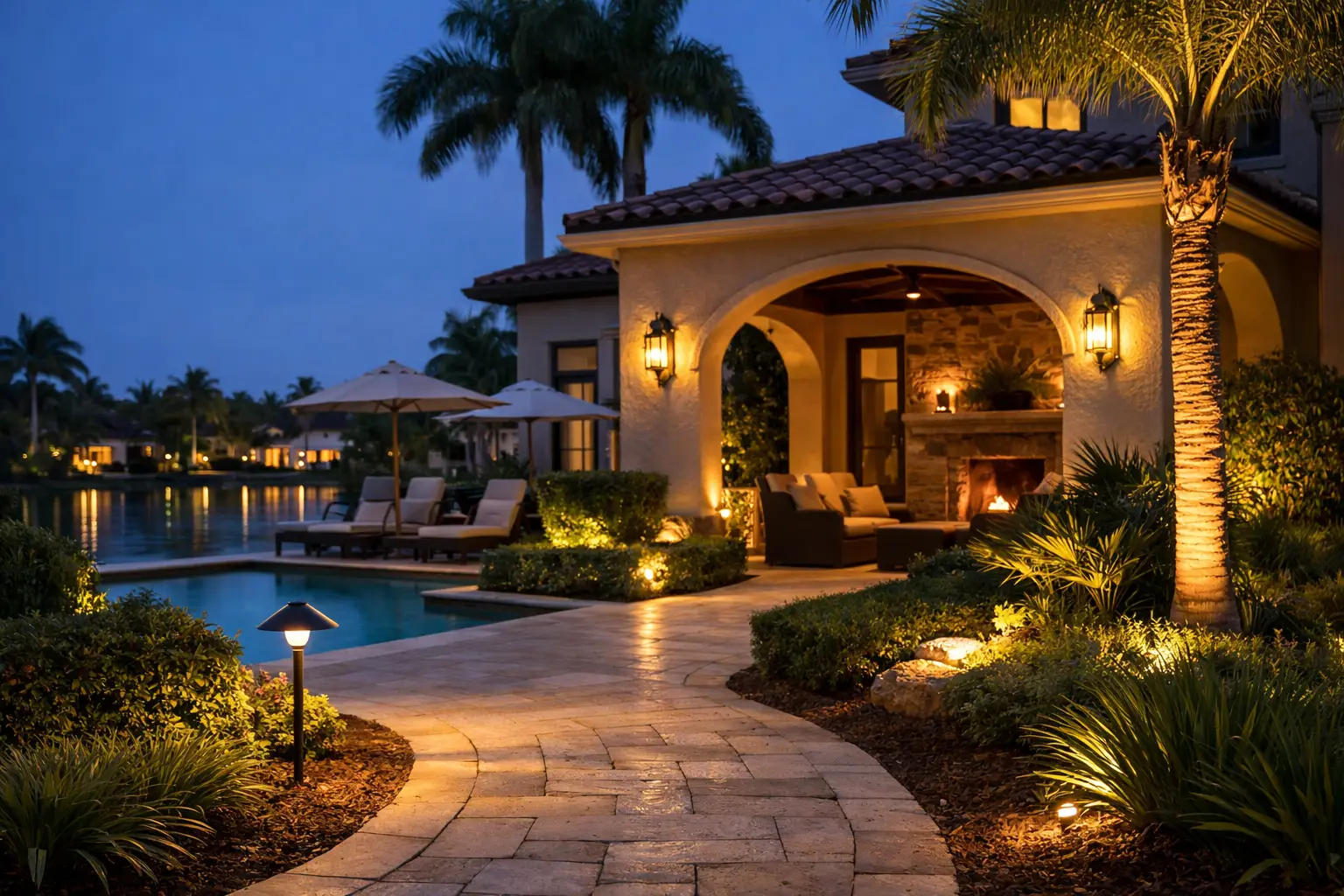
At the front of the property, subtle path and landscape lighting can define the approach without creating a runway effect. Downlighting from carefully selected tree locations can produce a natural moonlit feel over walkways and planting beds. Grazing light across stone, textured walls, columns, or specimen palms adds depth that daylight alone cannot provide.
In the backyard, the focus often shifts to comfort and visibility. Pool perimeters, outdoor kitchens, covered patios, pergolas, fire features, and seating areas each benefit from their own lighting layer. The goal is to create a space that feels inviting from every viewing angle, including from interior rooms looking out onto the landscape.
There is no universal fixture layout for Woodfield Country Club homes. A courtyard residence, an estate with deep landscape setbacks, and a renovated home with a resort-style pool require different solutions. Custom design protects the visual character of each property rather than applying a one-size-fits-all pattern.
Design for Safety Without Flooding the Yard With Light
Security and safety matter, but bright light everywhere is not the answer. Excessive glare can make it harder to see beyond the illuminated area, interrupt the atmosphere of the landscape, and spill into neighboring properties. The better approach is precise, shielded illumination where people walk, enter, and transition between spaces.
Steps, elevation changes, gates, side-yard routes, and transitions between patio materials deserve special attention. Fixtures should reveal these areas without shining directly into someone’s eyes. In many cases, integrated step lights, low-level path lights, and carefully aimed downlights are more effective than broad, exposed floodlighting.
The entrance also deserves thoughtful planning. Visitors should be able to identify the front walk and door clearly, while the home’s architecture remains the focal point. Lighting around access points can work alongside a professionally integrated surveillance and security system, giving homeowners both visual comfort and better awareness of activity around the property.
Fixture Quality Shows After the Installation
The polished appearance of outdoor lighting depends as much on what happens below ground and behind the scenes as it does on the fixtures seen at night. Wiring routes, connection methods, transformer capacity, voltage management, zoning, and fixture aiming all affect long-term system performance.
Premium outdoor-rated components are designed to stand up to heat, humidity, rain, irrigation, and the demanding South Florida environment. Even then, placement matters. Fixtures near dense planting may need periodic adjustment as landscaping grows. Areas exposed to regular sprinkler spray require appropriate planning, and trees that receive downlights need mounting methods selected with care.
Color temperature is another decision that changes the entire result. Warm white light typically complements natural stone, foliage, and residential architecture more gracefully than overly cool illumination. However, the ideal specification depends on the materials, existing exterior lighting, and the desired mood. The right professional will test and aim fixtures on site, then make final adjustments after dark when the actual effect can be evaluated.
Put the Entire Property on One Simple Control System
A lighting system becomes far more useful when it is easy to live with. Instead of walking outside to manage separate zones or relying on a fixed schedule that no longer matches the season, homeowners can bring landscape lighting into the same control experience as interior lighting, motorized shades, security, pool features, and entertainment.
A well-programmed system can provide a few purposeful scenes. “Arrival” can light the entry, driveway approach, and primary paths. “Evening” can shift attention to patio and landscape accents. “Entertain” can bring more definition to gathering areas while preserving a comfortable atmosphere. “Away” can support a lived-in appearance while maintaining essential exterior illumination.
Automation should remain practical. Some homes benefit from sunset-based scheduling, while others need separate controls for the front entry, backyard, and side-yard areas. The right level of programming depends on how often the home is occupied, whether it is used seasonally, and which outdoor zones receive the most use.
Plan Lighting Early in a Renovation or Landscape Project
Outdoor lighting is easiest to design before new hardscape, planting, pool features, and exterior finishes are complete. Early planning allows wiring to be routed cleanly, fixture locations to align with the finished landscape, and control infrastructure to be incorporated without visual compromise.
That does not mean an existing property cannot be upgraded. Many homes can receive a major improvement through a carefully phased installation. The key is to start with the highest-impact areas: arrival paths, front architecture, primary backyard circulation, and the outdoor living zone. Additional landscape accents can be added as the property evolves.
Coordination also matters when outdoor lighting is part of a larger technology project. Audio for the patio, distributed video, surveillance cameras, pool integration, Wi-Fi coverage, and centralized control all benefit from a unified plan. Working with one accountable integration partner reduces conflicting equipment choices and keeps the finished environment clean and intuitive.
What a Professional Lighting Consultation Should Cover
A productive consultation goes beyond asking where a homeowner wants lights. It should identify the property’s visual priorities, safety needs, operating preferences, and future plans. The design team should walk the site, review potential fixture locations, discuss control options, and explain how lighting will change after dark.
Homeowners should also expect a clear proposal that distinguishes the system components, installation scope, and areas covered by each zone. This creates a better foundation for decisions and helps prevent surprises during installation. After commissioning, final nighttime adjustments are essential. A fixture that appears correctly placed during the day may create unwanted glare or miss its intended architectural feature after sunset.
Sentry Audio Video approaches outdoor lighting as part of a complete living environment, with professional design, clean installation, integrated control, and continued support. For Woodfield Country Club homeowners, the right lighting plan turns the property’s evening hours into one of its most impressive features.