A security camera can record an event perfectly and still fail at the moment protection matters most. By the time someone reviews footage, the person who entered the property may be gone. Deep Sentinel Boca Raton solutions are designed around a different objective: identifying concerning activity at the perimeter and bringing live human attention into the response process before an incident escalates.
For homeowners, estates, offices, and hospitality-oriented properties, this model can be a meaningful addition to a professionally designed surveillance system. It is not a substitute for thoughtful camera coverage, access control, lighting, and reliable network infrastructure. It is a layer that can make those investments more proactive.
What Makes Deep Sentinel Different
Traditional video surveillance is primarily forensic. Cameras capture video, store it locally or in the cloud, and provide evidence after an event. Notifications may alert an owner or manager to motion, but they can also create a stream of activity that is difficult to evaluate in real time.
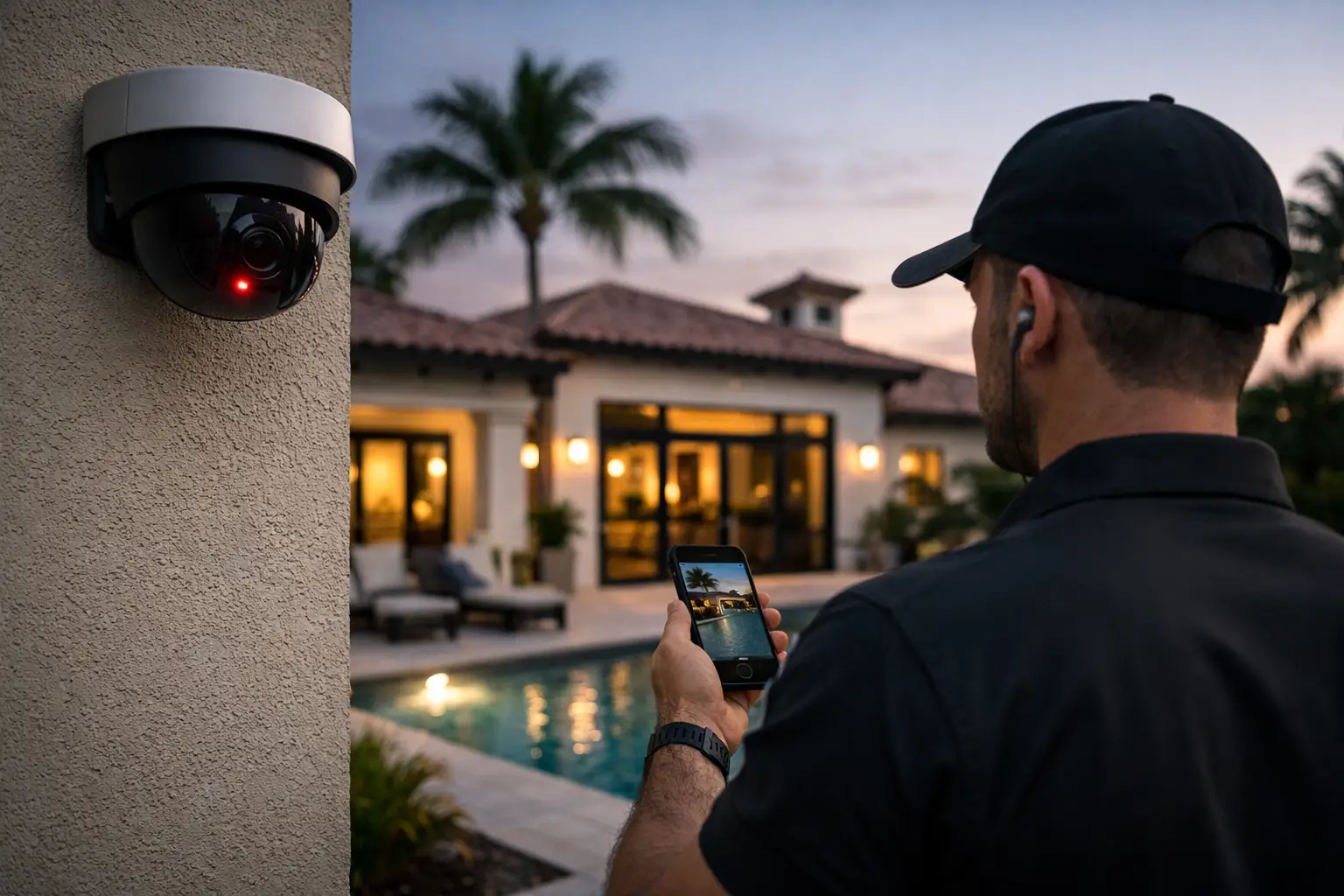
Deep Sentinel combines AI-based event detection with live monitoring by trained security personnel. When the system identifies activity that may warrant attention, live guards can review the situation and, when appropriate, communicate through on-site speakers to challenge an intruder. For verified threats, the monitoring team can follow the applicable escalation process, which may include contacting local law enforcement.
That distinction matters. The goal is not simply to produce more alerts. It is to create an informed response to meaningful activity while filtering out much of the routine movement that occurs around a property.
The outcome depends on the installation. A camera aimed at a busy sidewalk, a swaying palm, or a pool area with frequent family activity has a different operating profile than a camera protecting a side gate, service entrance, detached garage, or rear patio. Proper system design determines whether live monitoring becomes a valuable safeguard or an unnecessarily noisy source of notifications.
Where Deep Sentinel Boca Raton Fits Best
Boca Raton properties often have features that deserve more than basic front-door coverage: long driveways, side-yard access, expansive rear elevations, waterfront boundaries, guest houses, pool areas, and detached structures. Commercial properties may have receiving doors, employee entrances, parking areas, outdoor dining spaces, or equipment locations that are difficult to supervise after hours.
Live perimeter monitoring is especially compelling where there is a clear boundary between normal activity and suspicious activity. A side gate that should remain closed overnight is a strong candidate. So is a rear entry that has limited visibility from the street. For a business, an access point near stored inventory or a secluded service corridor may benefit from immediate human review.
It may be less appropriate to treat every camera as a live-monitored camera. High-traffic entrances, heavily used pool decks, and areas where staff, guests, family members, or service professionals are continually moving can require a more selective approach. The strongest designs use live monitoring where it provides the most protection and use conventional surveillance elsewhere for awareness and documentation.
Security Starts With the Property Walkthrough
A reliable system begins with a site review, not a camera count. The first question is what needs protection: people, entry points, valuables, outdoor amenities, sensitive business areas, or all of the above. The next question is how someone could approach or leave the property without being seen.
An experienced integrator evaluates sightlines, nighttime conditions, landscaping, gate locations, building layout, and available network pathways. They also consider how residents, staff, and visitors use the space. A camera placed solely for an attractive wide view may miss the facial detail, approach path, or trigger zone that makes the footage useful.
For exterior coverage, the most effective plan frequently focuses on choke points. These include driveway approaches, pedestrian gates, side passages, rear entries, and transitions between the home and outdoor structures. Coverage should overlap where practical so that one camera does not become the single point of failure for a critical area.
Camera height and angle require balance. A camera mounted too high may provide an excellent overview but poor identification. One mounted too low can be easier to tamper with or obstruct. Placement should also account for direct sun, reflective water, landscape lighting, and seasonal vegetation growth. South Florida weather adds another practical requirement: outdoor components and their connections must be selected and installed with heat, moisture, and storm exposure in mind.
Network Reliability Is Part of the Security System
Live monitoring depends on more than cameras. It depends on stable connectivity, sufficient bandwidth, proper switching, protected equipment locations, and power continuity. When the network is an afterthought, even premium surveillance equipment can become inconsistent at the worst possible time.
A professionally integrated design separates and manages security traffic appropriately, uses dependable wired connections where needed, and considers backup power for key components. It should also provide a clear plan for remote access, account permissions, software updates, and service support.
This is particularly important in larger residences with multiple access points, outdoor coverage, and smart home systems sharing the same infrastructure. In commercial settings, the surveillance network must coexist with operations, communications, guest access, and other business-critical systems. The right design protects performance without making daily management complicated.
Integrating Live Monitoring With a Complete Security Strategy
Deep Sentinel can be a powerful component, but it performs best within a coordinated security plan. Cameras should work alongside professionally designed intrusion detection, video recording, access control, perimeter gates, and controlled exterior lighting. Each system has a distinct role.
An alarm system can detect a door, window, or interior zone breach. Access control can identify who entered and when. Recorded video can preserve a detailed account of an incident. Live monitoring can add a real-time layer outside the building, where deterrence may be possible before someone reaches the structure.
For residential clients, centralized control can simplify the experience. Security status, cameras, gate control, exterior lighting, and selected alerts can be organized into a coherent interface rather than scattered across unrelated applications. The goal is not to put every function on one screen for its own sake. It is to make the system intuitive enough that it will be used consistently.
For businesses, the emphasis may shift toward operational accountability. Owners and authorized managers may need to review activity at specific entrances, verify opening and closing procedures, and maintain visibility across multiple areas without relying on a patchwork of standalone platforms.
Privacy, Expectations, and Daily Use
Any monitored camera system should be planned with privacy and clear expectations in mind. Cameras should be positioned to protect the property, not to capture private neighboring areas. For commercial locations, signage and policies may be appropriate depending on the setting, coverage areas, and local requirements.
Residents and staff also need to understand how the system will behave. Who receives alerts? Who has access to live video? What should happen when a trusted service provider arrives? Are there areas or schedules where monitoring rules need special consideration? These details should be addressed before installation, not after the first avoidable alert.
A well-configured system becomes part of a property’s normal rhythm. Family members can arrive without confusion, authorized employees can follow clear access procedures, and owners can feel confident that the areas requiring heightened attention have a defined response plan.
Choosing the Right Installation Partner
The technology is only one piece of the decision. Installation quality, camera placement, network design, programming, and ongoing support determine the experience over the long term. A security partner should be able to explain why each device is located where it is, what coverage it provides, and where its limitations are.
Sentry Audio Video approaches surveillance as part of a complete technology environment. That means coordinating security with structured cabling, network infrastructure, smart home control, outdoor spaces, and the performance standards expected in a refined home or professional business setting.
Before moving forward, ask for a property-specific plan that identifies protected areas, likely approach paths, live-monitoring zones, recording coverage, network requirements, and the service process after installation. A clear design gives you more than cameras on a wall. It gives you a security system built to respond when attention matters most.