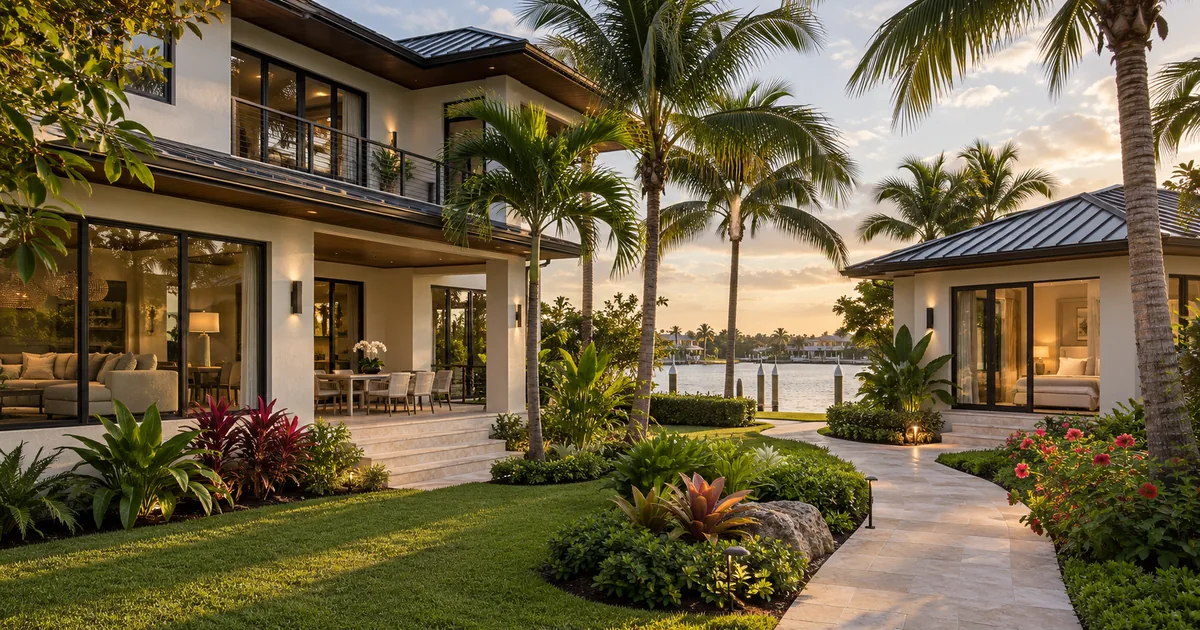
A detached guest house changes a Control4 design in a way that adding another bedroom does not. Equipment may sit in a different building, the connection between buildings becomes important, and guests may need simple local operation without managing the main residence. Before selecting controllers, decide what each building must operate and where those physical connections terminate.
For a new estate in Miami or Miami Beach, the useful starting question is not how many controllers fit the budget. It is which devices need a nearby connection, which can communicate over the network, and what behavior the owner expects when part of that network becomes unavailable.
Start with the equipment in each building
Make two separate equipment schedules: one for the main house and one for the guest house. Include televisions, audio equipment, lighting interfaces, shades, climate interfaces and any other systems included in the project. Record the proposed control method beside each item. A network-controlled device creates a different connection requirement from equipment that needs infrared or a serial connection.
A television and amplifier in a guest-house cabinet may require local connections even when their programming belongs to one larger Control4 project. Conversely, placing equipment in a remote building does not automatically establish that the building needs a particular controller model. The selected hardware, supported drivers and network design must justify that choice.
The schedule should distinguish equipment being supplied now from future allowances. An empty conduit is an expansion provision; it is not a completed control connection or a promise that any future device will work.
Separate the project controller from local connections
Control4 controller selection involves both system responsibilities and physical inputs and outputs. The controller hosting the project and the hardware providing a nearby connection do not have to be described as the same purchasing decision. Depending on the supported design, additional hardware may provide local control connections elsewhere on the property.
Ask the designer to identify the proposed project controller, its location, and the role of every additional controller or interface. The explanation should be understandable without relying on the word “processor” as a substitute for a connection plan. A simple equipment-to-location schedule often answers more than a list of model numbers.
Manufacturer installation and programming documentation should govern the actual arrangement. A generic rule such as one controller per building can result in unnecessary hardware or an incomplete system when the required connections differ from the assumed layout.
Treat the connection between buildings as part of the system
The guest house cannot be designed around an unspecified promise that the property has Wi-Fi. Establish the physical network route, distance, building entry points and equipment at both ends. A site assessment should determine the appropriate link rather than assuming an existing cable or wireless bridge is suitable.
Where a fiber connection is proposed, include the pathway, termination equipment and responsibility for installation. Where another link is proposed, document its practical limitations and service access. The important issue is an agreed, supported connection with a named owner, not simply a fast internet subscription.
Internet service and the local connection between buildings are different dependencies. Losing the internet does not necessarily mean the local network is down. Losing the interbuilding link can affect devices that still have power and local network service inside the guest house. Those scenarios deserve separate discussion.
Define what guests should be able to do
Consider a visitor arriving while the main house is unoccupied. They may need to turn on the guest-room television, choose a source, adjust volume and operate bedroom lighting. Decide whether those activities depend on equipment in the main house and whether the resulting arrangement suits the owner’s expectations.
Local operation should also have sensible boundaries. A guest-facing interface does not need every estate-wide scene or room. Decide which rooms and controls belong in that interface, how housekeeping will operate the space, and who will maintain any required accounts. These are configuration decisions that should be confirmed in the project scope.
Do not describe the guest house as independent merely because it contains another controller. Independence depends on the complete design, including programming, sources, network services and the devices being controlled. Ask for a specific explanation of what remains available in each failure scenario.
Review access before choosing the final locations
The nearest attractive cabinet is not always an appropriate equipment location. Controllers and interfaces need suitable power, ventilation, network connections and service access. A cabinet behind a fixed millwork panel may make a small future service visit unnecessarily disruptive.
The interior designer, electrician and AV team should agree on access before millwork is released. Show where connections enter, how equipment can be removed and whether furnishings will obstruct service. The goal is not to turn the guest house into an equipment room; it is to avoid hiding essential hardware where it cannot be maintained.
Record the final locations in the handover documents. A later technician should be able to identify which building contains the project controller and which device provides each local connection without tracing the property from scratch.
Put the decision into the proposal and acceptance test
Before ordering, request a building-by-building schedule that names the controller roles, connected equipment, interbuilding network provision and operating assumptions. Include a clear responsibility for any trenching, pathways, electrical work or network work outside the AV installation scope.
At acceptance, test ordinary use from the guest house rather than demonstrating only from the main rack. Confirm the intended remote or touch interface, the correct rooms and the expected sources. Have the installer demonstrate agreed dependency scenarios using a controlled service procedure, then record the results and any limitations.
Sentry Audio Video can plan the controller locations and equipment scope as part of a new Control4 installation. For a Miami or Miami Beach property, bring the site plan and the proposed guest-house equipment list to the consultation. Call (305) 502-0003. For related preparation, see our Control4 design guidance and rack planning guide.
Manufacturer and technical references
Technical references reviewed November 19, 2026. Confirm the exact equipment, software and licensing requirements for your project before ordering.
From our Google reviews
“They recently installed a Control4 system at both my home and my workplace, and the entire experience was flawless from start to finish.”
Control4 installation — home and workplace
Google review excerpt