
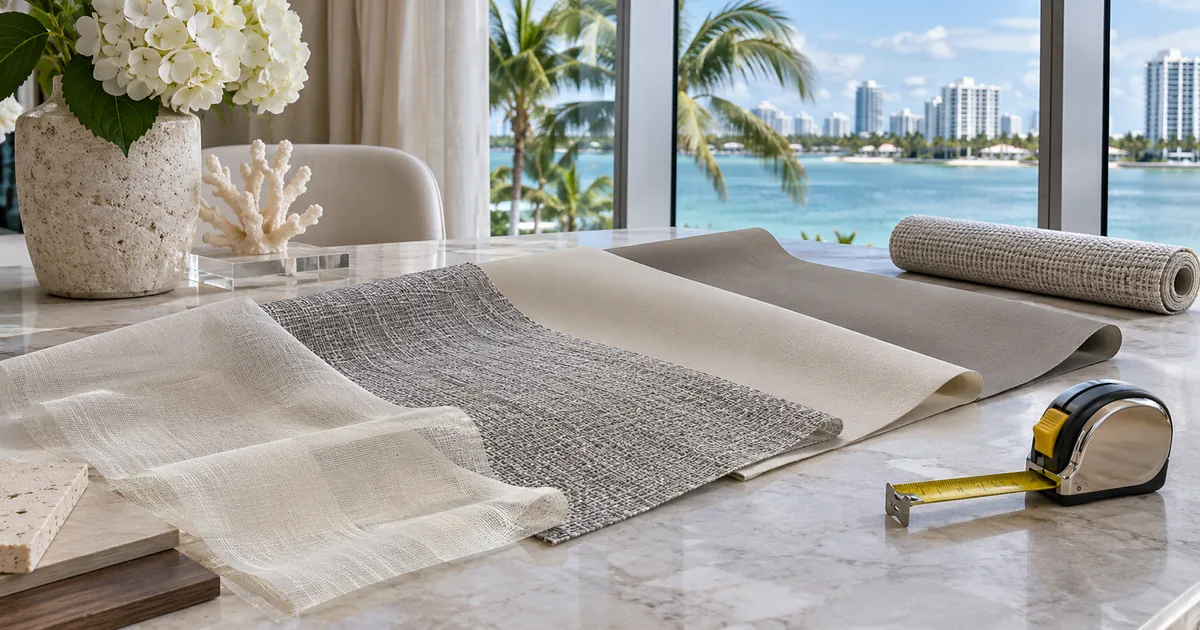
A fabric chosen for a room’s upholstery or drapery may look ideal beside the windows. That does not automatically make it suitable for a motorized roller shade. When a designer wants to supply material for new Lutron shades, the fabric and the shade assembly need a coordinated approval process before the order becomes final.
For a Miami Beach or Palm Beach interior, the goal is to preserve the design intent while confirming that the selected material can be fabricated and operated in the intended application. A sample’s appearance is one part of that decision; its construction and the manufacturer’s review are equally important.
Treat customer-supplied material as a separate purchasing path
Lutron describes a customer’s own material, or COM, process for applicable shade products. It involves identifying the proposed fabric, engineering review and a sample-testing stage. It should not be treated as an ordinary catalog fabric selection with a different supplier name.
Ask the dealer whether the requested material and shade type are eligible for the current process. Do that before the designer purchases production yardage or the client assumes a delivery date. Not every textile or product category is suitable.
The order should identify who is responsible for submitting information, obtaining approvals, supplying material and coordinating fabrication. A designer’s aesthetic approval and the manufacturer’s application approval are different milestones; one does not substitute for the other.
Assemble the actual fabric information
A swatch name is not enough to start a reliable review. Lutron’s published process calls for information about the manufacturer and fabric, including relevant construction and dimensional characteristics. The dealer should use the current submission requirements rather than estimating missing details from a small sample.
Have the supplier provide the exact product identification and current technical information. Confirm that the proposed production material will match what is submitted. A similar color in a different construction may not behave the same way on a roller.
If the textile has a pattern or directional weave, identify its intended orientation. The designer, dealer and fabric supplier should agree on how the material is expected to appear on the finished shade before that appearance becomes a client expectation.
Review the fabric and window dimensions together
The proposed shade width and drop affect whether a material can be used as intended. Available roll width, pattern direction and the selected assembly can constrain the result. Do not approve a room-wide visual concept without checking the actual opening dimensions.
For several adjacent shades, discuss the finished appearance as a group. Pattern placement, material variation and separate assemblies can affect continuity. Ask which details can be controlled in fabrication and which variations need to be accepted as part of the material.
This is especially useful along a large glazed wall. A drawing should show the proposed number of shades and their boundaries. The fabric review should use that arrangement rather than assuming one continuous treatment that the assembly cannot support.
Make sample approval a real project milestone
Follow the manufacturer’s current sequence for review and testing. Lutron’s process describes engineering review followed by a specified sample submission when approved to proceed. The dealer should confirm the current sample requirements and instructions before material is sent.
Do not treat an informal phone conversation or an attractive showroom swatch as final production approval. Keep the relevant written decisions with the project records so the designer and purchaser can see what has actually been accepted.
If a sample or detail is rejected, resolve the reason before buying more fabric. An alternative may involve a different material, a changed assembly or a revised design. The client should understand which part of the original concept has changed and why.
Separate appearance approval from operating performance
The designer can approve color and texture while the dealer reviews how the material is expected to roll, hang and fit the specified treatment. Both reviews matter. A material can coordinate beautifully with the interior and still create an unsuitable shade application.
Discuss the expected visible result, including any relevant limitations identified during review. Avoid promising that a custom material will look or behave exactly like a catalog shade fabric without supporting approval.
Where privacy or light blocking is important, evaluate those requirements separately. A fabric’s decorative role does not establish its performance in a bright bedroom, at night with interior lights on or alongside the proposed window gaps. Record the result being sought rather than relying on a general description such as opaque.
Agree on procurement and replacement responsibilities
Customer-supplied material introduces coordination questions beyond the shade hardware. Who orders it? Who confirms the correct quantity and production lot? Who handles a shortage, damaged shipment or later request for another matching shade? Put those responsibilities in the purchase process.
Ask how custom-material decisions affect the schedule and any order-specific terms. Use the actual supplier and manufacturer information; do not assume a COM order has the same lead time or change options as a standard catalog selection.
Consider keeping documented material identification for future service. A homeowner may want another shade years later, when the original textile is unavailable. Retaining the specification helps explain the options even though it cannot guarantee a future match.
Release the shade order only after the approvals align
Before final release, bring together the approved fabric identification, application approval, final dimensions, assembly selection, mounting detail and control scope. Confirm that the designer’s drawing and the dealer’s order describe the same product and arrangement.
This is the point to resolve any remaining substitution, not after the shade is fabricated. Changes to the fabric, dimensions or assembly should be reviewed through the appropriate process rather than assumed to fall under an earlier approval.
Sentry Audio Video can coordinate new Lutron shade design and installation with your designer and fabric supplier. Call (305) 502-0003 for Miami Beach or (561) 717-3280 for Palm Beach. Bring the fabric identification and window elevations. Our shade fabric guide covers related performance questions.
Manufacturer and technical references
Technical references reviewed November 19, 2026. Confirm the exact equipment, software and licensing requirements for your project before ordering.