A gate arm can stop an unapproved vehicle. It cannot tell a community what happened after a vehicle entered, whether a plate was on an approved list, or which direction a vehicle traveled. That is why the conversation around license plate recognition cameras in gated communities across Palm Beach County has moved beyond basic gate access. Properly designed systems give property managers, boards, and security teams usable vehicle intelligence when it matters.
For a gated neighborhood, condominium community, or private estate enclave, the objective is not to create friction for residents. It is to establish a more accountable entry process while preserving the polished arrival experience residents expect. License plate recognition, often called LPR, can support that goal when the cameras, access rules, retention policies, and operating procedures are designed as one coordinated system.
What License Plate Recognition Cameras Actually Do
A license plate recognition camera is not simply a standard surveillance camera pointed toward a driveway. It is designed to capture readable plate data under demanding conditions, then convert that data into searchable information. The system records the plate number, time, date, direction of travel, and typically an image of the vehicle and its surroundings.
That distinction is significant. A conventional camera may show that a sedan approached the gate at 9:14 p.m. An LPR system can help a manager search for a specific plate, identify every recorded entry or exit associated with it, and provide a clearer starting point for an investigation.
Performance depends on more than software. Plate capture is affected by vehicle speed, camera angle, headlight glare, shadows, rain, gate lighting, lane width, and the distance from camera to plate. Palm Beach County communities also contend with intense afternoon sun and seasonal downpours, both of which make professional camera placement and lighting design essential.
Where LPR Adds Value at a Gated Entrance
The strongest use case is not necessarily automatic access. It is accountability. Communities can use plate recognition to document traffic at resident gates, visitor lanes, service entrances, and exit lanes. When a resident reports a concern, the management team has a practical way to review activity without searching through hours of footage.
For example, a property manager may need to confirm whether a vendor entered through the service gate during an approved window. A board may want to investigate repeated tailgating behind authorized vehicles. Security personnel may receive a plate number connected to an incident and need to determine whether that vehicle was recorded on the property. In each case, searchable plate records can reduce the time required to find relevant video.
LPR can also strengthen vendor and visitor management. A community may choose to maintain lists for recurring service providers, approved residents, or vehicles that require review. The rules should reflect the community’s operating needs. A high-traffic condominium with staffed entry may use LPR primarily for verification and investigations, while a smaller private neighborhood may use it to support gate access decisions.
License Plate Recognition Cameras for Gated Communities in Palm Beach County
The right design begins with traffic patterns, not a camera specification sheet. Each community has different entrance geometry, staffing, visitor volume, and resident expectations. A main gate with two inbound lanes needs a different approach than a narrow service entrance or a shared access road serving multiple properties.
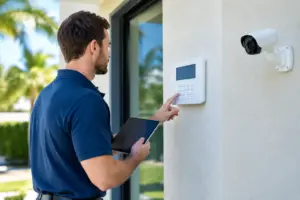
A professional site assessment should consider the camera’s capture zone, the path vehicles take through the lane, and whether the system needs to recognize front plates, rear plates, or both. It should also account for gate controllers, call boxes, credential readers, network infrastructure, power availability, and the location of the recording system.
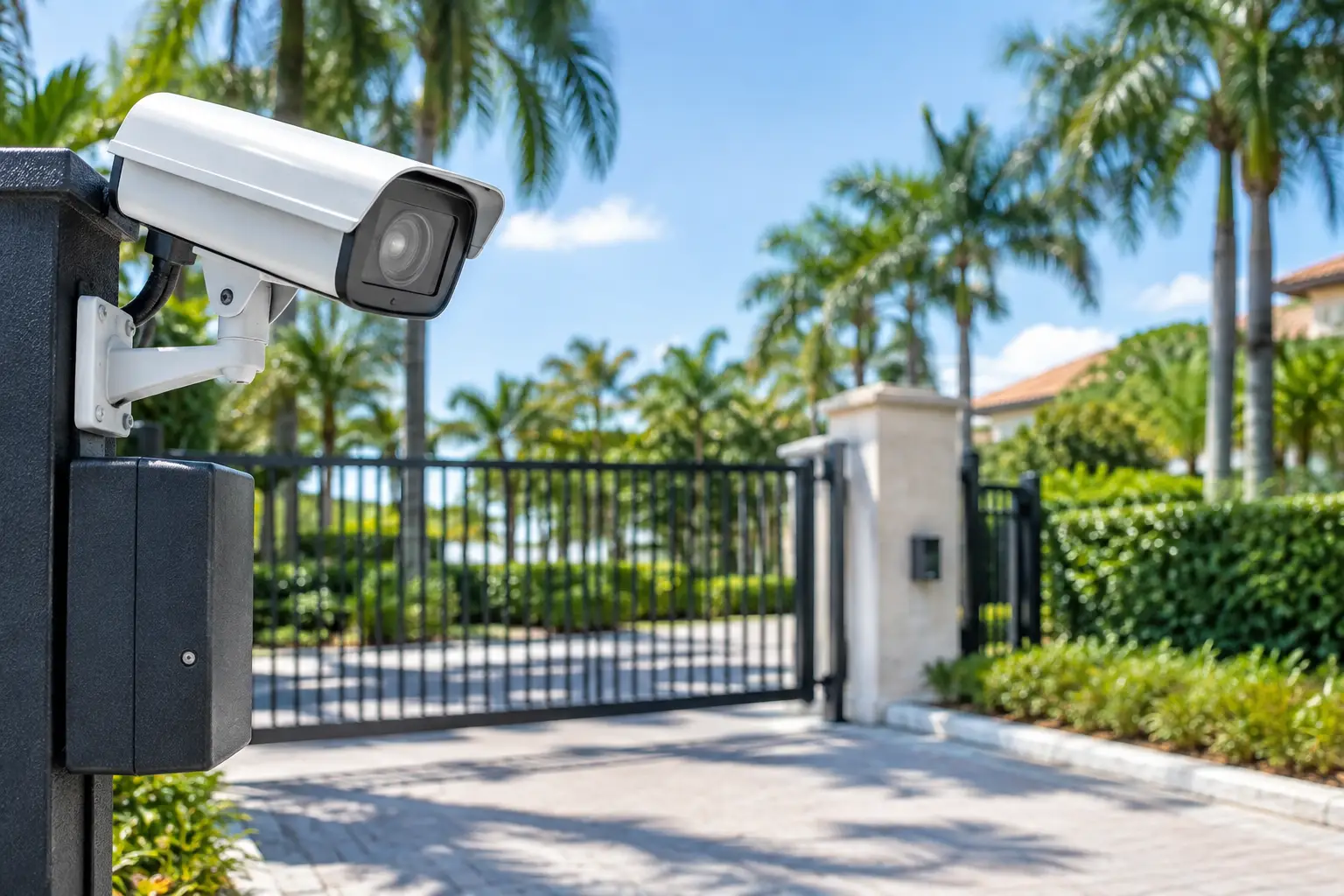
It is easy to overestimate what a single camera can accomplish. A camera mounted too high, aimed across several lanes, or installed far from the point of capture may provide a general view but inconsistent plate reads. In many cases, a dedicated LPR camera paired with an overview camera delivers better operational results. The LPR camera captures the plate, while the overview camera provides context such as vehicle color, occupants, lane activity, and gate behavior.
Access Control Integration Should Be Intentional
Plate recognition can be integrated with existing access control, but automatic opening should be approached carefully. If a recognized plate triggers the gate, the community needs clear rules for how plates are added, changed, removed, and audited. A resident may drive different vehicles. Service providers may change vehicles frequently. Plates can be obstructed, misread, or duplicated in a database through an entry error.
For many communities, LPR works best as one verification layer rather than the sole credential. It can complement a resident tag, keypad code, mobile credential, guard station procedure, or visitor authorization workflow. This layered approach helps balance convenience with control.
The system should also define what happens when a plate cannot be read. The answer might be a credential check, a call-box interaction, or guard review. A good design plans for exceptions instead of treating them as system failures.
Storage, Search, and Alerts Need Clear Policies
A plate database is useful only when authorized staff can search it efficiently and responsibly. Before installation, the association or ownership group should determine who can access records, how long records are retained, and what circumstances justify a search. Management companies, board members, security vendors, and law enforcement may all have different roles, so permissions should be specific rather than broadly shared.
Alerts deserve the same discipline. A community can create notifications for a plate associated with a security concern, but excessive alerts quickly become background noise. Alerts should be limited to defined situations and reviewed by the people responsible for responding. The point is to create actionable awareness, not an endless stream of notifications.
Privacy also deserves careful consideration. Communities should consult appropriate legal counsel regarding policies, signage, record handling, and access to data. Residents are more likely to support an LPR project when leadership communicates the purpose clearly: improving entry accountability, supporting investigations, and protecting the community’s shared environment.
Common Design Mistakes That Reduce Results
The most common problem is treating LPR as an add-on after the gate and surveillance system have already been planned. That often leads to poor camera angles, insufficient network capacity, or recording equipment that cannot support the desired search and retention requirements.
Another issue is overlooking nighttime conditions. Gatehouse lighting, headlights, reflective surfaces, and landscaping can interfere with plate capture. The solution is not always more light. It is the correct combination of camera technology, placement, field of view, and controlled illumination.
Communities should also avoid collecting more information than they can manage. A large plate database without user training, documented workflows, and regular system review can create uncertainty rather than confidence. The system needs an owner, a process for managing approved plates, and a service plan to keep cameras clean, aligned, updated, and recording correctly.
Selecting the Right Integration Partner
An LPR project touches security, networking, video surveillance, access control, and often gate operations. These systems perform best when one experienced team evaluates the full environment rather than treating each element as separate work.
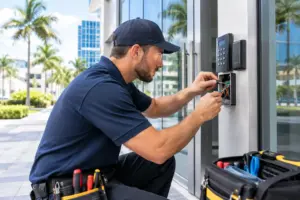
Ask prospective integrators how they validate plate capture at the actual site, not just in a showroom demonstration. They should be prepared to discuss lane coverage, lighting conditions, camera locations, network design, recording retention, remote access permissions, and integration options. Clean installation matters as much as technology selection, particularly at prominent entrances where exposed equipment or improvised wiring can undermine the community’s appearance.
Sentry Audio Video designs integrated security systems with the same attention to performance, workmanship, and long-term support expected in premium Palm Beach County properties. The goal is a system that staff can use with confidence, residents can understand, and management can maintain without unnecessary complexity.
A well-planned LPR system should make the gate operation feel more informed, not more intrusive. When a question arises about a vehicle, a vendor, or an incident, the community should have clear records, a defined process, and technology that performs when called upon.