
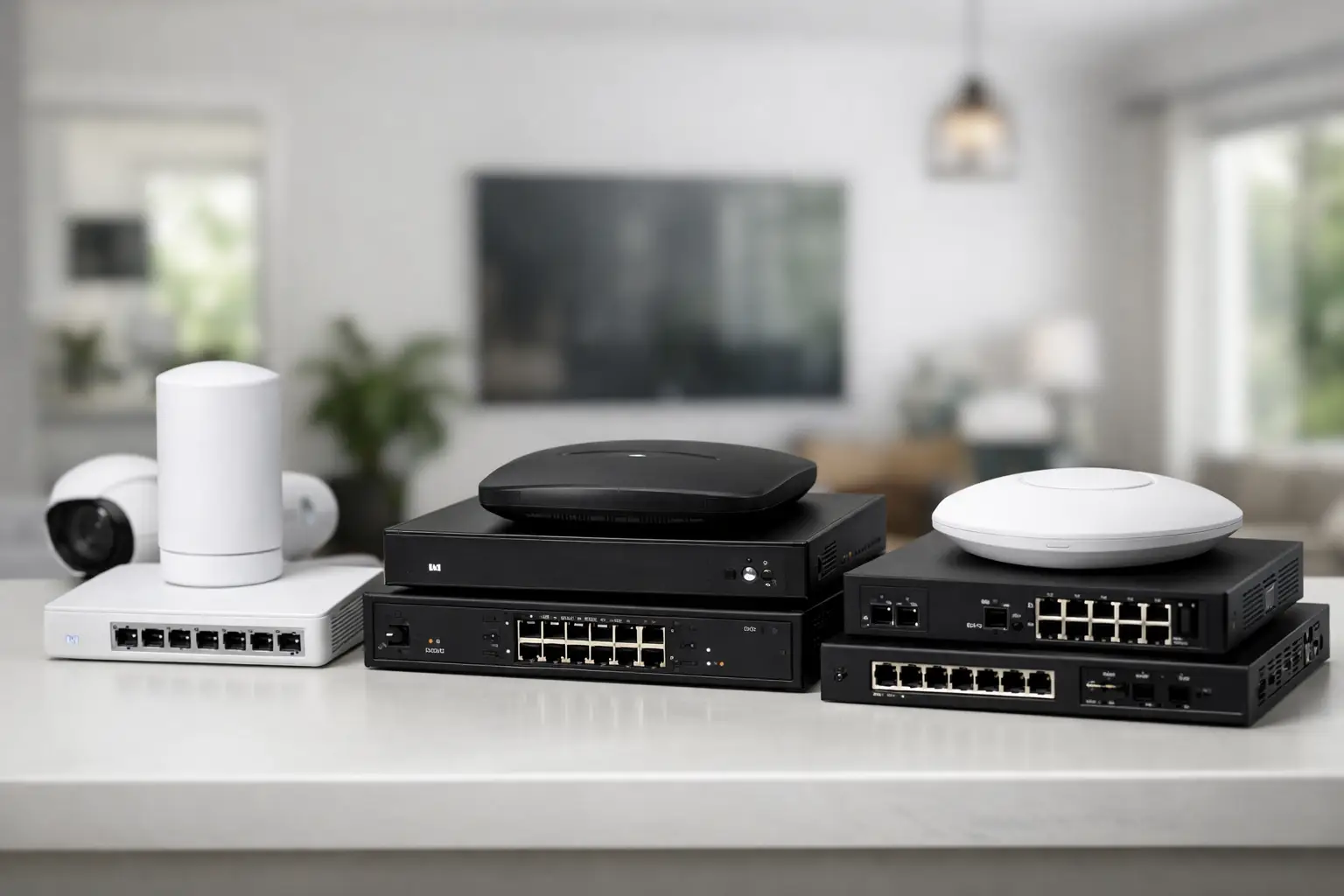
A beautiful home can have fast internet service and still suffer from dropped video calls, buffering in the primary suite, and dead zones by the pool. The Best Wi-Fi System for a Large South Florida Home: Ubiquiti vs Araknis vs Access Networks is not a question answered by the logo on an access point. It is answered by thoughtful design, professionally installed wired infrastructure, intelligent placement, and a support plan that treats the network as the foundation for the entire property.
For homes in Boca Raton, Fort Lauderdale, and surrounding coastal communities, the challenge is rarely square footage alone. Concrete block walls, steel reinforcement, hurricane-rated glass, dense neighboring networks, detached guest spaces, and expansive outdoor living areas can all weaken or complicate a Wi-Fi signal. The right platform matters, but the right network design matters more.
What a Large South Florida Home Needs From Wi-Fi
A professionally designed residential Wi-Fi system should deliver consistent coverage, not simply a high speed test result beside the router. It must support streaming, video surveillance, whole-house audio, smart lighting, automated shades, climate controls, pool equipment, and the many personal devices used by family and guests. Those devices are active throughout the day, often in areas that were not part of the original network plan.
A large property also needs capacity. A single access point may appear to cover a broad area, yet its performance falls apart when many devices compete for airtime through dense walls or at the edge of its range. Properly positioned access points, each connected with wired backhaul, create reliable coverage zones without asking one device to carry the entire home.
This is why a network proposal should begin with a site assessment and architectural review. Floor plans reveal likely signal barriers, but field testing can uncover challenges such as reflective glass, elevator shafts, masonry fireplaces, equipment rooms, and exterior construction materials. The objective is not to place the most access points. It is to place the right number in the right locations.
Ubiquiti: Flexible, Scalable, and Highly Visible
Ubiquiti’s UniFi platform is widely selected for large homes because it provides extensive control, a broad range of access points, and a unified management interface. When properly designed, it can scale from a modest residence to a multi-building estate with indoor, outdoor, and specialty coverage requirements.
Its greatest strength is visibility. A well-configured UniFi deployment gives the service team a clear view of access points, switches, internet performance, connected clients, and potential trouble areas. That visibility is valuable when a homeowner reports that a particular room, dock, or guest house is experiencing inconsistent service. It also supports logical network separation, such as keeping guest Wi-Fi and security devices apart from primary household devices.
Ubiquiti is especially compelling when a property has unusual requirements: multiple structures, extensive outdoor zones, a dedicated office, a large surveillance system, or advanced network segmentation. The platform provides flexibility, but flexibility comes with a responsibility to configure it carefully. Firmware updates, radio settings, security policies, and alerts should be managed under a deliberate service process rather than changed casually after installation.
For the right home, UniFi offers a powerful long-term foundation. It is not automatically the correct answer for every client, particularly when the priority is an integrator-managed ecosystem with the simplest possible service workflow.
Araknis: Built Around the Managed Smart Home
Araknis Networks is designed for professional integration environments, where the network must support the systems that make a home comfortable, secure, and easy to control. Its appeal is not only Wi-Fi coverage. It is the way the platform fits into an integrator’s installation, monitoring, and support process.
For homes with integrated entertainment, automation, surveillance, and remote service needs, Araknis can be an excellent fit. Remote management capabilities allow a qualified service team to review the network, troubleshoot devices, and address many issues without an unnecessary visit to the property. That can reduce disruption for homeowners and accelerate resolution when a connected system needs attention.
Araknis is often a natural choice when the project is centered on a cohesive smart home experience. The installer can design the switching, routing, wireless coverage, and connected control systems as one coordinated environment. It is a polished approach for clients who value a single accountable technology partner.
The trade-off is that Araknis may not be the preferred platform for every highly specialized networking requirement. A home with complex multi-building topology, unusually demanding high-density use, or specific enterprise-style policies may benefit from the broader configuration depth available elsewhere. The right answer depends on the actual property, not a one-size-fits-all specification.
Access Networks: High-Performance Design With a Service Focus
Access Networks has built its reputation around professionally engineered networking for premium residences and demanding connected environments. The brand has traditionally been associated with careful wireless planning, high-performance hardware, and a strong support model for integration partners.
For a large waterfront residence, a multi-level property, or a home where network interruptions affect security, work, entertainment, and automation, that design-first philosophy has real value. The network is treated as critical infrastructure rather than an accessory installed after the rest of the project is complete.
Access Networks can be particularly attractive when the client expects exceptional Wi-Fi performance across difficult areas, including outdoor entertainment spaces, guest accommodations, and portions of the home with dense construction. It is also well suited to projects where documentation, managed support, and rigorous commissioning are priorities.
There is an important practical consideration: product portfolios, support models, and platform roadmaps can change as technology brands evolve. Before selecting Access Networks for a new installation, homeowners should ask their integrator to explain the current hardware path, management tools, warranty coverage, and long-term service strategy. A premium network should be chosen for its ongoing fit, not solely for its historical reputation.
Ubiquiti vs Araknis vs Access Networks: Which Is the Best Fit?
There is no universal winner, because each platform serves a slightly different priority. Ubiquiti is often the strongest choice for flexibility, detailed network visibility, and properties with complex coverage or segmentation needs. Araknis is highly attractive for integrated homes that benefit from an installer-managed platform and coordinated remote support. Access Networks is a compelling option for clients seeking a high-performance, engineering-led network design and a premium service model.
The more useful question is this: what must the network support, and who will stand behind it after installation? A home with several access points and a sophisticated automation system should not be treated like a basic internet setup. It needs a documented network topology, labeled equipment, protected power for critical components, purposeful equipment-rack ventilation, and a service partner equipped to diagnose problems across the entire system.
Design Decisions That Matter More Than the Brand
The Wi-Fi brand is only one part of a successful project. These four decisions have an outsized effect on real-world performance:
- Wired backhaul: Each access point should be connected to the network through structured cabling whenever possible. This preserves capacity and avoids the performance compromises associated with extending coverage wirelessly.
- Access point placement: Equipment belongs where radio-frequency conditions require it, not simply where it is easiest to install. Central ceiling locations are often preferable, while equipment closets, cabinets, and corners are frequent sources of poor coverage.
- Outdoor coverage planning: Pool decks, patios, kitchens, docks, and landscaped areas require purpose-built outdoor access points positioned for coverage and exposure conditions. Indoor Wi-Fi pushed through exterior walls is rarely dependable.
- Professional commissioning: After installation, the network should be tested throughout the property. Roaming behavior, signal strength, channel selection, guest access, and performance in priority rooms all deserve verification.
In South Florida, construction details make these decisions even more significant. Reinforced concrete can sharply reduce signal strength between rooms. Hurricane-impact glass can interfere with coverage to exterior spaces. Waterfront and densely developed neighborhoods may also introduce more competing wireless signals than homeowners expect. A site-specific plan prevents these conditions from becoming recurring service calls.
The Right Investment Is a Network With Accountability
A high-performing network should feel unremarkable because it works consistently. Video surveillance remains connected, music follows the family outdoors, smart home controls respond promptly, and guests can access Wi-Fi without compromising the primary network. Achieving that result requires more than selecting Ubiquiti, Araknis, or Access Networks from a specification sheet.
Sentry Audio Video designs integrated network infrastructure around the property, the connected systems, and the way each client lives or works. Before committing to a platform, ask for a coverage strategy, equipment plan, commissioning process, and explanation of how future service will be handled. Those answers will tell you far more about the quality of your Wi-Fi experience than a brand name alone.