A security camera system should do more than record an incident after the fact. It should help business owners see what is happening across the property, verify alarms quickly, support employees, and provide clear evidence when it matters. Commercial Security Cameras Boca Raton businesses select should be designed around the building, daily operations, and real risks – not chosen from a one-size-fits-all package.
For offices, retail locations, hospitality properties, medical practices, and multifamily communities, camera performance depends as much on thoughtful design and installation as it does on the equipment itself. A professionally integrated system gives management reliable visibility without adding unnecessary complexity to the workday.
What Commercial Security Cameras Need to Capture
The first question is not how many cameras a property needs. It is what each camera must prove. A wide-angle overview camera may show activity in a lobby or parking area, but it may not provide enough detail to identify a face, read a license plate, or document a transaction at a point of sale.
Camera selection should reflect the purpose of the view. Entry points often require clear facial identification. Loading areas may need coverage of deliveries, gates, and vehicle activity. Interior cameras can help document access to inventory, records rooms, or restricted spaces. For properties with multiple entrances or buildings, management may also need a centralized way to review live and recorded video from one location.
High-resolution imaging is valuable, but resolution alone is not the answer. Lighting conditions, camera angle, lens selection, mounting height, and network performance all affect usable footage. A camera aimed into intense South Florida sunlight, for example, needs the right exposure handling to avoid turning faces into shadows. At night, infrared performance and properly placed exterior lighting become equally important.
Commercial Security Cameras in Boca Raton: Design Around the Property
Boca Raton commercial properties often combine polished public-facing spaces with service corridors, parking areas, outdoor amenities, and back-of-house operations. Those environments require different coverage strategies.
A retail storefront may prioritize entrances, registers, high-value merchandise, and rear delivery doors. A professional office may focus on visitor entry, reception, server or equipment rooms, and after-hours access. A condominium or hospitality property may require coverage across gates, common areas, elevators, package rooms, pools, and perimeter zones while respecting appropriate privacy boundaries.
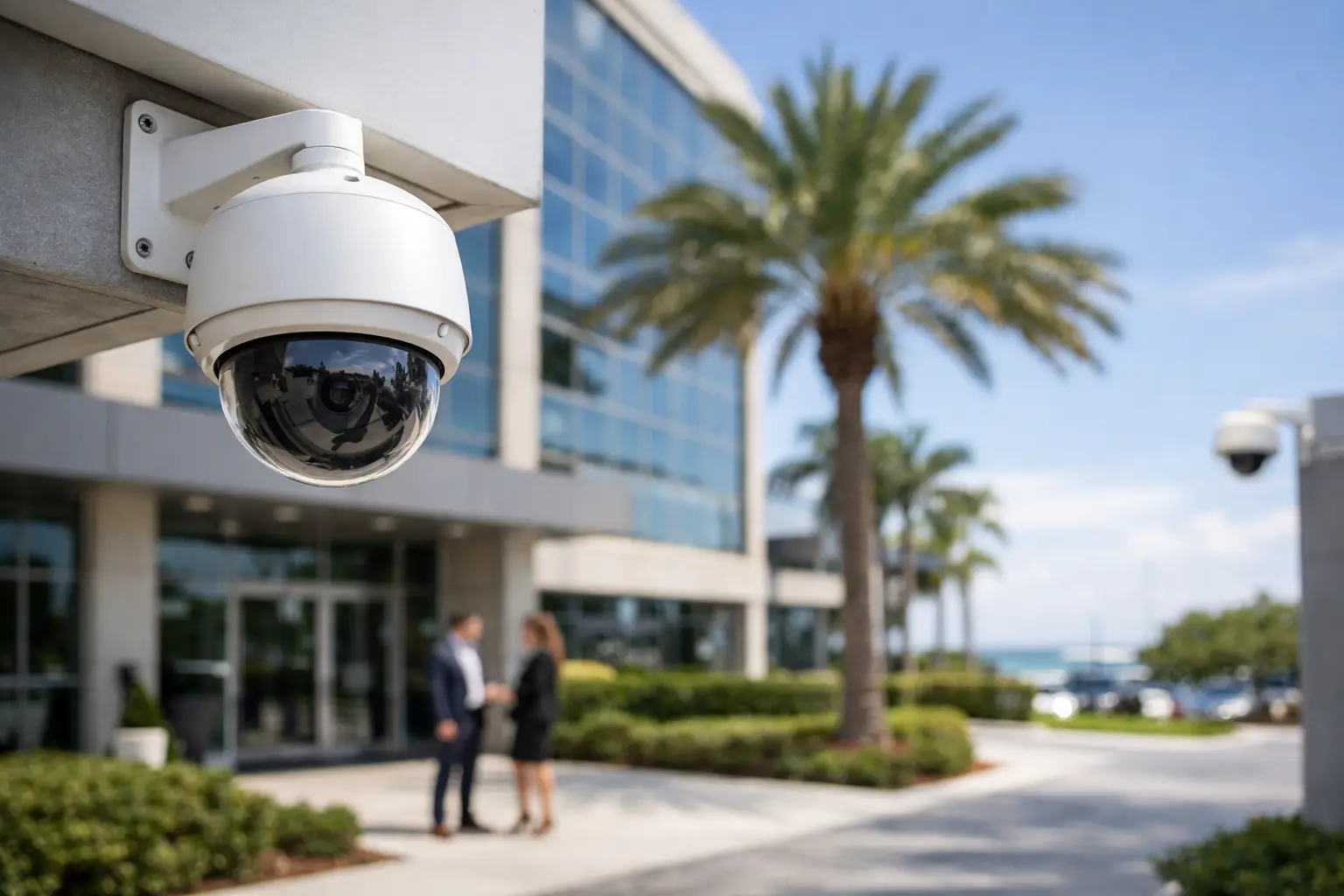
Outdoor camera placement deserves special attention. Cameras need a protected, stable mount and equipment rated for heat, humidity, rain, and coastal conditions where applicable. A clear view of the driveway is not useful if landscaping, glare, or vehicle headlights regularly obscure it. During the design process, a site review can reveal blind spots that are easy to miss on a floor plan.
Integration Makes Video More Useful
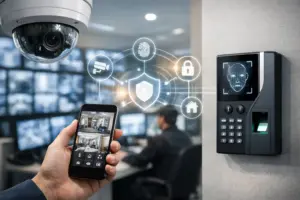
Standalone cameras can record video. An integrated security system can make that video easier to act on. When surveillance is coordinated with access control, intrusion detection, communications, and the property network, business owners gain a clearer picture of an event.
For instance, an access event at a secured door can be paired with video from the same time and location. An alarm notification can direct authorized users to the relevant live camera view. A manager can review a delivery dispute by checking footage from the loading area rather than searching through hours of recordings.
This level of coordination depends on sound infrastructure. Cameras consume network capacity, especially when a system includes high-resolution video, extended retention periods, or many simultaneous views. Structured cabling, managed network equipment, secure remote access, and properly sized recording hardware are core parts of system performance. They should be planned from the beginning, particularly during new construction or a major renovation.
Questions to Ask Before Approving a Camera System
Before moving forward, business owners should be able to get clear answers about coverage, storage, access, and long-term support. Ask how long recorded footage will be retained, who can view or export it, how remote access is secured, and what happens if internet service is interrupted.
It is also wise to discuss expansion. A growing company may later add doors, offices, parking coverage, or a second location. Selecting an architecture that can accommodate future needs helps protect the investment without overbuilding the system on day one.
Finally, clarify the service plan. Cameras occasionally need cleaning, adjustment, firmware attention, or troubleshooting. A system that is installed neatly but never tested again can fail at the worst possible moment. Ongoing support, documented equipment, and a team that understands the entire installation create real confidence.
Sentry Audio Video designs commercial surveillance systems as part of a complete technology environment, with clean installation and dependable performance at the center of every project. The right camera system gives your team visibility when it is needed and confidence that the footage will be there when it counts.