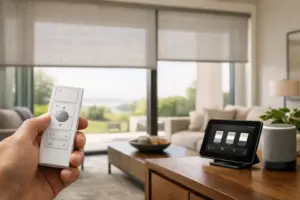

A quiet bedroom can make any mechanical sound more noticeable. When selecting Lutron motorized shades, agree on how operating sound will be demonstrated before ordering. A showroom impression or a manufacturer’s general quiet-operation description is useful context, but the homeowner’s actual expectations deserve a clearer conversation.
The question is not whether a shade can be promised to make no sound. It is what product is proposed, how it will operate in this room and what the owner considers acceptable during the routines that matter.
Describe the bedroom routine first
Ask when the shades will move and who may still be sleeping. A scheduled morning opening, a manual afternoon adjustment and a bedtime closing can produce different expectations. Note whether one shade or several will operate and whether the room is typically very quiet.
Decide which operations need a demonstration: full travel, a short adjustment, startup and stopping. If the owner wants an automated wake-up routine, make that sequence part of the review rather than relying solely on an afternoon showroom demonstration.
Identify the exact proposed shade
The equipment schedule should state the shade family, size, fabric assembly, power approach and mounting arrangement. A demonstration using a different size or product can help explain operation but should be labeled as representative, not treated as proof of an identical acoustic result.
Lutron describes its roller shades as engineered for quiet movement. That manufacturer description should not be turned into a universal promise of silence, nor should a sound figure from one product or test condition be applied to every bedroom installation.
- Which exact shade family is being quoted?
- How closely does the demonstration match the proposed assembly?
- Is the final pocket, fascia or mounting arrangement represented?
- Where will the listener be during the evaluation?
- What remains unverified until installation?
Agree on the demonstration conditions
Listen from the position that matters, such as the bed or a usual sitting area. Note the approximate room conditions and background sound. If air conditioning, music or conversation masks operation in a demonstration, acknowledge that limitation rather than assuming the same impression will hold in a quieter room.
A phone recording can provide a reference, but its microphone processing and playback level do not establish a calibrated sound measurement. If numerical acoustic acceptance is required, agree on the measurement method, equipment and applicable product documentation with the responsible specialist.
Check mounting and finish conditions
The installed shade should be reviewed as an assembly, including brackets and surrounding finishes. Follow the selected product’s installation instructions and verify unobstructed movement. If an unexpected rubbing, vibration or other sound occurs, document the condition and have the installation assessed.
A pre-order listening review does not replace ordinary commissioning. Likewise, commissioning should not assume every objection is a motor defect. The service team needs the exact condition and a reproducible operation to determine the appropriate next step.
Write practical acceptance criteria
- Identify the product and assembly being evaluated.
- Record the demonstrated operations and listener position.
- Describe any material difference from the proposed bedroom installation.
- Agree on final on-site operation and inspection after installation.
- Document concerns promptly and define the assessment process.
- Confirm the approved schedule or manual routine with the homeowner.
Describe expectations in concrete terms instead of relying only on words such as silent or luxury. A written demonstration note helps both the buyer and installer understand what was reviewed and what still requires a final site check.
Compare a representative sample with the proposed bedroom
Imagine a bedroom with three adjacent windows where the owner wants the shades to open early while another person may still be asleep. A single showroom shade moving during a busy afternoon is a useful introduction, but it does not answer every question about that bedroom routine. Ask what the demonstration represents, which proposed operations it includes and what will still need approval in the completed room.
Use an appointment note to record the sample product, the listener's position, the observed movement and the background conditions. Then list material differences from the order, such as the number of shades, assembly sizes or mounting details. The point is to make the comparison honest, rather than reject a useful sample or present it as an identical installation.
For a new shade project, arrange this discussion before the equipment order and final pocket details are approved. For a takeover or replacement project, identify whether the owner is concerned about the existing operating sound, a changed bedroom routine or a newly developed noise. An unexpected sound on an installed shade needs a model-specific service assessment; it should not automatically become a promise that different fabric or programming will resolve it.
Agree who reviews any concern after installation and how the installer will reproduce the reported condition. Record the actual travel and listening circumstances rather than relying on a phone recording played at an arbitrary level. The resulting purchase brief should identify the chosen product, the demonstration's limits and the final on-site acceptance step. It gives the homeowner something more concrete than a general quiet-operation adjective without inventing a universal sound threshold.
Coordinate sound expectations with the whole shade purchase
Room-darkening goals, fabric appearance, power and physical fit still need their own decisions. Keep the acoustic review focused so it adds useful evidence to the purchase instead of becoming another broad shade-selection article. A product can meet one requirement while leaving another unresolved.
Sentry Audio Video provides Lutron shade consultations and installations for South Florida homes. Request a bedroom shade consultation or call (561) 717-3280. Tell us the window arrangement and the bedroom routine you want to support.
Technical reference
Reviewed October 30, 2026: Lutron’s roller-shade product overview. Exact product documentation and an agreed demonstration should govern the proposed installation; no universal in-room sound level is promised here.
Featured image: AI-generated illustration, not a photograph of a Sentry Audio Video project.