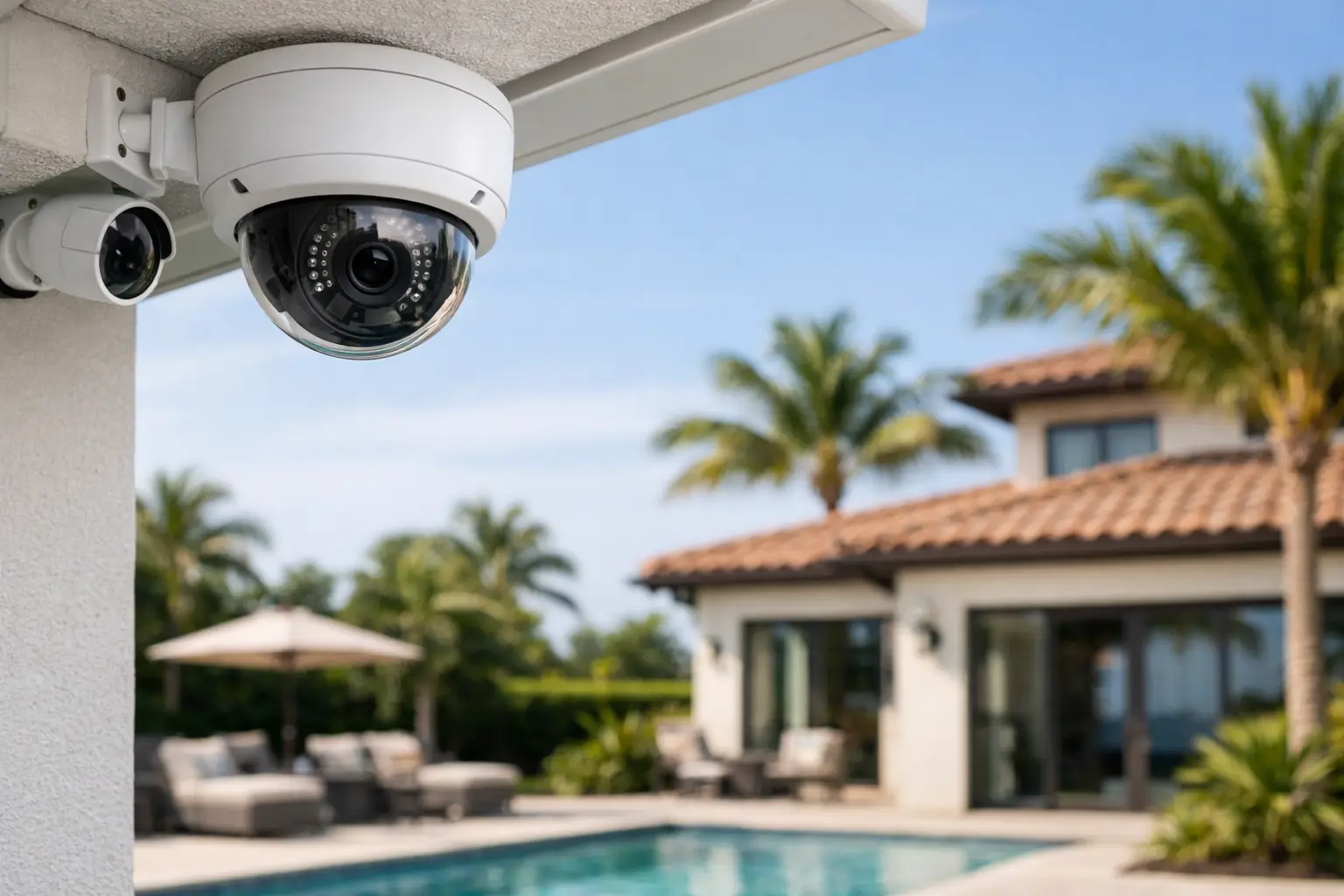
A camera above the front door is not a complete security plan. For many Boca Raton homes and businesses, the meaningful risks are at the side gate, service entrance, rear patio, parking area, elevator lobby, or point where a delivery changes hands. Security cameras Boca Raton property owners depend on should be designed around how the property is actually used, not simply mounted wherever there is an open wall.
A professionally planned surveillance system gives you more than recorded footage after an incident. It provides awareness at the moments that matter, dependable visibility in changing South Florida conditions, and a practical way to check activity from home, the office, or while traveling. The difference comes down to system design, camera selection, installation quality, and support after the project is complete.
Start With Coverage, Not Camera Count
The right number of cameras depends on the property’s layout, sightlines, access points, and level of activity. A large home with a pool area, detached guest space, gated entry, and waterfront exposure has different requirements than a condominium or professional office. More cameras do not automatically mean better protection if they create blind spots, record unusable angles, or make daily review unnecessarily difficult.
A site assessment should identify where people, vehicles, packages, and staff enter or leave the property. It should also account for areas where valuables are stored, outdoor gathering spaces, perimeter transitions, and any location where an event may be difficult to reconstruct later. The objective is to create useful visual coverage, not merely to place equipment in visible locations.
For residences, that often means combining entry-point coverage with deliberate views of driveways, walkways, gates, and backyard access. For commercial properties, the design may also include reception areas, cash-handling locations, inventory rooms, loading zones, common corridors, and parking facilities. Each camera should have a stated purpose: identification, observation, license plate capture, or broad-area monitoring.
Identification Requires a Deliberate View
A wide-angle camera is valuable for seeing activity across a large area, but it may not provide the detail needed to identify a face at a distance. Conversely, a tightly framed camera can capture excellent detail while missing the approach path that explains what happened before someone reached the door.
A well-designed system balances these roles. One camera may establish context by showing a driveway or lobby, while another provides a closer view at the entrance. This layered approach is especially helpful for properties with long driveways, extensive landscaping, multiple building entrances, or active outdoor spaces.
Choose Cameras for the Conditions They Will Face
Boca Raton’s heat, humidity, intense rain, glare, and frequent nighttime transitions can expose weak points in poorly specified systems. Cameras must perform when sunlight reflects off water or pavement, when landscaping moves in the wind, and when a sudden storm reduces visibility. A clear image at noon is only part of the standard.
The right camera type depends on its job. Fixed cameras are often ideal for a specific entrance or corridor because they hold a consistent view. Pan-tilt-zoom cameras can help cover larger exterior areas, but they work best as part of a broader plan rather than as the only camera watching a critical location. Multi-sensor cameras can provide wide coverage of large open areas while reducing the number of mounting positions.
Image quality matters, but resolution alone is not the deciding factor. Lens selection, lighting, camera height, positioning, and video processing all affect whether footage is useful. Placing a camera too high can create an impressive overhead view while making faces difficult to recognize. Positioning it directly toward a bright entryway can leave subjects in shadow. Professional design addresses these variables before installation, not after an event reveals a gap.
Night Visibility Needs More Than Infrared
Nighttime footage is where many systems fall short. Infrared illumination can be effective in dark areas, yet reflective surfaces, glass, rain, and nearby objects can interfere with the image. Exterior lighting, color-capable low-light cameras, and thoughtful angles can often improve clarity significantly.
There is also a trade-off between privacy, illumination, and image quality. A camera should be aimed at legitimate property areas and configured appropriately for its purpose. For businesses, this includes maintaining clear policies around monitored spaces and avoiding areas where privacy is expected. A qualified integrator can help establish sensible coverage boundaries while protecting the property.
Recording, Retention, and Remote Access Are Part of the System
A camera without reliable recording is only a live view. Storage capacity should be planned around the number of cameras, resolution, activity level, recording schedule, and the length of retention you need. A quiet residence may have different storage needs than a busy office, retail environment, or multi-entrance property.
Continuous recording can provide a full timeline of activity, while motion-based recording can conserve storage and simplify review. In many cases, a hybrid approach is appropriate: continuous coverage for critical cameras and event-based recording for lower-priority areas. The correct approach depends on the operational need and how quickly footage may need to be located.
Remote access should be straightforward for authorized users, whether they are checking on a residence during travel or reviewing a business location after hours. It should not require a collection of disconnected apps, uncertain login procedures, or repeated troubleshooting. Access permissions can be structured so that family members, managers, or designated personnel see the functions relevant to their role.
Cybersecurity also deserves attention. Surveillance systems sit on the network and should be configured with secure credentials, appropriate network architecture, current firmware practices, and dependable remote-access methods. This is one reason integrated security planning has value: camera performance, network stability, and remote viewing are closely connected.
Security Cameras Should Work With the Rest of the Property
A surveillance system becomes more useful when it is considered alongside the property’s other systems. At a residence, camera views can be accessible through a centralized control interface, alongside gate access, lighting, motorized shades, and whole-home automation. A homeowner can verify who is at the gate, view a perimeter camera, or check an outdoor area without moving between unrelated platforms.
For commercial environments, cameras may complement access control, intercoms, alarm systems, communications, and structured cabling. A rear-door event, for example, is more useful when it can be associated with an access record and clear video of the area. Integration should serve the way the business operates, not add complexity for its own sake.
The physical installation matters just as much. Clean cable routing, properly weather-protected exterior connections, secure mounting, and organized equipment locations contribute to long-term reliability and the appearance of the property. A premium installation should feel intentional, with technology that performs reliably without distracting from the architecture.
What a Professional Camera Installation Process Should Include
The strongest projects begin with a conversation about the property and the owner’s expectations. Before selecting equipment, an experienced team should understand where concerns exist, who needs access, whether the system will connect with other technology, and what level of ongoing management is appropriate.
A complete process generally includes a walkthrough, coverage plan, equipment recommendation, installation schedule, network and recording configuration, user orientation, and post-installation support. This structure reduces surprises and ensures that every camera, recorder, cable run, and control option supports the original goal.
Sentry Audio Video approaches video surveillance as part of a complete residential or commercial technology environment. That means coordinating security cameras with the infrastructure behind them and delivering an installation that remains easy to use long after the final walkthrough.
When to Upgrade an Existing Camera System
An older system may still record video, but that does not mean it provides the clarity, access, or reliability the property now requires. Common signs include grainy nighttime images, recurring connection issues, limited storage, inaccessible footage, inconsistent mobile viewing, or cameras that no longer cover remodeled areas and changed traffic patterns.
An upgrade does not always require replacing every component. In some cases, existing cabling or equipment locations can support a more capable system. In others, a redesign is the wiser choice, particularly when the property has expanded, landscaping has changed sightlines, or new access points have been added. A professional assessment can clarify which path delivers the most value and avoids carrying old limitations into a new installation.
Your cameras should make it easier to understand what is happening around your property, not create another system that demands attention. A thoughtful design gives you clear views, dependable access, and the quiet confidence that the right areas are covered when you cannot be there.