
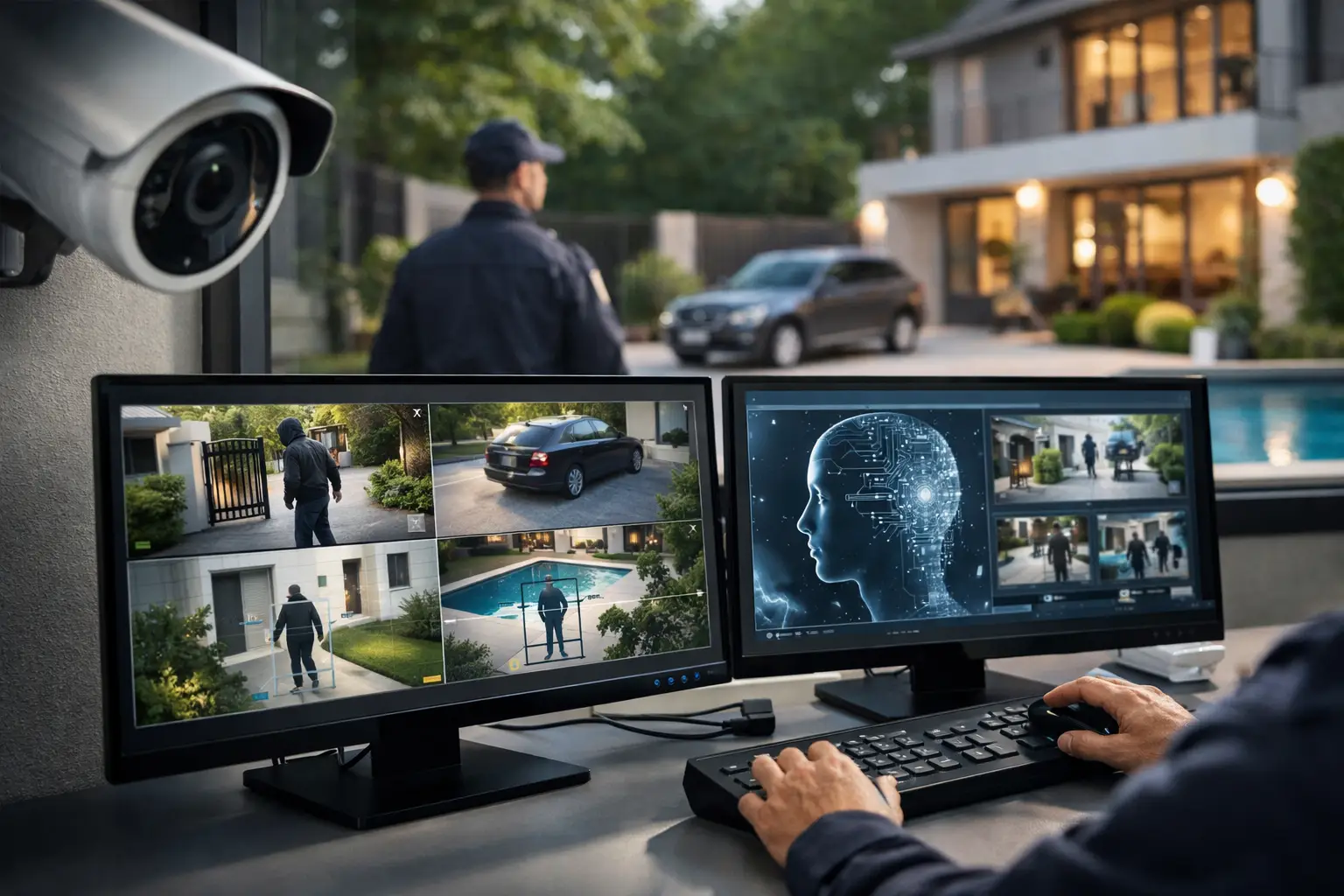
A camera can record an incident. AI video analytics can help you recognize that something requires attention while there is still time to respond. For homeowners and business owners protecting valuable property, people, and operations, that distinction changes the role of surveillance from passive recordkeeping to active awareness.
Traditional video systems often leave users with hours of footage, frequent motion notifications, and little context. A properly designed intelligent surveillance system filters for meaningful activity, helping the right people receive a relevant alert rather than another notification caused by shadows, rain, landscaping, or routine movement.
What AI Video Analytics Actually Does
AI video analytics uses software within a camera, recorder, or connected management platform to interpret what is happening in a video scene. Instead of treating every pixel change as motion, the system can identify and classify objects such as people, vehicles, or packages. Depending on the selected platform and camera capabilities, it can also recognize direction of travel, line crossing, loitering, crowding, and unusual occupancy patterns.
The practical benefit is specificity. A conventional motion alert may tell a property manager that something moved near a rear entrance at 2:14 a.m. An analytics-based alert can be configured to report that a person crossed into a restricted area, while ignoring vehicles on an adjacent street or branches moving in the wind.
This is not the same as replacing human judgment. Analytics identifies patterns and events according to defined rules. A homeowner, security team, manager, or monitoring professional still determines whether the event needs action. The technology improves the quality and speed of the information available to that person.
Why Intelligent Surveillance Matters
Security footage is most useful when it is easy to find and reliable when it matters. For a large residence, multifamily property, office, retail environment, restaurant, or warehouse, manually reviewing video after every concern can consume valuable time. Intelligent search tools can narrow recorded footage by person, vehicle, color, direction, or a defined area of interest.
That can make a real difference after an event. Rather than reviewing an entire afternoon of footage from multiple cameras, an authorized user may be able to search for a white vehicle entering a service drive or a person approaching a side gate. Results will vary by system, scene quality, and camera placement, but the time savings can be substantial when the installation is designed correctly.
Analytics can also improve day-to-day awareness. At a residence, a tailored alert might identify a person entering a gate after hours. At a commercial property, it may notify management when someone enters a staff-only corridor, a vehicle uses an unauthorized entrance, or a delivery area remains occupied longer than expected.
The goal is not to generate more alerts. It is to produce fewer, more useful alerts.
Where AI Video Analytics Delivers Value
Every property has different priorities, so the right analytics rules begin with how the space is used. A waterfront residence may need attention around perimeter gates, docks, driveways, and exterior amenities. A professional office may be more concerned with access points, reception areas, equipment rooms, and after-hours activity. A hospitality or retail location may need a clearer view of entrances, cash-handling areas, employee-only spaces, and parking areas.
Several use cases are especially effective when paired with professional video surveillance design:
- Perimeter protection can identify people crossing a virtual line or entering a defined zone after selected hours.
- Vehicle detection can distinguish cars from pedestrians and help track activity around drive lanes, garages, loading areas, or parking lots.
- Loitering rules can flag prolonged presence near an entrance, gate, restricted room, or exterior access point.
- Object-based search can help locate relevant recorded events without reviewing long blocks of video.
- Occupancy and people-counting analytics can support operational awareness in appropriate commercial spaces.
A well-configured system should reflect normal activity, not fight against it. For example, a front entrance at an active business has a different traffic pattern than a private side gate. The settings, schedules, notification recipients, and retained footage should be planned around the property’s actual routines.
Camera Placement Still Determines Performance
Artificial intelligence cannot correct a poor camera view. If faces are too distant, vehicle plates are unreadable, a scene is heavily backlit, or landscaping blocks the field of view, the analytics engine has less useful information to interpret.
This is why system design matters as much as the camera specification. The right installation considers the purpose of each camera, the height and angle of the mounting location, lighting conditions, network capacity, recording requirements, and the areas that must remain visible at night. A wide overview camera may establish context, while a dedicated camera at a gate, doorway, or driveway may be needed for dependable identification.
South Florida properties present additional design considerations. Intense sun, reflections from water, tropical landscaping, heavy rain, salt exposure near the coast, and frequent outdoor activity can all affect a surveillance scene. Equipment selection and placement should account for these conditions from the start, rather than relying on software settings to compensate afterward.
AI Video Analytics Is Not a One-Size-Fits-All Feature
The term can describe a broad range of functions, and not every feature is appropriate for every property. Object classification and intrusion detection are often highly practical. Advanced facial recognition, behavior analysis, or cloud-dependent tools may involve privacy, policy, reliability, and operational considerations that deserve careful review before deployment.
False alerts are another reality. Even a well-designed system can be affected by changing light, reflections, animals, weather, camera obstructions, or unusual activity. Proper configuration reduces unnecessary notifications, but it does not create perfect certainty. The strongest approach combines thoughtful scene design, realistic rules, periodic system review, and a clear response plan.
Privacy should be addressed just as seriously. Cameras should be positioned to protect legitimate areas of concern without intruding on private spaces. Commercial clients may also need to consider employee communication, visitor policies, signage, retention practices, and access permissions. Limiting who can view, export, or administer footage is an essential part of a professional security strategy.
How Analytics Fits Into an Integrated Security System
Video analytics is most effective when it works alongside the rest of the property’s security and technology infrastructure. An alert from a perimeter camera can be viewed through a centralized control interface, verified from a mobile device, or coordinated with access control and other approved security workflows. Clear notifications, reliable recording, and secure remote access all contribute to a system that is easier to use under pressure.
Network design also plays a major role. High-resolution cameras, continuous recording, remote viewing, and analytics processing require dependable infrastructure. A system should have sufficient bandwidth, organized structured cabling, appropriate power, protected equipment locations, and secure remote connectivity. These details may not be visible after installation, but they directly influence reliability.
For larger homes and commercial properties, scalability matters as well. A surveillance system should be designed with room for future cameras, expanded storage, additional entry points, or evolving operational needs. Planning for those possibilities during a renovation or new construction project can prevent unnecessary disruption later.
Choosing the Right Approach for Your Property
The first question is not which camera has the longest feature list. It is what event you need to detect, where it is most likely to occur, and what should happen after the alert arrives. That conversation determines the camera type, analytics capability, recording plan, network requirements, and user experience.
Sentry Audio Video approaches surveillance as part of a complete, professionally integrated environment. For homes and businesses, that means aligning camera coverage and intelligent alerts with the property layout, daily routines, security priorities, and long-term expectations for performance and support.
The most valuable security notification is the one that provides clear context and arrives when it can still support a decision. With careful design and responsible configuration, AI video analytics can give your property a more watchful, more useful layer of protection.