A smart home should not become harder to live with because the original integrator is unavailable, the system documentation is missing, or a small programming issue has grown into a daily frustration. Savant Repair and Programming in Boca Raton: Existing-System Takeovers Explained begins with a simple fact: a properly installed Savant system can often be restored, improved, and supported without replacing every component in the property.
For many homeowners, the warning signs are familiar. A remote or app controls only part of the house. A room that once worked properly no longer responds. Lighting scenes behave inconsistently, distributed audio drops out, or a new network change has affected control throughout the property. The system may still contain premium equipment and sound infrastructure, but no one has a complete picture of how it was designed.
An existing-system takeover is the professional process of assessing that environment, gaining authorized access, documenting what is present, correcting failures, and establishing a dependable path for ongoing service. It is not guesswork, and it should not start with promises that every issue can be solved remotely or immediately. It starts with a careful evaluation.
What a Savant System Takeover Really Means
Savant is a sophisticated control platform that can bring entertainment, lighting, shades, climate, security, pool features, and other connected systems into one consistent experience. In a well-planned installation, the interface is simple for the homeowner because the design, programming, network, and equipment configuration behind it are not simple.
That complexity matters when the original programmer is no longer servicing the system. Control processors, network settings, user interfaces, equipment drivers, scenes, service credentials, and physical rack connections may all affect performance. A takeover gives a qualified integrator the opportunity to understand those relationships before making changes.
The goal is not to erase a working system and begin again. The goal is to determine what can be retained, what needs correction, and where an upgrade would materially improve reliability or daily use. A strong takeover protects the investment already in the home while bringing accountability back to the system.
Why Existing Savant Systems Lose Reliability
Savant failures are not always caused by a failed piece of equipment. Often, the visible symptom is the result of a larger issue. A room that will not turn on may involve control programming, an IP address conflict, an audio/video distribution path, a network switch, or a device that is no longer communicating as expected.
South Florida properties add practical considerations. Seasonal occupancy, service interruptions, network equipment changes, renovations, storm-related power events, and newly added connected devices can all affect an integrated system. A high-end residence may also have systems installed in stages by different providers. Over time, that can leave programming and infrastructure that no longer align cleanly.
A takeover identifies whether the problem is isolated or systemic. That distinction prevents unnecessary equipment replacement and helps avoid a temporary fix that creates future service issues.
The First Visit: Assessment Before Programming
A professional Savant takeover begins on site. Before changing programming, the integrator should inspect the central equipment location, connected rooms, network infrastructure, control interfaces, and the homeowner’s reported concerns. The purpose is to create a factual baseline.
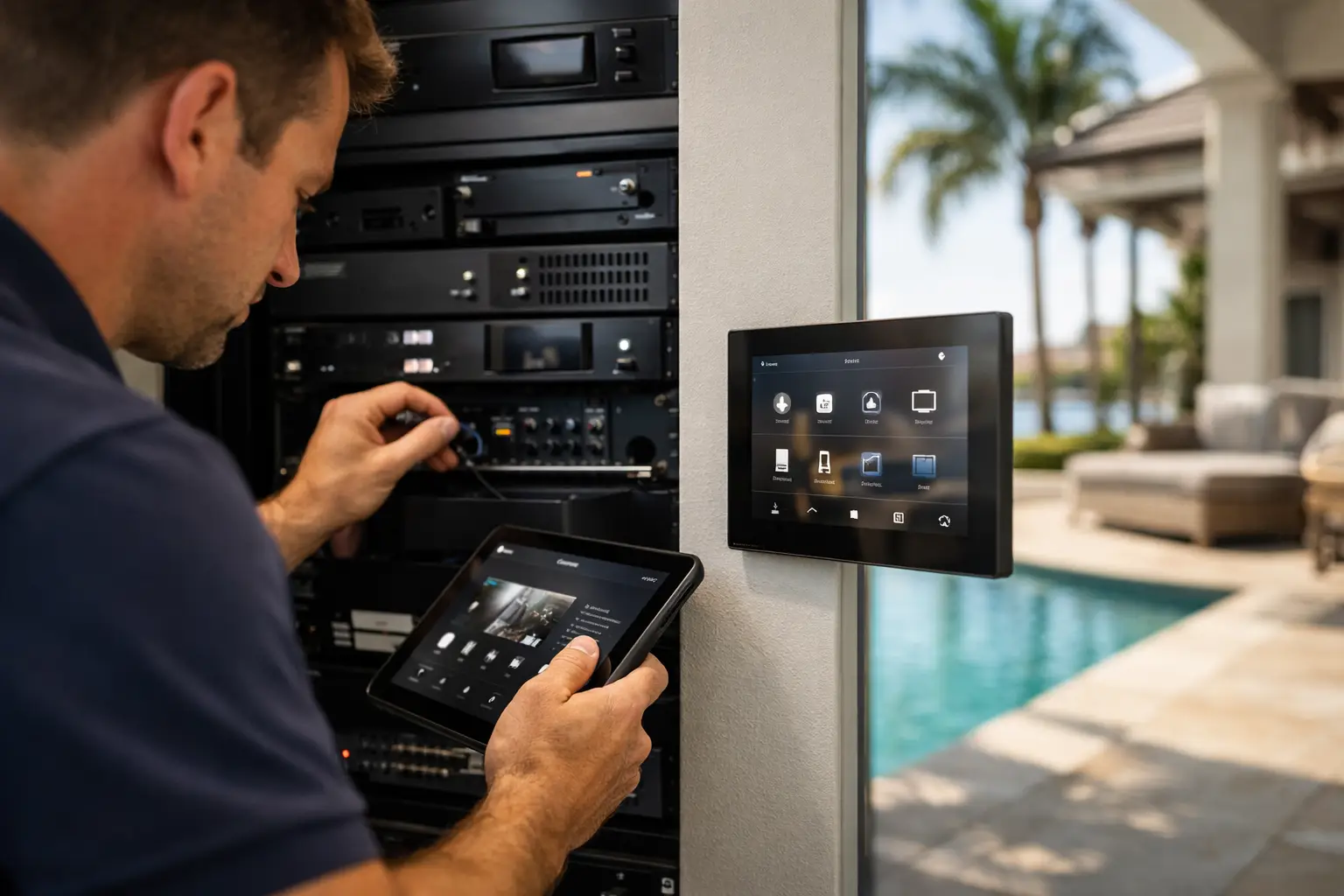
This review typically includes the Savant host and remotes, keypads, touch panels, audio/video sources, distribution equipment, wireless access points, network switches, power conditioning, and any integrated lighting, shading, surveillance, or outdoor entertainment components. The technician also evaluates workmanship inside the equipment rack or enclosure. Clear labeling, proper cable management, ventilation, and accessible connections make future service more efficient. Missing labels and undocumented work do not make a system unusable, but they do require more discovery.
At this stage, homeowners should expect candid guidance. Some systems need limited repair and programming refinement. Others have outdated hardware, unsupported components, or network architecture that should be corrected before the control experience can become dependable. The right recommendation is based on the condition of the property, not a one-size-fits-all replacement plan.
Access, Documentation, and Ownership
Authorized access is one of the most important parts of an existing-system takeover. Without proper access to the Savant configuration and associated network environment, an integrator may be limited in what can be adjusted safely. In some cases, access can be transferred or recovered through the appropriate channels. In others, a portion of the programming may need to be rebuilt.
That is why documentation is more than administrative work. It provides a practical service record for the home. A thorough system record should identify installed equipment, locations, connections, network details, control zones, programmed scenes, and known limitations. It should also note which credentials and licenses are available and which need attention.
Homeowners benefit when their property has a documented technology foundation. If service is needed later, the next visit begins with knowledge instead of investigation. That saves time, reduces disruption, and makes it easier to plan future improvements around the systems already in place.
Savant Repair and Programming in Boca Raton: What Gets Corrected
Once the system has been assessed and access has been addressed, repair and programming work can begin. The exact scope depends on the findings, but it commonly involves restoring communication between Savant and connected devices, correcting control commands, refining room behavior, updating user interfaces, and resolving network-related conflicts.
Programming should reflect how the household actually uses the property. A family may want one-touch access to common entertainment zones, a clear way to manage outdoor audio, and dependable scenes for entertaining. A second home may require straightforward remote monitoring and intuitive controls for arriving guests or property staff. The system should support those routines without burying essential functions behind confusing menus.
This is also the right time to address frustrations that may have existed since the original installation. Examples include remotes that control the wrong source, rooms with unclear naming, lighting scenes that no longer match the space, or interfaces crowded with functions the homeowner never uses. Good programming is not measured by how many buttons appear on a screen. It is measured by whether the right control is available at the right moment.
When Repairs Are Enough and When Upgrades Make Sense
Not every takeover requires a major modernization. If the Savant host, interfaces, and connected equipment remain compatible and stable, focused repair work may be the most sensible approach. Retaining quality components can preserve familiar operation and direct attention toward the actual issue.
There are times, however, when an upgrade is the responsible recommendation. Older control hardware may no longer support current software requirements. Network equipment may lack the capacity or configuration needed for a large connected home. An overloaded rack, unreliable power protection, or aging distribution equipment can also undermine an otherwise well-programmed system.
A professional integrator should explain the reason for each recommendation in plain language. The value of an upgrade is not the new equipment itself. It is the improved performance, serviceability, and confidence that the system will support the home for years to come.
The Network Is Part of the Control System
Many Savant service calls lead back to the network. Smart home control, streaming sources, wireless interfaces, surveillance, and distributed audio all depend on reliable communications. If the network was added later, configured without the needs of an integrated property in mind, or altered by a third party, the effects may appear throughout the home.
During a takeover, the network should be evaluated as a core part of system performance. That includes device addressing, switch configuration, wireless coverage, equipment placement, and the separation of critical systems where appropriate. A stable network does not merely improve app response. It supports dependable control across the entire property.
This is one reason homeowners often prefer a single technology partner. When audio/video, automation, security, and infrastructure are treated as separate problems, responsibility can become unclear. When they are evaluated together, the source of an issue is easier to identify and resolve.
What Homeowners Should Prepare Before a Takeover
A takeover moves more efficiently when the homeowner can share any available project files, equipment lists, original proposals, service records, login details, or notes about recurring issues. Even an old email thread or a list of rooms that are not working properly can help establish history.
It is equally helpful to describe the desired outcome, not only the malfunction. Perhaps the objective is reliable whole-home music, simplified control for guests, better outdoor entertainment operation, or an organized plan for future renovations. Those priorities guide the programming and help determine whether repairs alone will meet expectations.
Sentry Audio Video approaches existing Savant systems with the same ownership mindset applied to new installations: inspect the details, communicate clearly, and build a service plan around the property rather than forcing the property to fit a preset solution. The result should be a system that feels intentional again, with a qualified team accountable for what happens after the first service visit.
A Savant system takeover is ultimately about restoring confidence. With a careful assessment, authorized access, disciplined programming, and dependable infrastructure, an existing smart home can return to doing what it was meant to do: make the property more comfortable, more controlled, and easier to enjoy.