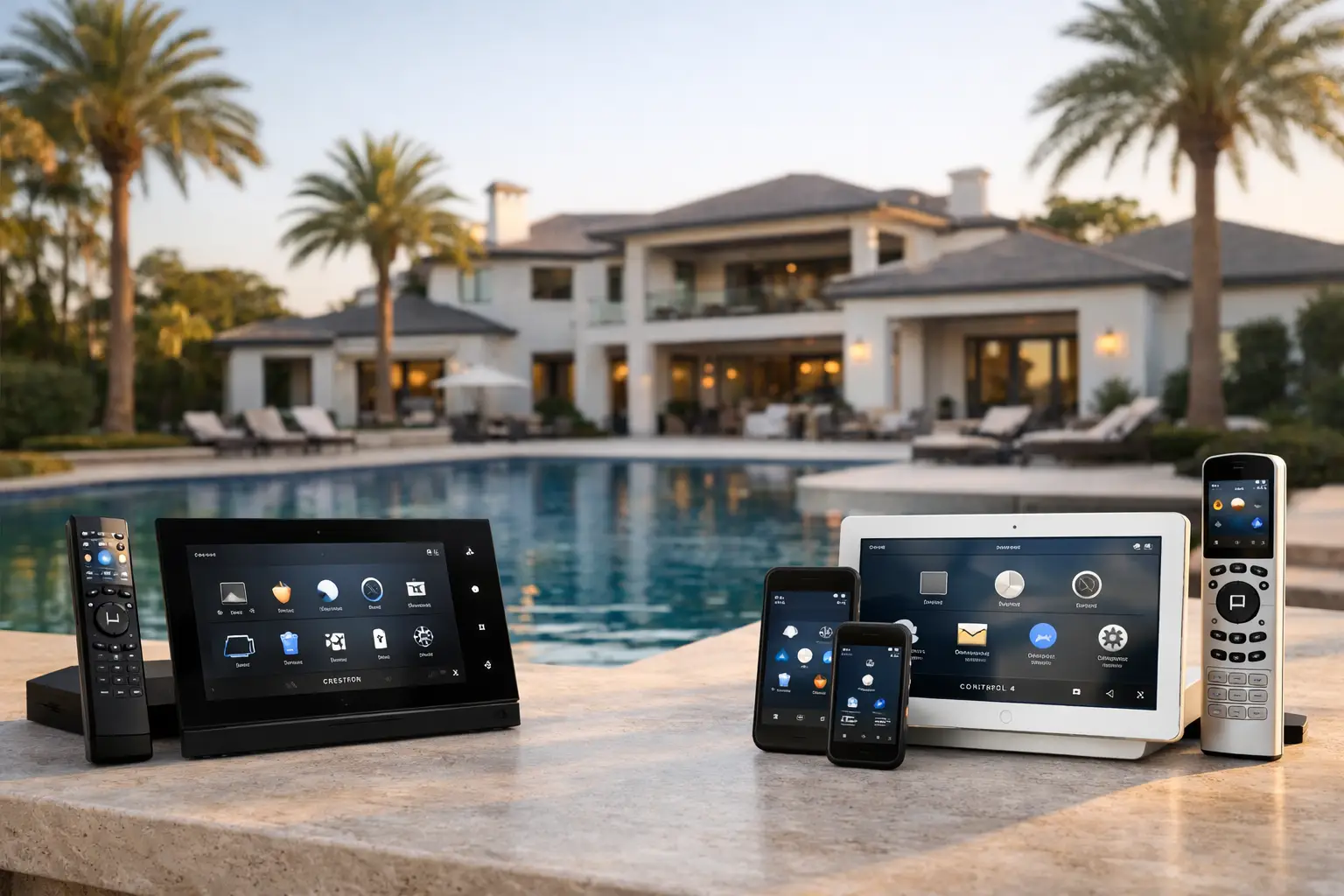
A large estate can turn a simple smart-home request into a serious systems-design decision. When the main residence, guest house, pool area, gates, outdoor entertainment, security cameras, and multiple equipment rooms must work as one, the platform matters. Choosing Crestron vs. Control4 for Large-Acreage Estates in Boca Raton is less about selecting a brand name and more about defining how the property should perform every day, how much customization it requires, and who will support it for years to come.
Both Crestron and Control4 are respected professional automation platforms. Both can bring lighting, shades, climate control, distributed audio, video, surveillance, access control, and outdoor spaces into a unified control experience. The right choice depends on the scale of the estate, the complexity of the technology plan, and the owner’s expectations for personalization.
The estate is the system, not the residence
A large-acreage property should never be approached as a collection of isolated rooms and devices. It is an ecosystem with long cable runs, separate structures, outdoor zones, potentially inconsistent wireless coverage, specialized security requirements, and different user needs for family, guests, household staff, and property managers.
That complexity is common in Boca Raton estates, particularly properties with expansive grounds, detached guest quarters, pool pavilions, gates, and dock or waterfront amenities. A control system has to account for more than a wall keypad in the living room. It must coordinate reliable communication between systems that may be hundreds of feet apart and remain easy to use despite the sophistication behind it.
Before choosing Crestron or Control4, an experienced integrator should establish the technology architecture. That includes structured cabling, fiber or network links between buildings, properly designed wireless access points, equipment-room ventilation planning, backup power, and network segmentation for critical systems. No automation platform can compensate for an undersized or poorly planned infrastructure.
Crestron vs. Control4 for large-acreage estates
Crestron is often the stronger fit when an estate calls for a deeply tailored control environment. Its ecosystem is built for extensive customization, sophisticated programming logic, enterprise-grade control requirements, and large projects with many subsystems. A Crestron installation can be designed around how a specific household operates rather than around a pre-defined set of interface options.
For example, a single “arrival” command can be configured to open an approved gate, activate selected exterior lighting, adjust comfort settings in occupied areas, disarm designated zones, start music in the foyer, and notify the household team. The behavior can change based on the time of day, who is arriving, or whether the property is in residence, guest, or travel mode. That level of conditional control is where Crestron is particularly compelling.
Control4 also delivers polished, centralized control and is highly capable for luxury homes. Its interface is intuitive, its ecosystem supports a broad range of residential systems, and it can provide an excellent experience for estates that need whole-property entertainment, lighting, shades, security visibility, and straightforward scene control. For many properties, Control4 offers the right balance of advanced functionality and familiar daily operation.
The key distinction is not that one platform is “good” and the other is “better.” It is the degree of custom behavior the estate requires. Crestron generally provides more flexibility when the project involves unusual integrations, extensive inter-building coordination, highly specific user permissions, or a unique architectural and lifestyle vision. Control4 is often an excellent choice when the estate benefits from a refined, standardized platform with a clean interface and a well-defined set of control priorities.
Where Crestron earns its place
Crestron is well suited to properties where no two zones behave alike. A primary residence may have formal entertaining areas, a theater, a fitness suite, bedrooms, staff areas, a guest residence, pool and patio zones, and a perimeter-security system. Each area may require distinct controls, access levels, and automation rules.
Its flexibility is especially valuable for sophisticated lighting and shade strategies. On a large property, lighting is not simply on or off. It may include architectural scenes, landscape lighting, pathway safety, perimeter illumination, decorative water features, and preset settings for events. Shades may need to respond to sun exposure, privacy needs, occupancy, and scheduled routines across several structures.
Crestron can also support a more custom visual experience on touch panels. Owners who want room-specific interfaces, staff dashboards, or controls that mirror the design language of the property may prefer the latitude Crestron provides. For estates with a dedicated technology manager or a highly involved household operations team, that customization can be meaningful.
There is a trade-off. More customized programming requires disciplined design documentation, rigorous commissioning, and a qualified integration partner who remains accountable after installation. The platform’s capability is an advantage only when the system is engineered, tested, and maintained with the same care as the estate itself.
Where Control4 is the right answer
Control4 is a compelling choice for owners who want premium property-wide control without making every interaction highly customized. Its strength is a cohesive experience across touchscreens, remotes, keypads, and mobile devices. Family members and guests can quickly understand how to select music, adjust lighting scenes, view cameras, operate shades, or control a media area.
For a large estate, that consistency is valuable. A guest suite should not require a tutorial. The pool terrace should be easy to operate from a keypad or touchscreen. A property manager should be able to confirm that gates, cameras, and lighting zones are functioning without navigating a complicated interface.
Control4 can handle extensive audio distribution, video control, lighting, shading, surveillance integration, and security-related notifications. It can also scale across multiple buildings when the underlying network and cabling plan are correctly designed. For properties with conventional luxury-home requirements, a focused scope, and a preference for a familiar control environment, Control4 can be an exceptionally strong platform.
The limitation appears when the project demands highly specialized workflows or extensive custom logic across numerous third-party systems. Some integration needs may require available drivers or additional programming approaches, while certain requirements may be better addressed by a more open, custom-oriented Crestron design. This is why the discovery process matters more than a feature checklist.
The decisions that should drive the selection
Start with the property’s daily patterns. Does the family need simple control of entertainment, lights, shades, and cameras across several structures? Control4 may provide everything needed in a polished format. Does the estate require detailed operational modes for staff, privacy-sensitive zones, events, perimeter management, specialty systems, and multiple user profiles? Crestron may offer the greater design freedom.
Next, consider the role of security. Both platforms can provide convenient camera viewing, alerts, and access-related control. However, surveillance, access control, intrusion detection, and life-safety systems should be designed as dependable systems in their own right. Automation should enhance awareness and convenience, not create a single point of failure for property protection. Critical security functions must remain available even if a touchscreen, app, or entertainment system is offline.
Long-term service is equally important. An estate control system is not a one-time installation. Software updates, network changes, equipment replacements, seasonal occupancy, staff turnover, and evolving homeowner preferences all affect performance. A clear support plan, accurate system documentation, labeled equipment, and remote service capability protect the investment long after construction ends.
Finally, evaluate the people who will live with the system. A highly customized platform is only successful if it feels natural to the owner and household. Conversely, an easy interface is not enough if it cannot support the property’s operational requirements. The goal is control that disappears into the experience: dependable scenes, predictable responses, and technology that supports the home without demanding attention.
A professional design process prevents costly compromises
The strongest estates begin with a technology plan before finishes are finalized. Early coordination allows for concealed wiring paths, correctly located equipment rooms, reliable coverage across the grounds, proper shading provisions, and clean integration with security and outdoor amenities. It also prevents a common failure point: adding sophisticated controls after the infrastructure decisions have already limited what is possible.
Sentry Audio Video approaches these projects as a complete integration effort, from consultation and system design through installation, programming, testing, and ongoing support. Whether Crestron or Control4 is the better match, the objective remains the same: a clean installation, dependable performance, and a control experience worthy of the property.
For a Boca Raton estate, the right platform is the one that fits the way the property is used today while leaving room for the next phase of ownership. A thoughtful site review and design conversation will reveal whether the estate needs Control4’s refined simplicity or Crestron’s deeper custom capability.