
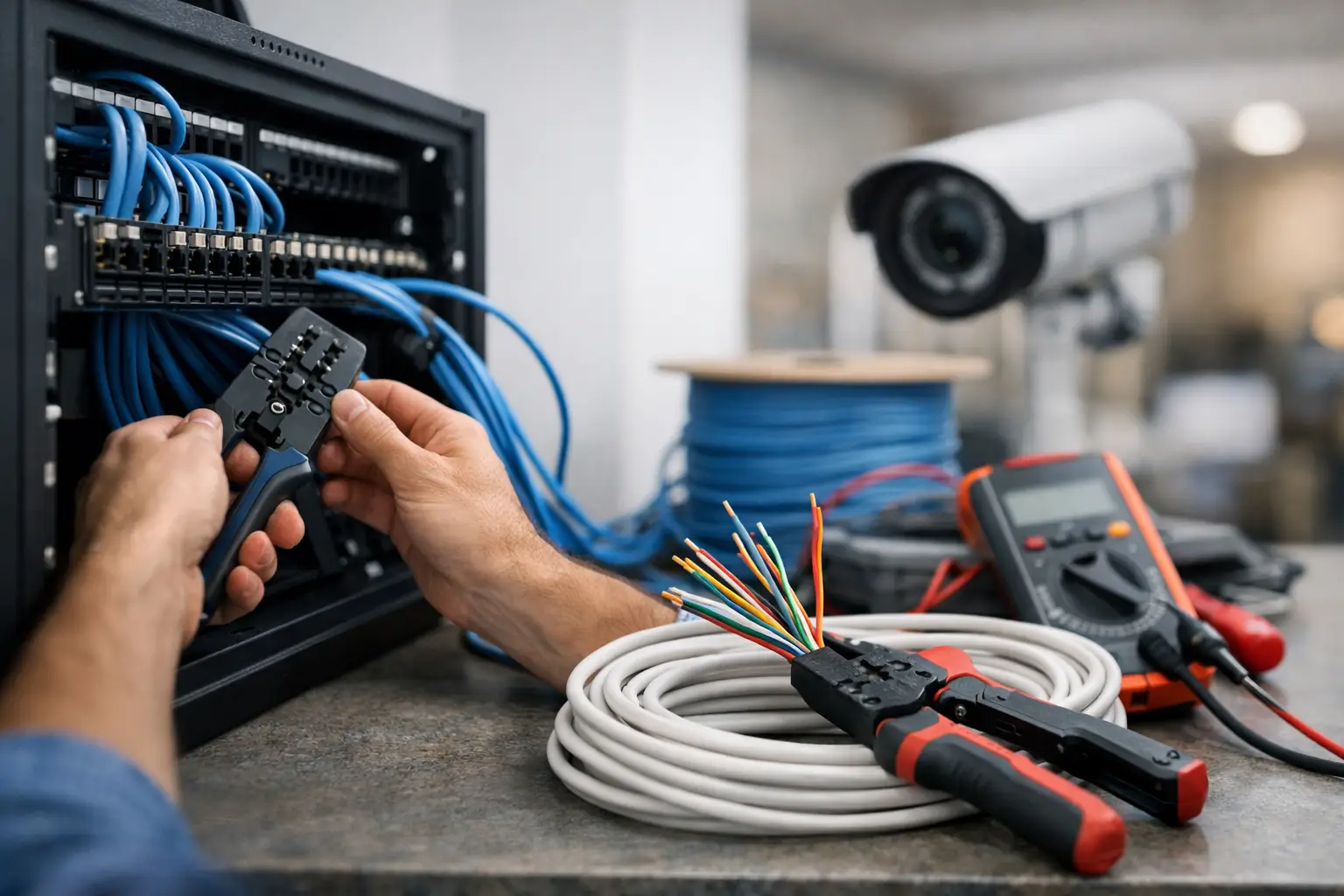
A finished wall can hide a costly decision for years. When cabling is planned as an afterthought, even premium surveillance, audio, networking, and control equipment can be limited by crowded pathways, undocumented runs, or inaccessible connections. The best low voltage wiring practices begin before finishes are installed, with a system plan built around how the property will actually be used and supported.
For a luxury home, that may mean dependable Wi-Fi coverage, outdoor entertainment, security cameras, distributed audio, shades, and centralized control. For a business, it may involve communications, video surveillance, access systems, displays, network infrastructure, and life-safety coordination. In either setting, the cabling is the foundation that allows every connected system to perform as intended.
Start With a Complete System Plan
Low voltage wiring should follow the design, not lead it. Before cable is pulled, define the equipment locations, user needs, network demands, control requirements, and likely expansion points. A conference room, media room, front gate, pool area, guest suite, and outdoor kitchen all create different wiring needs.
A professional plan accounts for more than what is being installed on day one. It considers future display locations, additional cameras, access points, speakers, control keypads, and changing network requirements. Pulling the right cable while walls and ceilings are open is far more practical than trying to create a new path after a property is complete.
This does not mean every room needs every possible wire. Overwiring without a purpose can add complexity and make service harder. The goal is intentional infrastructure: enough capacity for flexibility, with a clear reason behind every run.
Design Around Centralized Equipment
Most high-performance installations benefit from a dedicated, climate-appropriate equipment location. This may be a structured wiring enclosure for a modest system or a properly designed rack room for a larger residence or commercial property. The location should have adequate space, ventilation, lighting, grounding provisions, power planning, and service access.
Avoid treating the rack as leftover closet space. Network switches, audio components, video distribution hardware, control processors, surveillance recorders, and cable management need room to be installed and maintained correctly. A clean rack is not simply an appearance detail. It makes diagnosis faster, protects connections, supports airflow, and reduces the chance of accidental disconnections during future service.
Use the Correct Cable for the Application
Cable type is not interchangeable. The right choice depends on the signal, distance, environment, code requirements, and equipment being installed. Network cabling, speaker wire, fiber, control wire, coaxial cable, and security cabling each have different performance characteristics.
For example, a network run intended to power an access point or camera through Power over Ethernet must be selected and installed with power delivery, conductor quality, distance, and heat accumulation in mind. A cable that appears acceptable for basic data use may not be the appropriate choice for higher-power PoE applications in a dense bundle.
Outdoor, coastal, and high-moisture areas require additional attention. In South Florida, humidity, salt exposure, heat, and storms can affect cable pathways, enclosures, connectors, and exterior device locations. Use materials rated for the environment, protect penetrations, and avoid leaving exterior connections exposed to water or direct weather conditions.
Where long distances or high-bandwidth demands are expected, fiber may be the stronger long-term choice. It is particularly valuable between buildings, across larger properties, or in locations where electrical interference and distance make copper less desirable. The right answer depends on the layout and future requirements, not a one-size-fits-all rule.
Keep Low Voltage Pathways Organized and Protected
One of the most important low voltage wiring practices is physical separation from power wiring. Low voltage cables should be routed and supported according to applicable codes and manufacturer requirements, with appropriate separation from line-voltage conductors. This helps reduce interference risks, prevents damage, and supports safe, professional installation practices.
Pathways matter as much as cables. Conduit, sleeves, cable tray, J-hooks, pull strings, and accessible raceways create a controlled route for present and future wiring. They also protect cables from sharp edges, excessive bending, compression, and construction damage.
Cables should never be pulled so tightly that their performance is compromised. Observe bend-radius limits, avoid kinks, and keep pulling tension within the cable manufacturer’s specifications. This is especially important for category cable and fiber, where physical stress can affect signal integrity in ways that are not immediately visible.
Fire-rated assemblies need special care. Any penetration through a rated wall, floor, or ceiling must be treated with approved firestopping methods that preserve the assembly’s rating. This is a coordination point that should be addressed during construction, not left for the final walkthrough.
Label Every Run at Both Ends
A system cannot be serviced efficiently if nobody can identify what each cable does. Every low voltage cable should be labeled at both ends with a consistent naming convention tied to documentation. Labels such as “Camera 03” are useful, but “Camera 03 – East Drive Entry” is far more helpful when service is needed years later.
Good documentation includes cable schedules, equipment location details, rack layouts, network information, and as-built drawings that reflect the final installation. This is particularly valuable when a property has multiple levels, detached structures, outdoor zones, or a mix of security and entertainment systems.
Labeling also protects the client’s investment when ownership changes, a renovation occurs, or an additional system is added. A well-documented infrastructure gives future technicians a reliable starting point instead of forcing them to trace unidentified wires through finished spaces.
Test Before the Walls Close
Visual inspection is not enough. Cable runs should be tested after installation and before the construction phase makes access difficult. Network cabling should be verified for continuity, wire map, and performance appropriate to its intended category and application. Fiber should be inspected and tested with the proper tools. Speaker, control, camera, and coaxial runs should also be checked for continuity and proper termination.
Testing early catches pinched cable, damaged jackets, incorrect terminations, mislabeled runs, and routing mistakes while corrections are still manageable. It also establishes a performance baseline before equipment is connected.
For systems that depend on network connectivity, testing should continue after commissioning. A camera may power on and show video, yet still reveal problems under sustained traffic. An access point may appear online but provide inconsistent coverage if its cable, switch port, placement, or network configuration is not correctly planned. End-to-end verification is where infrastructure becomes a dependable system.
Plan for Network Capacity, Not Just Connectivity
Modern properties place more demand on the network than many owners expect. Video surveillance, whole-property audio, streaming video distribution, motorized shades, touch panels, access control, and wireless devices all rely on dependable network performance.
That makes network cabling and switching a design decision, not an accessory. Provide dedicated runs for fixed devices where practical, place wireless access points based on a coverage plan, and allow sufficient capacity at the rack for managed switching, power delivery, and orderly patching. Wireless is essential for mobility, but hardwired connections remain the preferred foundation for stationary, performance-critical equipment.
Network segmentation can also be valuable when a property includes security devices, guest access, business operations, or many connected control devices. The exact approach depends on the system’s complexity, but thoughtful network design improves reliability and makes future support more controlled.
Coordinate With the Entire Project Team
Low voltage infrastructure crosses paths with framing, millwork, lighting, drywall, landscape, security, and interior design. Coordination prevents conflicts such as a speaker location blocked by a beam, a camera view obstructed by decorative elements, an access point hidden inside a metal enclosure, or a television location with no practical equipment path.
Early coordination also produces a cleaner result. Wall plates can align with finishes, recessed equipment can be planned around cabinetry, and exterior devices can be positioned for both coverage and appearance. Premium properties deserve technology that performs exceptionally without distracting from the architecture.
For renovation projects, site conditions may limit available pathways. In those cases, an experienced integrator evaluates the trade-offs between access, aesthetics, system performance, and future serviceability. The right solution is often a carefully planned combination of existing pathways, strategic conduit, wireless design, and selective new cabling.
Treat Wiring as Long-Term Infrastructure
Equipment will evolve. Displays, cameras, access points, control platforms, and network hardware will eventually be upgraded. Well-planned wiring gives those upgrades a clear path forward and helps preserve the value of the property.
Sentry Audio Video designs low voltage infrastructure as part of the complete technology experience, from the initial proposal through installation, commissioning, and ongoing support. The focus is not simply on getting devices online. It is on delivering a clean, documented, serviceable foundation that supports the way a home or business operates.
The best time to protect system performance is before the walls are closed. A thoughtful wiring plan turns future technology decisions from construction challenges into straightforward improvements.