
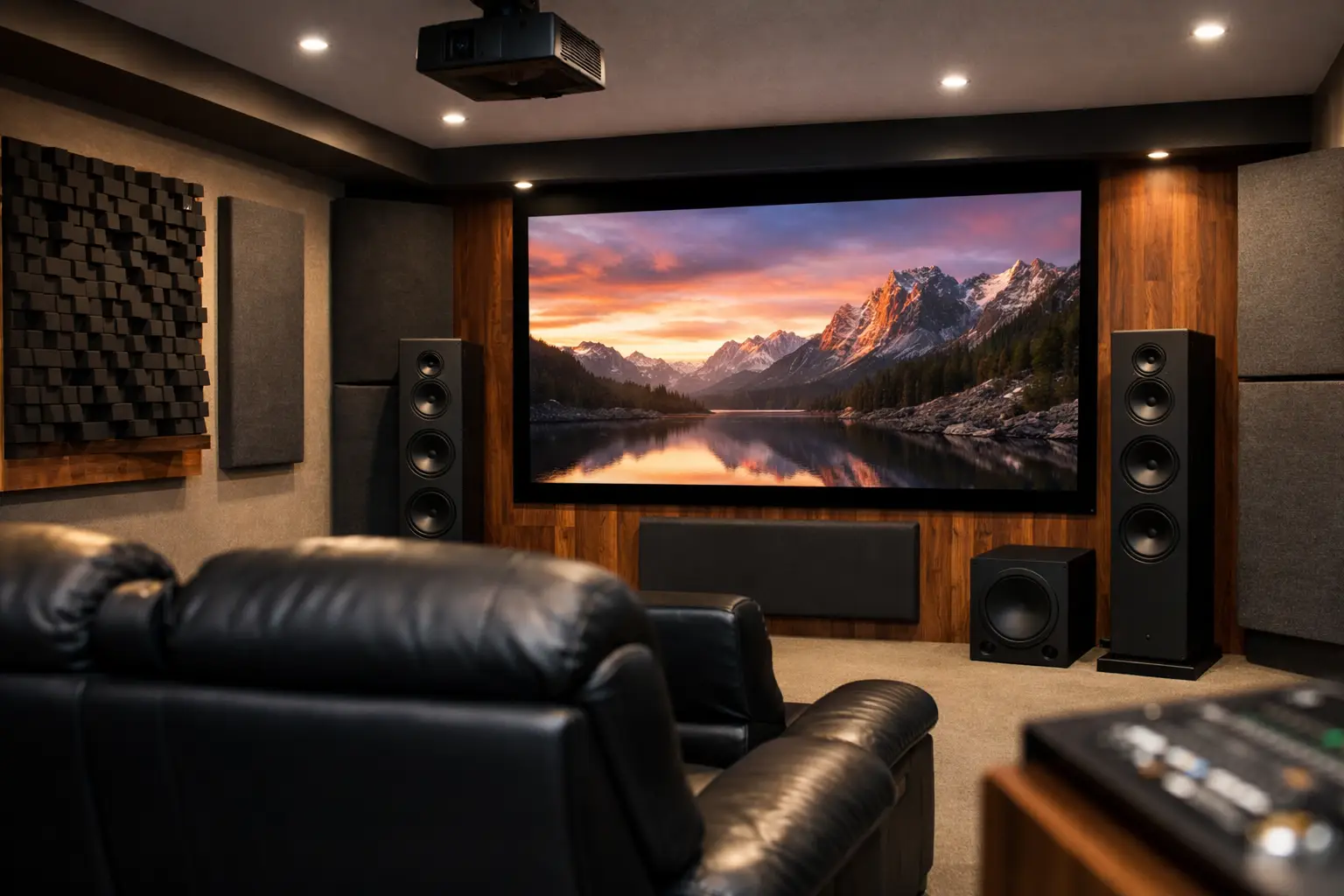
You can spend heavily on displays, speakers, and amplification, then still end up with a room that sounds flat, harsh, or muddy. That usually comes down to one thing: the home theater acoustics setup was treated as an afterthought. In a performance-driven theater, acoustics are not a finishing touch. They are part of the system.
A great theater should do more than get loud. Dialogue should stay intelligible at every seat. Bass should feel controlled instead of bloated. Effects should move convincingly around the room without calling attention to individual speakers. Those results come from the way the room is designed, furnished, treated, and tuned as a complete environment.
Why home theater acoustics setup matters so much
The room has as much influence on sound as the equipment itself. Hard, reflective surfaces can make voices sound sharp or smeared. Parallel walls can create flutter echo. Room dimensions can exaggerate certain bass notes and nearly erase others. Even a premium speaker system will struggle if the room is working against it.
This is where many homeowners are surprised. A theater is not judged only by the specifications of its components. It is judged by what happens at the listening position. If the front row hears overpowering bass while the back row loses impact, the system is not performing at the level it should. If music swells but dialogue gets buried, the room is shaping the experience in the wrong way.
Acoustics also affect how effortless a system feels. In a well-controlled room, you do not have to push volume to hear detail. The soundtrack opens up naturally. That is one of the clearest signs of a professionally considered theater.
Start with the room, not just the rack
A successful home theater acoustics setup begins before final speaker placement and long before calibration. Room size, shape, construction materials, ceiling height, flooring, and seating layout all influence what is possible.
Rectangular rooms are usually easier to predict and tune than wide-open multipurpose spaces. Dedicated theaters offer the most control, but media rooms can also perform exceptionally well when they are designed with acoustics in mind. What matters is understanding the constraints early. Glass walls, stone finishes, and open floor plans may look impressive, but they create acoustic challenges that need to be addressed directly.
Seating layout is another major factor. The primary listening positions should avoid sitting too close to rear walls, where bass buildup often becomes excessive. Speaker locations, screen size, and row spacing should all be coordinated. A room that looks balanced on paper can still sound compromised if seating ends up in the wrong acoustic zone.
In higher-end homes, this planning stage is where custom integration has real value. Instead of forcing equipment into a finished room, the room itself is prepared to support the performance the client expects.
Speaker placement is foundational
No amount of tuning can fully correct poor speaker placement. Left, center, and right speakers should create a stable front soundstage with convincing scale and precise dialogue anchoring at the screen. If the center channel is squeezed into cabinetry or blocked by finish materials, clarity will suffer.
Surround and height speaker placement should support immersion without drawing attention to the hardware. That balance depends on room dimensions, seating, and the audio format being used. A layout that works well in one theater may feel too aggressive or too diffuse in another.
Subwoofer placement deserves even more attention than most people expect. Low frequencies interact with room boundaries in complex ways. One subwoofer may be enough in some rooms, but multiple subwoofers often provide smoother bass response across several seats. The goal is not simply more output. It is more consistent output.
This is one of the clearest examples of why acoustics are not one-size-fits-all. A visually symmetrical layout is not always the acoustically correct one.
Acoustic treatment is not decoration
Acoustic treatment is often misunderstood. It is not about making a room feel dead or overly soft. It is about managing reflections, controlling low frequencies, and preserving clarity while keeping the soundtrack dynamic and engaging.
Absorption, diffusion, and bass control
Absorptive materials help reduce early reflections that blur detail, especially from side walls and ceilings. Diffusion helps scatter sound energy so the room feels spacious without becoming overly reflective. Bass traps or other low-frequency control methods target the most difficult part of the spectrum, where room problems are usually the most severe.
Each of these elements has a place, but balance matters. Too much absorption can make a room feel closed in. Too little leaves it bright and uncontrolled. Bass treatment is especially important because low-frequency issues are rarely solved by equalization alone.
Placement matters more than quantity
Adding more panels is not automatically the answer. Treatment should be placed where it will have the greatest effect, such as first reflection points, rear wall zones, and pressure-heavy bass areas. The right treatment plan depends on the room and the system. A theater with multiple rows, for example, may need a different rear-wall strategy than a single-row room.
This is also where design and aesthetics need to work together. In a premium theater, acoustic materials should complement the architecture, seating, lighting, and finishes. Performance and presentation should never feel like competing priorities.
Calibration matters, but it is not magic
Once placement and treatment are handled properly, calibration can refine the system. This includes level matching, distance settings, crossover integration, subwoofer alignment, and room correction where appropriate. Done well, calibration brings cohesion to the room. It helps the speakers disappear and lets the soundtrack take over.
But calibration has limits. It can improve what is already fundamentally sound. It cannot fully rescue a room with severe reflections, poor speaker locations, or major bass nulls. That is why professional theater design follows a clear order: room considerations first, then speaker and subwoofer positioning, then treatment, then final tuning.
When that sequence is reversed, the system may still produce impressive moments, but it is less likely to deliver consistent, repeatable performance.
Common mistakes in home theater acoustics setup
One of the most frequent mistakes is prioritizing visual symmetry over acoustic performance. Another is assuming high-end equipment will compensate for a difficult room. It will not. Better equipment often reveals room problems more clearly.
Oversized rooms with minimal soft surfaces can feel exciting at first because they sound lively. Over time, that liveliness turns into listening fatigue. On the other hand, heavily padded spaces can lose energy and realism if they are not balanced with proper diffusion and bass management.
There is also a tendency to focus almost entirely on the front of the room. The rear wall, ceiling, and corners often need just as much attention. Low-frequency behavior, in particular, does not respect visual focal points. It follows physics.
Dedicated theater or media room – the answer depends
A dedicated theater usually allows for the highest level of acoustic control. Light, sound isolation, speaker placement, and treatment can all be coordinated around one purpose. If the goal is reference-level movie performance, that kind of room offers significant advantages.
A media room can still achieve outstanding results, but the design approach has to account for everyday living. Open-concept layouts, shared seating areas, and decorative priorities introduce more variables. The solution is not to compromise expectations. It is to design with those realities in mind from the beginning.
For homeowners in places like Boca Raton, Fort Lauderdale, and other luxury markets where architecture and interior finishes matter just as much as performance, that coordination is essential. A theater should sound exceptional without disrupting the visual standard of the home.
What professional design changes
A professionally designed theater does not rely on guesswork. It considers room dimensions, construction details, finish materials, speaker models, seating positions, acoustic treatment strategy, and system calibration as one integrated plan. That approach protects the investment and avoids the common frustration of impressive equipment delivering average results.
This is where an experienced firm like Sentry Audio Video brings measurable value. Clean installation is only part of the job. The real outcome is a room where every element supports the performance of the whole system, from dialogue intelligibility to bass control to long-term reliability.
The difference is easy to hear. Soundtracks feel effortless. Voices stay locked to the screen. Bass has authority without overpowering the room. And every seat feels intentionally considered, not secondary.
If you want a theater that truly lives up to the promise of premium audio and video, start by respecting the room. The right acoustic plan is what turns impressive equipment into a cinematic experience worth sitting down for again and again.