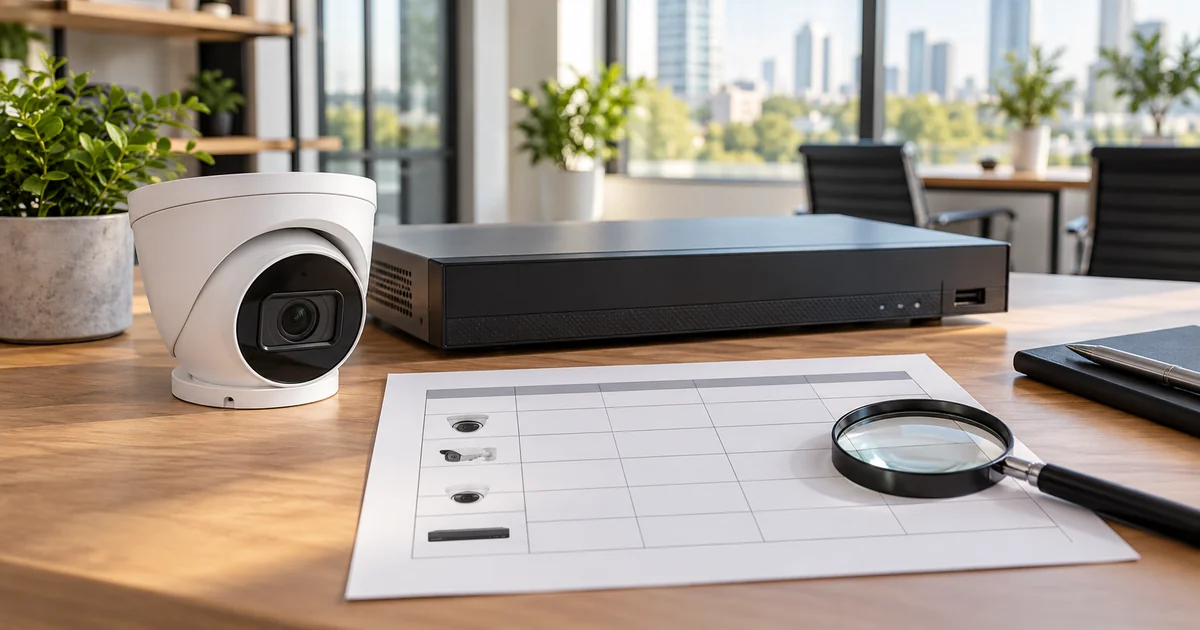
A proposal that says only “NDAA-compliant cameras” leaves a practical question unanswered: what exact equipment will arrive, and what evidence supports the claim? For an owner, property manager or purchasing team, the useful deliverable is a traceable equipment schedule. Each camera, recorder and relevant component should be identifiable from quotation through installation.
This guide concerns documentation for a camera upgrade. It is not a determination that a particular project qualifies for federal procurement. Section 889 requirements, contract clauses and other purchasing conditions must be evaluated by the responsible procurement or legal team. The installer’s job is to provide accurate equipment information and keep substitutions visible so that the reviewer can make that decision.
Start with the requirement the buyer actually has
Ask the purchasing team to identify the applicable specification or contract clause before choosing products. “NDAA,” country of origin, Trade Agreements Act eligibility, FCC status and cybersecurity requirements are not interchangeable labels. A statement addressing one does not automatically resolve the others. Put separate requirements in separate columns rather than presenting a single green checkmark as universal approval.
The federal acquisition rules implementing Section 889 address covered telecommunications and video surveillance equipment and services, with distinct procurement and contractor-use provisions. Their application involves more than an installer recognizing a familiar camera brand. If a project has funding or contract conditions, the owner should route the proposed equipment and supporting statements to the authority responsible for those conditions.
Identify the exact item, including the variant
A product family name is not a complete equipment schedule. Record the manufacturer, full part number, description, quantity and intended location. Include suffixes that distinguish regional versions, lens options or bundled hardware. A camera and a recorder sold under one brand are still separate items requiring their own identification. The same applies to an accessory if the project’s review requires it.
- Schedule line and intended installation location.
- Manufacturer and exact manufacturer part number, including suffix.
- Product role: camera, recorder, software, accessory or other component.
- Supporting manufacturer statement, its date and where it was obtained.
- Reviewer disposition and any unresolved documentation questions.
- Approved substitution procedure and installed-equipment confirmation.
Keep the original manufacturer document, not just a distributor’s shorthand product title. Save enough information for someone reviewing the project later to understand which statement was relied on. If a statement covers a defined list or category, check that the proposed exact item is within its scope. An undated sales sentence copied into a quote is weak evidence of that relationship.
Request clarification when the evidence is incomplete
Manufacturers may publish compliance information or provide project-specific statements through their official channels. Use those channels to resolve uncertainty rather than inferring a model’s status from the logo on the housing. For example, Axis maintains government compliance resources and a published Section 889 statement. Those materials still need to be matched to the proposed equipment and the actual purchasing requirement.
When asking for clarification, include the full part number and the precise question. A useful request might ask whether the current statement covers a particular camera variant and recorder combination. It should not ask a sales representative to certify the owner’s entire legal eligibility. Distinguish evidence about a product from representations that the contracting entity may be required to make about its own use of equipment.
Control substitutions before equipment is ordered
An approved schedule can lose its value when a backordered camera is casually replaced with something described as equivalent. Similar resolution, appearance or price does not establish equivalent documentation. Require proposed substitutions to show the new exact model, technical differences and supporting manufacturer evidence. The owner’s designated reviewer should approve changes before they become purchase commitments.
Consider a hypothetical twelve-camera project. Ten units match the approved schedule, while two are supplied under a different suffix because of availability. The sensible response is to flag and review those two lines. Do not silently change the schedule to make the delivery appear to match. A clear exception log is easier to resolve than a handover package that hides what was installed.
Keep technical suitability beside compliance evidence
Documentation alone does not prove that a camera can do its job. The schedule should also connect the proposed model to the required view, recording platform, power supply and installation environment. Night performance, analytics compatibility and storage requirements need their own technical review. A compliant product that cannot deliver the required scene remains a poor selection for the project.
Separate those judgments explicitly. One column can record the manufacturer evidence received; another can record the owner’s procurement acceptance; a third can track technical acceptance. This prevents a product statement from being mistaken for a performance warranty or a cybersecurity audit. It also makes it clear who must resolve each open question before equipment ships.
Close the loop at delivery and handover
Compare delivered labels with the approved schedule before installation. Record serial numbers in the controlled project records where appropriate, and retain purchase and warranty information. At completion, issue an as-installed schedule reflecting approved changes. Do not place serial numbers, network details or other sensitive system information in a public case study or ordinary marketing document.
The handover package should be usable without reconstructing conversations from memory. Include the approved equipment schedule, supporting statements, substitution approvals and the separate technical test results. Define who keeps the documents and how future replacements will be reviewed. An upgrade several years later should start with an understandable installed-equipment record rather than a vague promise from the original quote.
Buyer questions
Can the installer guarantee that a whole brand meets every purchasing requirement?
A brand-level assurance is not a substitute for checking exact equipment and the applicable rules. Ask for manufacturer evidence and have the responsible procurement authority determine whether it satisfies the project. Avoid broad legal guarantees in the installation proposal.
Should we approve an equivalent camera without updating the paperwork?
No. Treat a different model as a proposed substitution. Review its documentation and technical suitability, record the decision, and update the installed schedule if accepted. That creates a reliable record for purchasing, support and later upgrades.
Plan the next step with Sentry Audio Video
For a South Florida project, start with our video surveillance design and upgrades service. Sentry Audio Video can review the existing equipment, define the proposed change and identify the tests needed before ordering. Request a project review and include the equipment models, room or camera locations, and the outcome you want.
Related planning: planning a documented camera replacement.
Manufacturer and technical references
- Federal Acquisition Regulation 52.204-25
- Acquisition.gov Section 889 policies
- Axis government compliance resources
Technical sources reviewed October 23, 2026. Confirm exact model, software, licensing and project requirements before purchase. Featured image is an AI-generated illustration, not a photograph of a Sentry customer project.
From our Google reviews
“Brian and his team did an outstanding job installing our security cameras.”
Security camera installation
Google review excerpt