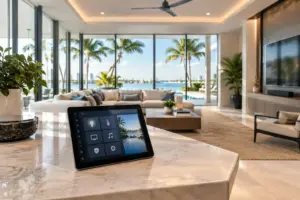
A Palm Beach estate can look complete while its wireless network quietly falls short. The issue often appears in the places owners use most: a guest suite with inconsistent streaming, a terrace where music drops out, a gate camera that loses connection, or a home office that cannot maintain a clear video call. Estate WiFi network installation Palm Beach property owners can rely on requires more than placing wireless access points around the house. It requires a designed infrastructure that accounts for the property, the architecture, and the way every system will be used.
For a large home, WiFi is not a convenience layer. It is the foundation supporting entertainment, surveillance, smart home control, communications, and connected daily life. When it is engineered correctly, the experience feels simple because the technical work has been handled behind the walls, in equipment racks, and through careful system programming.
What Makes Estate WiFi Different
A typical residence may need coverage in a few primary rooms. An estate can include multiple structures, thick masonry walls, expansive outdoor areas, detached guest quarters, a pool house, staff spaces, garages, gates, and waterfront-facing patios. Each introduces distance, obstructions, environmental exposure, or a combination of all three.
Square footage alone does not define the project. Construction materials matter just as much. Concrete, steel, stone finishes, impact-rated glass, mirrored surfaces, and mechanical equipment can all affect wireless signal behavior. A strong signal in one room does not guarantee reliable performance through a wall or across a courtyard.
The number and type of connected systems also changes the design. Video surveillance, access control, motorized shades, distributed audio, climate controls, streaming sources, tablets, and guest devices may all share the network. The goal is not simply to connect everything. It is to organize traffic so critical systems remain dependable when the home is active.
Coverage Is Only One Part of Performance
It is easy to judge WiFi by whether a device shows a connection. That is not the same as a network performing well. A professionally designed system considers signal strength, capacity, roaming between access points, wired backhaul, channel planning, and how devices behave under load.
For example, a family may move from the kitchen to the pool deck while on a call. Their device should transition between access points without a noticeable interruption. At the same time, cameras may be recording, guests may be streaming, and the home automation system may be sending commands. Proper design anticipates these moments rather than treating them as exceptions.
The Right Starting Point: A Property-Specific Network Plan
The most reliable installations begin before equipment is selected. A site review allows an integration team to evaluate the estate’s layout, construction, existing wiring, internet service, equipment location, and future plans. This step prevents a common mistake: trying to correct a coverage problem after finishes, landscaping, and furnishings limit the available options.
A complete plan identifies where wired connections are essential and where wireless access points should be placed. Wired connections remain the preferred path for fixed, high-demand equipment such as televisions, surveillance cameras, networked audio components, and control processors. This reduces unnecessary wireless traffic and gives core systems a more consistent connection.
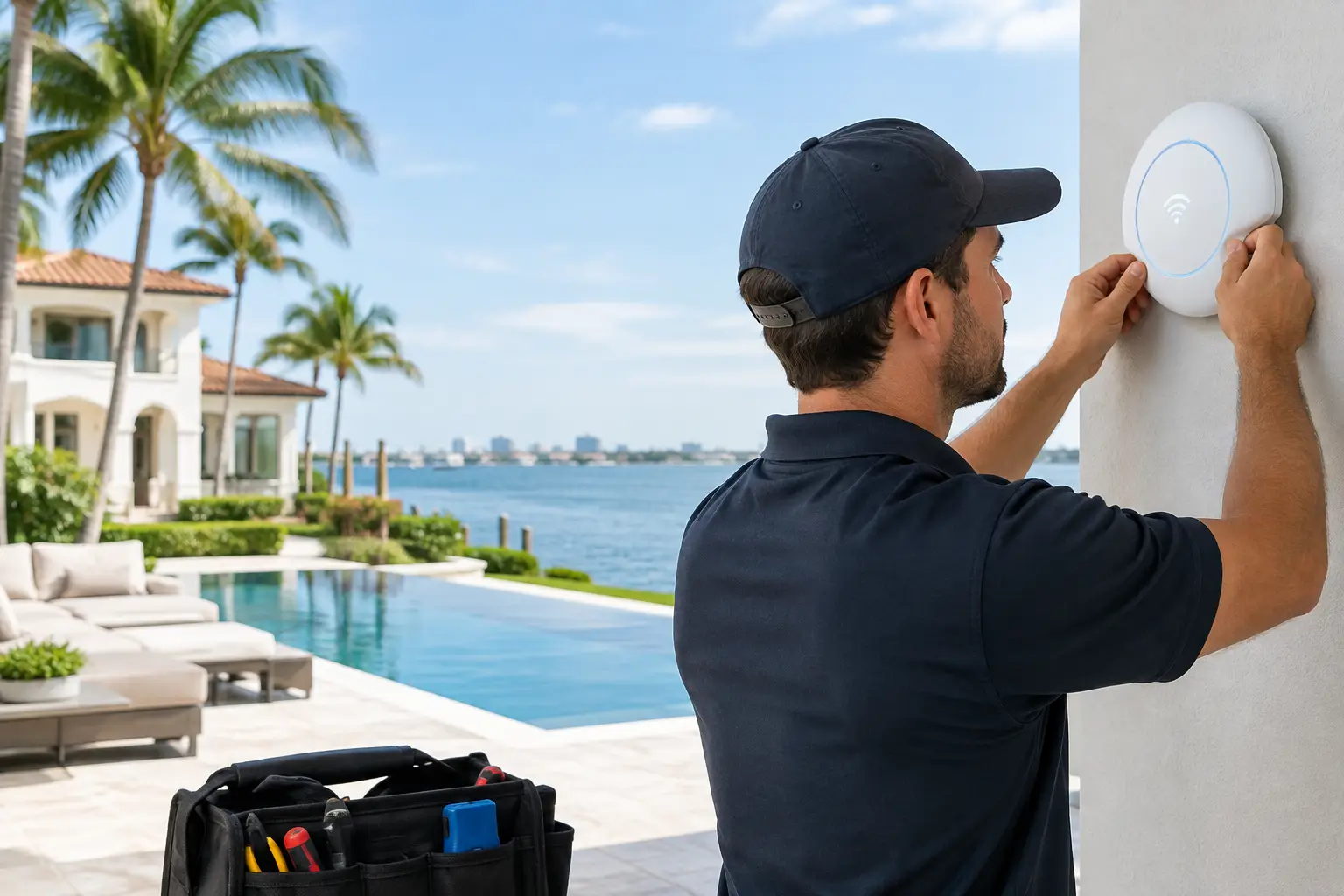
Access point placement should be intentional and discreet. In a finished Palm Beach residence, that may mean ceiling-mounted units selected and located to preserve the architecture, weather-rated equipment for outdoor entertaining areas, and carefully planned connections between the main house and secondary structures. The objective is broad, reliable coverage without visual clutter.
Structured Cabling Protects Long-Term Flexibility
A well-designed WiFi system is closely tied to structured cabling. Cabling gives the network a dependable backbone, provides power to many network devices, and allows equipment to be upgraded later without reopening walls or relying on temporary solutions.
During a renovation or new build, this is the right time to plan for more than current needs. A guest house may not be occupied daily now, but it may later require its own entertainment, security, and network coverage. A pool pavilion may become a regular event space. Installing the right pathways and cabling early gives the estate room to evolve.
This is also why equipment should be centralized in a properly designed rack or technology area whenever possible. Clean cable management, ventilation, labeled connections, and service access make a meaningful difference over the life of the system. A network should be easy for a qualified technician to diagnose and maintain without disrupting the home.
Security and Privacy Need Their Own Design
A luxury property often has more connected endpoints and more reasons to protect them. Network security should be part of the initial design, not an afterthought. That includes secure network hardware, professionally managed settings, current firmware practices, and sensible separation between device categories.
Separating guest access from the home’s private systems is a practical example. Visitors should be able to connect without gaining access to cameras, security controls, media servers, or personal devices. Staff access can also be configured appropriately depending on the property’s needs. These details support privacy while making the network easier to manage.
For estates with remote access to cameras, gates, or automation, secure configuration is particularly important. Owners should be able to check on their property from another residence or while traveling with confidence that access is controlled and the system is operating as intended.
Outdoor and Waterfront Coverage Require Special Attention
Palm Beach living extends beyond interior rooms. Terraces, pools, docks, outdoor kitchens, cabanas, and landscaped entertaining areas are often central to how a property is enjoyed. Those areas deserve the same careful network planning as the main residence.
Outdoor WiFi is not simply an indoor signal pushed through glass doors. Coverage can be affected by distance, dense landscaping, exterior construction, sunlight exposure, humidity, and storms. The equipment selected for exterior use must be suited to the environment, while its placement must balance coverage with a polished appearance.
Waterfront properties can introduce additional considerations. Long lots, guest docks, boat lifts, gates, and detached structures may require dedicated network paths or specialized wireless links. The correct approach depends on the property’s geometry and the systems being supported. A site-specific design is more reliable than assuming one outdoor access point can cover every area.
How a Professional Installation Comes Together
A quality estate network project should feel organized from the first walk-through through ongoing service. After assessing the property and discussing the owner’s priorities, the integration team develops a plan for infrastructure, equipment, coverage zones, security, and control requirements.
Installation is then coordinated with the home, builder, designer, or property manager as appropriate. This matters because network equipment intersects with ceilings, cabinetry, landscaping, security, audio/video, and automation. Coordination protects the finished appearance of the property and avoids unnecessary rework.
Once the system is installed, configuration and testing are essential. Each access point, wired connection, network segment, and connected system should be tested in the areas where it will actually be used. The process should include verification of outdoor spaces, guest areas, and handoff between coverage zones, not just a signal check near the equipment rack.
Sentry Audio Video approaches estate technology as one integrated environment. WiFi, security, whole-house entertainment, automated shades, pool controls, and communications should support one another rather than compete for attention or create separate service issues.
When an Existing Network Needs an Upgrade
Not every project begins with new construction. Many Palm Beach homeowners contact an integrator after repeated dead zones, camera interruptions, slow performance during gatherings, or unreliable control of connected systems. These symptoms may come from aging hardware, poor access point placement, insufficient wired infrastructure, or a network that was never designed for the home’s current demands.
An evaluation can identify whether the system needs a targeted correction or a more comprehensive redesign. In some homes, additional wired access points and better equipment placement solve the primary issue. In others, the network’s core hardware, cabling, and security architecture need attention as well. The answer depends on the property and should be based on measured conditions, not assumptions.
A reliable network should not demand constant attention from the homeowner. When technology is planned around the estate and supported by a qualified team, it becomes what it should be: a quiet, dependable foundation for the way the property is lived in. Before the next renovation, expansion, or seasonal return, a professional site assessment can reveal what your network needs to perform at the level your home deserves.