A luxury smart home should never feel like a collection of apps, remotes, wall switches, and competing voice assistants. How Control4, Josh.ai and Lutron Shades Work Together in a Luxury Smart Home is about solving that exact problem: giving every space a consistent, intuitive way to respond to the people living in it.
Each platform has a distinct role. Control4 acts as the operating system for the property, coordinating entertainment, lighting, security, climate, outdoor areas, and more. Josh.ai provides a refined voice-control experience designed around natural language and privacy. Lutron shades deliver precise daylight and privacy management with the quiet performance and fabric options expected in high-end interiors. Properly designed, these systems do not compete. They reinforce one another.
Three premium systems, one coordinated experience
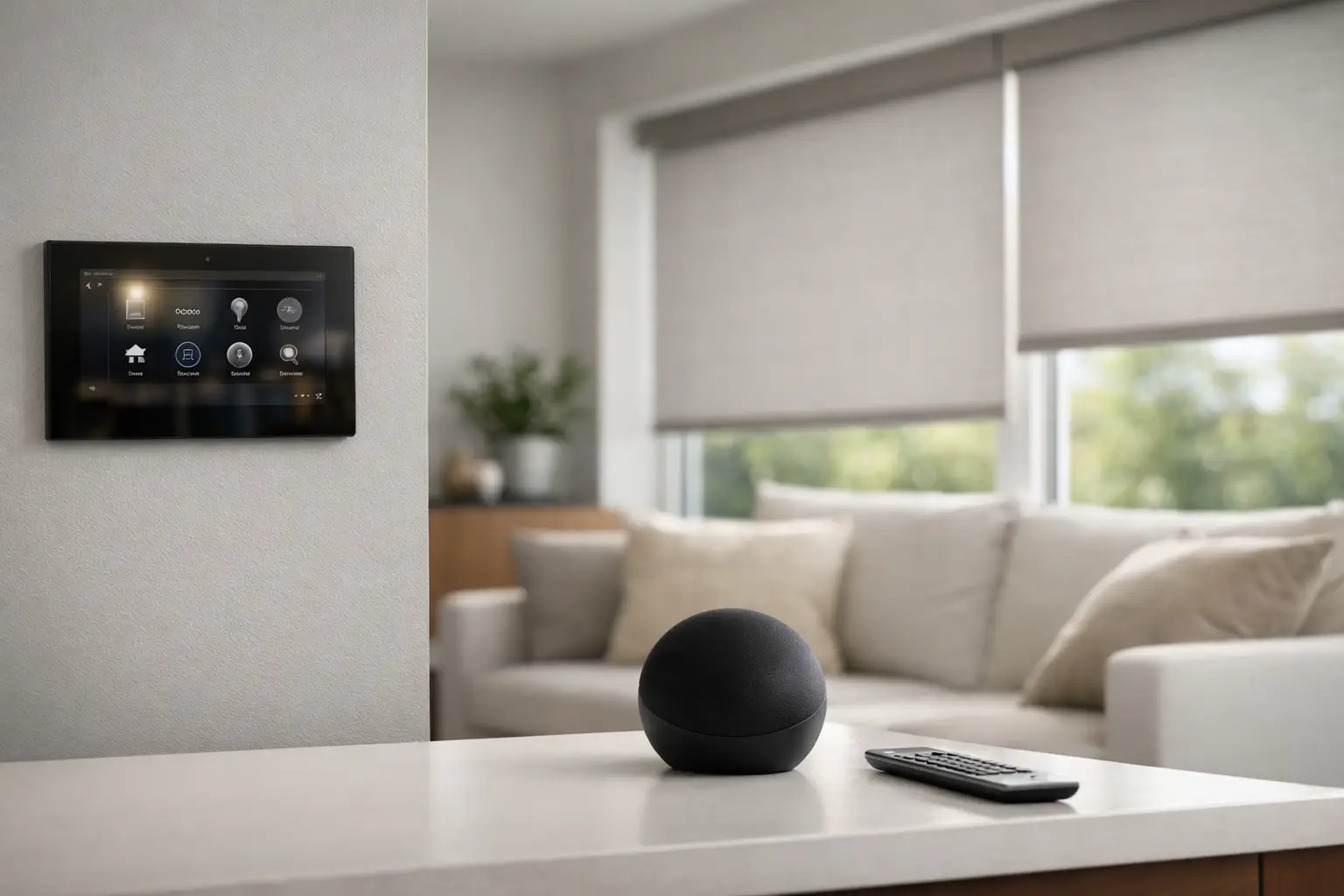
Control4 is the central control platform. It gives homeowners a unified interface through elegant touchscreens, in-wall keypads, handheld remotes, and mobile access. More importantly, it allows an integration professional to create automations that connect systems that otherwise operate independently.
For example, a single “Goodnight” command can turn off selected lights, lower motorized shades, arm the security system, adjust the temperature, and shut down distributed audio. Control4 handles the logic behind that multi-step response. It can also bring control to rooms that have different needs, from a dedicated theater and wine room to a pool deck, guest suite, or waterfront outdoor living area.
Josh.ai adds a different and highly valuable layer: natural voice interaction. Instead of memorizing rigid commands, a homeowner can use conversational requests such as, “Josh, lower the bedroom shades halfway,” or “Josh, set the family room for a movie.” The system is built for sophisticated homes with multiple rooms, users, scenes, and connected devices.
Lutron shades are the physical component that makes daylight control feel considered rather than incidental. They can rise, lower, open, close, or move to a specified position on command or according to a programmed schedule. In a South Florida home with expansive glass, shades can help manage glare, privacy, and intense afternoon sun while protecting interiors from prolonged direct light.
The value is not simply that all three brands can be installed in one property. The value is in their programming, placement, network design, power planning, and ongoing support as one integrated system.
How Control4, Josh.ai, and Lutron Shades Work Together
A well-designed project starts with Control4 as the coordination layer. Control4 communicates with Lutron shade systems and exposes shade control through the same interface used for lighting, AV, cameras, gates, and other connected features. A homeowner does not need a separate shade app to make a room comfortable or private.
Josh.ai can then trigger Control4 scenes through voice. When someone says, “Josh, start dinner,” Josh.ai can pass the request into the programmed control system. Control4 can set the dining room lighting, begin a favorite playlist, and close the appropriate Lutron shades. The requested outcome is the focus, not the individual device commands.
This matters because luxury homes often have complex layouts. A residence may include motorized window treatments across multiple floors, automated lighting in dozens of zones, audio in indoor and outdoor areas, surveillance, and dedicated entertainment spaces. Asking each system to work in isolation creates friction. Coordinating them allows the home to respond as one environment.
The same logic can be applied to time of day. Morning scenes may raise bedroom shades gradually, bring selected lights to a soft level, and start audio in the kitchen. An afternoon scene can lower west-facing shades before glare reaches the main living space. At night, a whole-home arrival scene can illuminate pathways, adjust shades for privacy, and make the house feel occupied before the homeowner walks through the door.
Voice control that feels appropriate for a private residence
Voice control is useful only when it is reliable, discreet, and aware of context. Josh.ai is particularly well suited to high-end residential projects because it supports room-aware requests. A Josh Nano installed in a room can understand a request such as “turn off the lights” as a command for that room, not the entire home.
For more specific requests, homeowners can speak naturally: “Set the kitchen shades to 30 percent,” “Close the primary suite,” or “Prepare the patio for dinner.” The actual phrasing depends on how the system is programmed, but the goal is to remove unnecessary steps from daily routines.
Privacy is also part of the Josh.ai appeal. Homeowners investing in a professionally integrated residence often care about where voice data is processed and how microphones are managed. Josh.ai was designed with a privacy-forward approach, including local processing for many functions. An integrator should explain the privacy settings, device locations, and expected behavior before the system is installed.
Voice is not intended to replace every control method. In-wall keypads remain valuable for immediate, tactile control at room entries. Touchscreens offer clear visual feedback. Control4 remotes are often the preferred interface for entertainment. The strongest projects give homeowners several dependable ways to control the house, with each interface used where it makes the most sense.
Lutron shades do more than cover glass
In a luxury residence, window treatments have to satisfy architectural, aesthetic, and performance requirements at the same time. Lutron offers shade solutions across a range of fabrics, openness levels, mounting conditions, and control styles. That flexibility is essential when a property includes large sliders, tall windows, curved spaces, blackout requirements, or rooms where preserving a view is a priority.
The automation possibilities are equally important. A theater scene can lower blackout shades before a movie begins. A kitchen scene can position solar shades to reduce glare without eliminating daylight. A bedroom scene can close privacy shades at sunset while leaving other parts of the home open to the view.
Quiet operation matters. Shades that are disruptive or uneven quickly undermine the experience, especially in bedrooms, offices, and formal spaces. Professional shade planning addresses motor selection, alignment, power access, recessed pockets, fascia, fabric choice, and control placement before construction details become difficult to change.
There are trade-offs to consider. Full blackout performance usually requires careful treatment of side gaps and top details. Battery-powered shades can be appropriate in retrofit situations, but hardwired power is often preferable for larger or more heavily used shade systems. Fabric selection affects glare control, daytime privacy, and the clarity of an exterior view. These decisions should be coordinated with the interior designer, architect, and integration team early in the process.
Scenes turn individual products into a lifestyle system
The most meaningful benefit of integration is not opening or closing shades from a phone. It is creating scenes that fit how the home is actually used.
A “Movie” scene might dim the room, lower Lutron blackout shades, power on the display or projector, select the preferred source, and adjust audio. A “Leave Home” scene can turn off entertainment areas, place shades in a chosen position, and activate the property’s security routine. A “Wake Up” scene may slowly introduce light through the shades rather than switching on bright overhead fixtures.
For a residence in Boca Raton, Fort Lauderdale, or a coastal community where sunlight and privacy can change dramatically throughout the day, scheduled shade scenes can be especially practical. Still, automation should not become overly aggressive. A homeowner may want shades to respond to time and sun position in a great room but prefer complete manual control in a study or guest bedroom. Good programming respects these preferences rather than applying one rule everywhere.
Integration quality determines daily reliability
Premium equipment alone does not guarantee a premium experience. The quality of the infrastructure and installation determines whether commands respond quickly, interfaces remain consistent, and future service is straightforward.
That begins with a properly designed network, structured cabling, equipment location, power protection, and labeled documentation. It also requires clean coordination among shades, lighting, AV, security, and control programming. If a shade motor loses communication, a voice command fails, or an interface is confusing, the homeowner experiences one system failure regardless of which manufacturer is involved.
This is why a full-service integrator matters. Sentry Audio Video approaches projects as complete environments, coordinating the systems that support entertainment, comfort, privacy, and protection. The objective is a clean installation that works reliably from day one and remains serviceable as the property evolves.
The right design does not put technology on display for its own sake. It gives the homeowner less to think about: a room that adjusts to the sun, a movie night that starts with one request, and a home that feels ready when they arrive.
See how Sentry plans the complete experience with our Josh AI systems overview and installation and programming services.
Plan an Integrated Lutron Lighting and Shade System
Sentry can coordinate shade design, measuring, fabric and power choices with the lighting and smart-home controls. Review Lutron shade sales and installation and Lutron lighting control design and installation before selecting equipment.
Call (561) 717-3280 or request an integrated-system consultation.