A rear door is found open after hours. Commercial surveillance vs access control determines whether you can see what happened, know who entered, or both. For business owners, that distinction affects far more than incident response. It shapes daily accountability, employee convenience, visitor management, liability exposure, and the long-term security of the property.
Video surveillance and access control are often discussed as though they are interchangeable. They are not. Each solves a different security problem, and each becomes more valuable when designed to work with the other. The right choice depends on your facility, operating hours, number of users, risk profile, and the questions you need your security system to answer.
Commercial Surveillance vs Access Control: The Core Difference
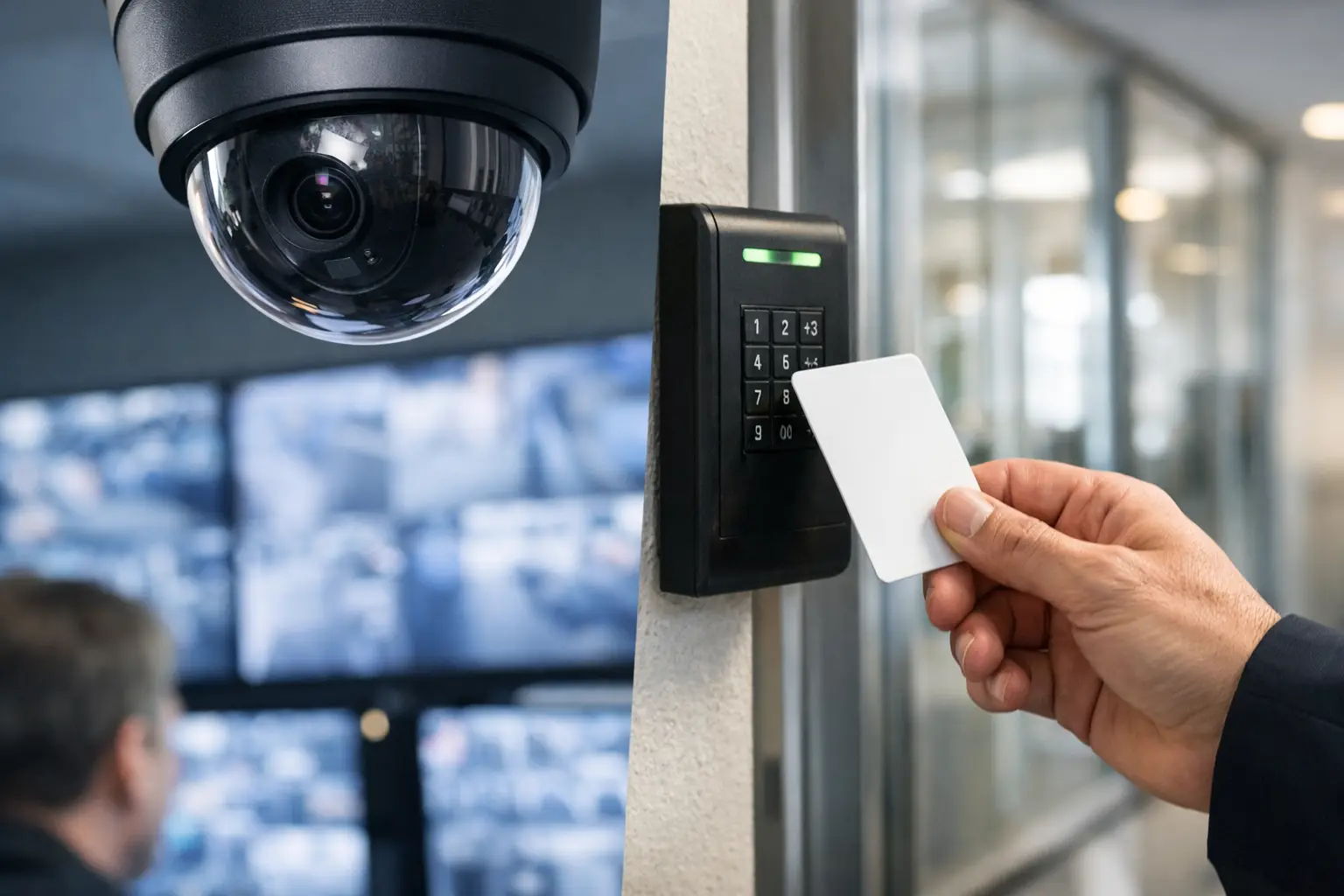
Commercial surveillance uses strategically placed cameras to observe, record, and sometimes alert staff to activity in and around a business. Its primary purpose is visibility. Cameras can document a delivery entrance, lobby, parking area, point of sale, warehouse aisle, or restricted room. When an event occurs, recorded video provides context that an alarm or access log alone cannot deliver.
Access control governs who can enter a door, gate, elevator, suite, or designated area and when they are permitted to do so. Instead of relying on conventional keys, users may enter with credentials such as key cards, fobs, mobile credentials, PIN codes, or biometric verification. Its primary purpose is control and accountability.
A camera can show a person entering a room. An access control system can prevent unauthorized entry in the first place and create a time-stamped record of approved entry attempts. Neither outcome replaces the other.
For a professional office, restaurant, medical practice, condominium common area, private school, or multi-tenant commercial property, the stronger question is rarely, “Which one should we install?” It is, “Where do we need visibility, where do we need permission-based entry, and where should those systems work together?”
What Commercial Surveillance Does Well
A properly designed surveillance system gives management eyes on the areas that matter without requiring someone to physically monitor every space. It can help document incidents involving theft, property damage, workplace disputes, unauthorized visitors, safety concerns, and after-hours activity.
The value comes from more than placing cameras at obvious entry points. Camera placement, lens selection, lighting conditions, recording retention, network capacity, and viewing permissions all affect whether footage will be usable when it is needed. A camera that captures a wide lobby may be appropriate for situational awareness, but it may not provide the detail needed to identify a face at a distant doorway. A loading area may require coverage designed for changing light, vehicle movement, and activity after dark.
Commercial surveillance is especially useful when your main concern is understanding events. It answers questions such as:
- What happened at the property?
- Who was present before and after an incident?
- Did a delivery arrive, and where was it left?
- Was a door propped open or an area entered after hours?
- Did staff follow established procedures?
However, cameras are largely reactive when used on their own. They may document an unauthorized person entering a server closet, stockroom, or administrative office, but they do not decide whether that person should have been allowed through the door. They also require thoughtful policies around privacy, especially in areas where employees or guests have a reasonable expectation of privacy.
What Access Control Does Well
Access control replaces the uncertainty of physical keys with managed credentials and documented permissions. A traditional key can be copied, shared, lost, or retained by a former employee. With an access control system, a credential can be assigned to an individual, limited by location and schedule, and removed quickly when circumstances change.
This is particularly valuable for businesses with multiple employees, vendors, service personnel, tenants, or restricted zones. A manager can allow a cleaning crew access to designated doors after business hours while keeping executive offices, inventory rooms, records storage, and IT spaces secured. A property manager can administer access across several entry points without the ongoing burden of rekeying locks after staffing changes.
Access control also produces a useful operational record. If a door is accessed at 6:42 a.m., the system can identify the credential used. If someone attempts entry with an expired credential, the event can be logged. Depending on the system design, administrators can receive alerts for forced doors, doors held open, and unusual access activity.
Still, access logs have limits. A credential record does not always prove the credential holder was the person who walked through the door. Someone may tailgate behind an authorized user, or an employee may share a fob. This is where camera verification becomes highly valuable.
Why Integrated Security Delivers Better Answers
When surveillance and access control are integrated, an access event can be tied to video from the associated entry point. Instead of reviewing hours of footage after an issue, authorized staff can move from a door event to the relevant camera view. That connection improves incident response, supports investigations, and reduces the guesswork that comes with reviewing isolated records.
Consider a private office building where a restricted suite is accessed outside normal hours. Access control can show which credential opened the door and whether the entry was authorized by schedule. Nearby video can confirm who entered, whether anyone followed behind them, and what occurred around the entrance. If a door was forced rather than opened by an authorized credential, both systems can provide a clearer timeline.
Integration also supports better daily operations. Reception staff can verify visitors at a controlled entrance. Managers can investigate alarms with visual context. Property teams can monitor perimeter activity while keeping internal areas limited to approved users. The goal is not to create unnecessary friction for employees and guests. It is to create a controlled environment that remains easy to manage.
How to Decide Where Each System Belongs
A quality security design begins with the business, not a product catalog. Start by identifying the areas that require observation, the areas that require controlled entry, and the events that would create the greatest operational or financial disruption.
Surveillance should typically be considered at exterior approaches, parking areas, reception spaces, delivery zones, corridors, cash-handling locations, and other areas where visual documentation is essential. Access control is most valuable at perimeter doors, employee entrances, executive offices, equipment rooms, storage areas, records rooms, gates, and spaces containing sensitive assets or information.
The answer changes by property type. A restaurant may prioritize rear-door monitoring, cash-office access, and camera coverage of delivery and service areas. A medical or professional practice may require carefully managed access to records and staff-only spaces, with surveillance focused on entrances and common areas. A multi-tenant property may need centralized control for common entry points while giving individual tenants appropriate access to their own suites.
Four planning factors deserve special attention:
- User management: Consider how often employees, contractors, and tenants change, and who will be responsible for adding or removing access.
- Remote administration: Decide whether designated managers need the ability to review cameras, respond to alerts, or manage credentials from off-site locations.
- Network and power planning: Cameras, recording equipment, door hardware, readers, and controllers need professionally planned infrastructure for dependable performance.
- Future growth: A system should accommodate additional doors, cameras, users, and locations without forcing a complete redesign.
Avoiding the Most Common Security Gaps
The most common mistake is treating security as a collection of unrelated devices. A few cameras may be installed after a problem occurs, while conventional locks remain on doors that should be controlled. Or a card reader may be added to a sensitive room without video coverage to verify access activity. Both approaches leave blind spots.
Another frequent issue is poor placement. Cameras mounted too high, aimed too broadly, or exposed to glare may capture activity without providing useful identification. Access readers positioned without considering door behavior, emergency egress requirements, visitor flow, or cabling pathways can create frustration and compromise the finished appearance of the space.
Ongoing administration matters as well. Credentials should be reviewed when staffing changes. Recording retention should match the organization’s needs and policies. Camera views, alerts, and permissions should be tested periodically. A security system earns trust through consistent performance, not simply through installation.
For commercial properties in South Florida, weather exposure and the demands of multi-site or seasonal occupancy can add further considerations. Exterior cameras, gate access, and network equipment should be selected and installed for the environment they will serve, with clean wiring and dependable support behind the visible components.
Build Security Around the Way Your Business Operates
The strongest commercial security systems are designed around real routines: who arrives first, where deliveries enter, which spaces hold sensitive assets, how visitors are received, and what happens when an employee leaves. That level of planning turns surveillance into useful evidence and access control into practical protection rather than another administrative burden.
Sentry Audio Video designs and supports integrated commercial systems that bring surveillance, access control, communications, and underlying infrastructure into one professionally executed solution. A thoughtful site assessment can identify the right coverage, entry controls, and management tools before gaps become costly problems.
If you are planning a new commercial space, renovation, or security upgrade, begin with the doors and events that matter most. The right system should give your team clearer visibility, more confident control, and a dependable record when questions need answers.