A Security Upgrade Boca Raton property owners choose should do more than add cameras to a building. It should give families, staff, and property managers a clearer view of what is happening at the property, tighter control over who enters, and confidence that every component will perform when it matters. For a waterfront residence, estate, retail location, office, or hospitality space, that requires a system designed around how the property is actually used.
Security is most effective when it is planned as an integrated environment rather than a collection of separate devices. Cameras, access control, intrusion detection, fire and life-safety systems, communications, lighting, gates, and the network supporting them all have a role. The right combination depends on the property, the risk profile, and the people who need to operate the system every day.
Start With the Property, Not the Equipment
A meaningful upgrade begins with a professional site assessment. The goal is to identify the places where visibility, access, response, or communication could be improved. That includes obvious points such as front doors, driveways, gates, parking areas, receiving entrances, and perimeter lines. It also includes less obvious areas: side yards, pool gates, service corridors, equipment rooms, elevators, and locations where packages or deliveries are received.
For homes, the conversation often centers on protecting the family without making the property feel institutional. A well-designed system can provide discreet coverage of exterior areas, monitored entry points, and dependable alerts while keeping the interface simple for everyone in the household. For businesses, the priorities may include employee access, customer-facing areas, inventory, after-hours activity, and incident documentation.
Placement matters as much as camera count. A camera mounted too high may capture a broad scene but miss facial detail. One facing direct Florida sun can produce inconsistent images unless the design accounts for glare, weather, and changing light. Coverage should be intentional, with overlapping views where appropriate and clear attention to the routes people actually take through the property.
Video Surveillance Should Deliver Useful Evidence
Modern surveillance can provide exceptional image quality, but resolution alone does not guarantee a useful system. The question is whether footage will clearly answer the questions that arise after an event: Who arrived? Which direction did they travel? What vehicle was involved? What happened before and after the incident?
A professional design considers field of view, nighttime performance, storage duration, camera locations, and recording reliability. In Boca Raton, exterior equipment also needs to stand up to heat, humidity, rain, salt exposure near the coast, and severe weather conditions. Selecting equipment rated for the environment and installing it cleanly protects both performance and the appearance of the property.
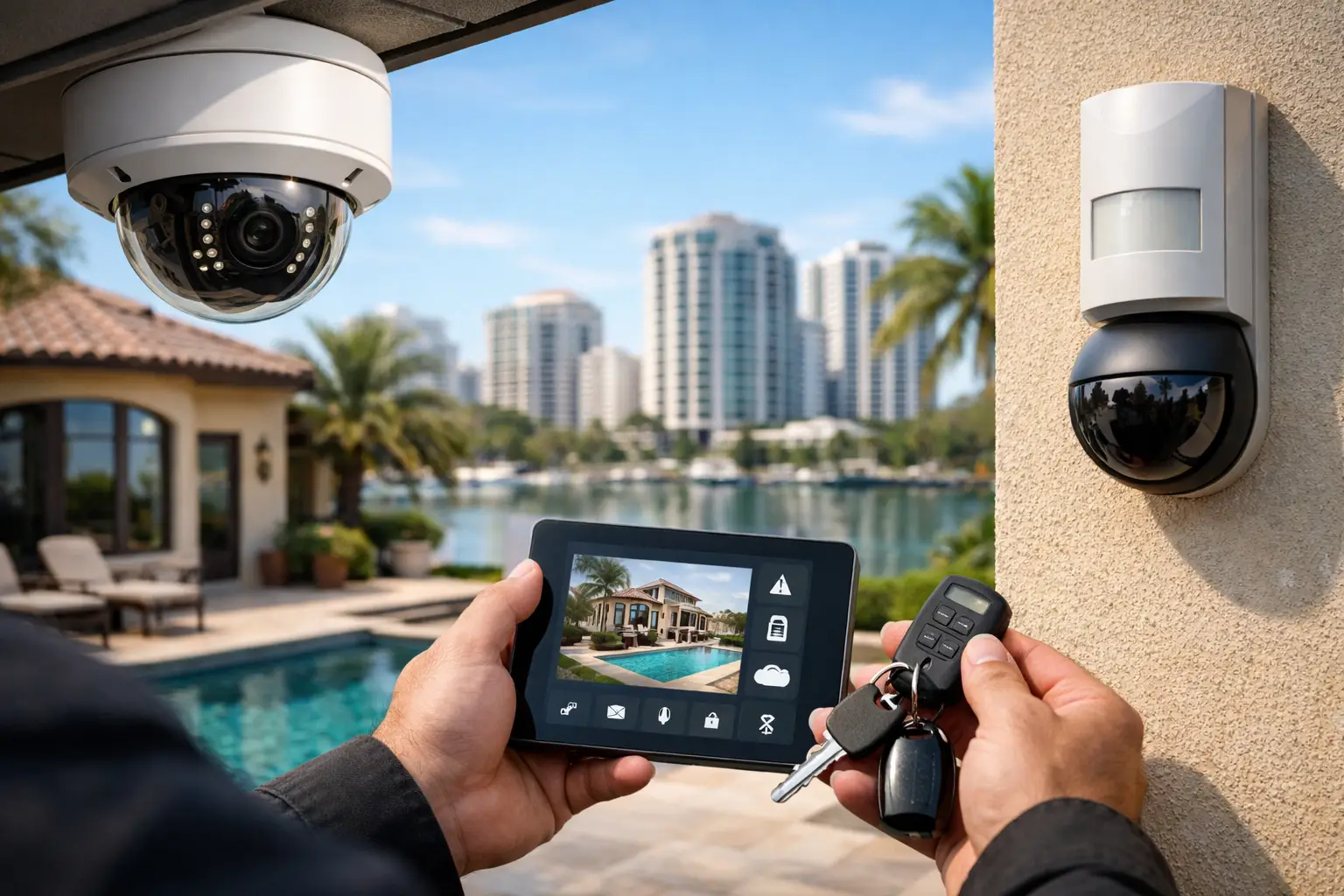
Remote viewing is valuable, particularly for seasonal residents, frequent travelers, and multi-location business owners. Yet remote access should be configured with the same care as the cameras themselves. Authorized users need an intuitive way to check live views, review recordings, and receive relevant alerts without exposing the system to unnecessary network risk.
Avoid Alert Fatigue
An app that sends a notification for every passing vehicle, moving palm frond, or employee arrival quickly becomes ignored. Intelligent alert settings can focus attention on meaningful activity, such as a person entering a designated area after hours or a vehicle approaching a private gate.
The correct settings depend on the location. A busy commercial driveway needs different rules than a quiet residential side entrance. Fine-tuning after installation is part of making a security system practical instead of distracting.
Control Access Without Creating Friction
Access control replaces uncertainty with accountability. Rather than relying entirely on physical keys, owners and managers can control entry through credentials, keypads, video intercoms, mobile access, and scheduled permissions. The benefit is not simply convenience. It is the ability to know who has access, when they entered, and how quickly permissions can be changed.
For a residence, access control may coordinate a pedestrian gate, driveway gate, front door, and service entry. It can allow household members and approved service providers to enter on defined schedules while preserving owner control. Video intercom capability adds another layer by allowing occupants to see and speak with a visitor before granting access.
Commercial properties gain operational clarity from centralized access management. When an employee leaves, access can be removed without collecting keys from every door. When a vendor needs entry for a limited appointment, permissions can be scheduled accordingly. This is especially valuable for offices, private clubs, medical facilities, retail spaces, and properties with multiple restricted areas.
There are trade-offs to consider. A highly granular system provides more control, but it needs a clear process for managing users and credentials. The right design balances security with daily operations, so staff are not forced to work around a system that feels unnecessarily complicated.
Connect Intrusion, Fire, and Communication Systems
A camera records activity. An intrusion system is designed to detect it and trigger an appropriate response. Combining the two gives property owners better context during an alarm event. When doors, windows, glass-break sensors, motion detection, and exterior zones are thoughtfully planned, the system can identify issues early while reducing false alarms.
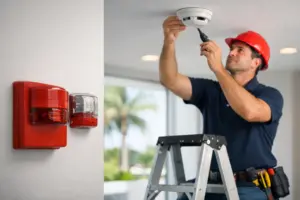
Fire alarm systems and life-safety devices should also be treated as a serious part of the overall protection strategy, particularly in commercial environments. Requirements vary by occupancy, building layout, local codes, and existing infrastructure. A qualified integrator can coordinate the technology plan so life-safety components, security monitoring, communications, and network infrastructure are properly considered from the start.
For larger homes and businesses, communications matter during both routine operations and emergencies. Intercom stations, door stations, paging, and integrated notifications can help the right people receive information quickly. The value comes from clear coordination, not from adding features for their own sake.
The Network Is Part of the Security System
Security devices depend on a stable, well-managed network. Cameras consume bandwidth, recorders require dependable connections, access systems need responsive communication, and remote access must be protected. When security is added to an aging or poorly organized network, the result can be delayed video, dropped connections, inconsistent notifications, and difficult troubleshooting.
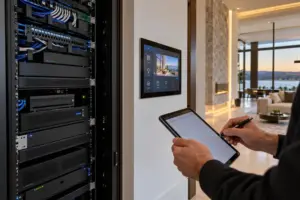
Structured cabling is often the foundation of long-term reliability. Whenever construction or renovation makes it possible, properly installed wiring creates a stronger path for cameras, access points, touch panels, intercoms, and future expansion. Wireless technology has an appropriate role, but fixed security devices generally benefit from a wired connection where practical.
Network segmentation, secure account practices, protected remote access, and professional configuration all matter. The objective is to make the system easy for authorized users while reducing exposure to unauthorized access. This is one reason a complete security upgrade should be handled as an infrastructure project, not a standalone equipment purchase.
Plan for the Way You Live or Operate
The strongest security plan is one people will use correctly. A homeowner should be able to arm the property, check a gate, review a camera, and respond to a visitor without navigating a confusing set of separate apps. A business manager should be able to review an event, manage access, and understand system status without relying on an outside technician for every routine action.
Integration can bring these functions into a more organized experience. At a residence, an entry event might activate exterior lighting, present a camera view, and send a selected alert. At a business, a door forced open after hours can be paired with video verification and notification to the appropriate contact. The degree of integration should match the client’s needs. Some properties need comprehensive centralized control; others are better served by a focused, highly reliable security platform.
Sentry Audio Video approaches these projects as a complete design, installation, and support relationship. That means evaluating the security needs alongside the property’s network, communications, automation, and future plans, then delivering a clean installation with systems that are straightforward to operate.
Make Support Part of the Decision
Security systems are not set-and-forget installations. User needs change, staff changes occur, landscaping grows into camera views, software updates become available, and a renovation may introduce new entry points. Ongoing support ensures the system continues to serve its original purpose.
Before moving forward, ask how service requests are handled, whether the system can be expanded, how footage is retained, who can manage users, and what happens if a critical component needs attention. Clear answers signal that the provider is thinking beyond installation day.
The most valuable next step is a walk-through with an experienced integrator who will listen before recommending equipment. A security plan should reflect the property, the people on it, and the level of confidence you expect each time you leave the gate, lock the door, or close for the evening.