If a household uses both English and Spanish, spoken-language support should be settled before a voice-control system is purchased. A convincing demonstration in one language does not establish that the same commands will work in another. The right buying decision starts with the people who will operate the home and the controls they are comfortable using.
As checked on November 6, 2026, Josh.ai’s public FAQ identifies English as the supported spoken language and says additional languages are in development. Do not purchase on the assumption that Spanish home-control commands are already supported. Confirm the current manufacturer position again when the project is specified.
Separate spoken language from the voice you hear
A system’s output voice, accent and personality are different questions from the language it recognizes for home-control requests. Josh.ai discusses voice personalization separately from its language-support answer. A demonstration using a different voice should not be taken as proof that a different spoken command language has been enabled.
Ask the integrator to identify exactly what is being demonstrated: a supported home-control request, a conversational assistant response or an interface setting. The proposal should describe the purchased function plainly. An impressive answer to a general question does not establish that a household’s preferred language can operate every proposed light, shade or entertainment activity.
Make a household-use list before selecting equipment
List the people who will regularly use the system and the ordinary tasks they need to perform. Include owners, family members, frequent guests and authorized household staff where relevant. The purpose is to understand operation, not to collect unnecessary personal information or make assumptions based on someone’s background.
For each person, identify whether spoken control is essential, useful or simply optional. Someone may enjoy voice control for music while preferring a familiar remote for television. Another person may want straightforward physical lighting control. Those preferences should influence the project scope before microphone locations and hardware quantities are finalized.
Demonstrate real requests with the intended users
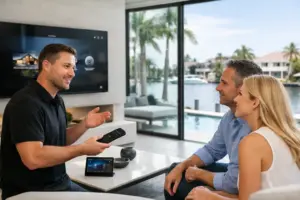
Prepare a short set of everyday requests, such as adjusting the main room lights or starting a supported entertainment activity. Ask the people who expect to use voice control to participate in the demonstration. Observe whether they can accomplish the task naturally within the manufacturer’s currently supported language and the proposed integration.
Do not substitute a rehearsed installer performance for that review. A demonstration is most useful when the owner understands what was requested, what equipment responded and how the result was confirmed. If a request does not work as expected, clarify the limitation rather than silently changing the demonstration and leaving the household with an inaccurate expectation.
Agree on nonvoice operation for daily essentials
Voice should be one part of an understandable home-control plan. For each everyday task, agree on an appropriate alternative that is included in the actual installation: a wall control, remote, supported app or another suitable interface. Verify that the selected alternative works with the proposed equipment and is practical for the person expected to use it.
This matters particularly for guests who have not learned the home’s routine. They should receive a simple explanation of the controls they need, without a lengthy technical introduction. Keep the discussion focused on usability; a broad claim that the home has an app does not establish that every guest can access or operate it conveniently.
Keep product promises separate from future development
If a future language is important to the purchasing decision, record that requirement explicitly and ask what is available now. An announced direction or a feature described as being in development should not be presented as a delivered function. The owner can then decide whether the current supported experience is appropriate for the project.
Avoid informal assurances that a software update will certainly arrive by a particular date or provide a specific result unless the manufacturer has made a clear, applicable commitment. Even then, the installed hardware and software requirements need review. A complete installation proposal should stand on the functions being supplied and accepted, not on a hoped-for change.
Use a short acceptance record
Document the agreed tasks, supported spoken language, relevant interfaces and the result of the household demonstration. Include any function that was excluded or requires a different control method. This can be a concise operating schedule rather than a complicated technical document.
At handoff, repeat the important tasks with the installed equipment. Confirm that the household knows how to use the agreed alternatives and how to report a problem. The acceptance review should focus on the language and operating experience approved for this project, not become another general tutorial about microphone placement or scene naming.
Can an English- and Spanish-speaking household still consider Josh.ai?
Yes, the decision can be evaluated around the currently supported experience and the household’s preferences. The key is that each intended user understands what is available and has an acceptable way to operate the included functions. This does not change the need to verify spoken-language support with the manufacturer before promising Spanish voice commands.
If supported Spanish commands are a requirement that determines whether the project proceeds, identify that requirement at the first consultation. It should influence the recommendation before an equipment order, rather than emerging as a disagreement after the installation is complete.
Plan a Josh.ai project with clear expectations
Explore Sentry Audio Video’s Josh.ai system planning and Miami and Miami Beach services. Describe the rooms, intended users and the everyday functions that matter most. Sentry can review the proposed integration and the demonstration needed to establish a realistic installation scope.
Request a project consultation or call (305) 502-0003 for Miami Beach and (561) 717-3280 for Boca Raton. Current product support and the final equipment proposal should be confirmed before purchase.
Manufacturer references
- Josh.ai frequently asked questions: languages, accents and direct controls
- Josh.ai tips and interface tutorials
Technical references reviewed November 6, 2026. Confirm applicable product, software and installation requirements when specifying the project.