Six speaker zones do not necessarily mean six people can play six different online music selections at once. For a Savant audio expansion, count independent listening demands separately from the number of rooms. Then verify the music sources, routing and authorized service accounts needed to meet those demands.
The practical question is what happens when one person starts a playlist in the kitchen while another wants different music on the patio. A clear plan should explain whether those requests can coexist and what equipment or account changes, if any, are required.
Start with simultaneous listening examples
Write down an ordinary busy evening, rather than assuming every room needs a separate stream. The kitchen and dining area might share a program, while the patio and a home office each need something different. That example creates three independent selections even if it involves four or more speaker zones.
Also document occasional use: a party, a guest suite or two family members with different playlists. Decide which scenarios the purchase must support and which are optional. A system designed for every theoretical combination may be larger than the household actually needs.
Keep zones and sources in separate columns
An audio zone describes a destination with its control behavior. A music stream supplies content. Multiple zones may share one selection where supported, while independent selections require sufficient source capacity and a compatible route to the intended destinations.
Savant’s published IP Audio 125 product description provides a useful example: it describes several zone outputs while identifying a single built-in Savant Music stream. That distinction shows why output count and independent music count should be written separately. It does not establish the capacity of an unidentified existing Savant installation.
- Destination: room or speaker zone.
- Required selection: shared program or independent music.
- Source: exact server or supported playback device.
- Account: authorized service and plan used by that source.
- Control: who can start, stop or change the selection.
Verify the installed hardware and software
List the Savant host, music server, audio distribution and amplification models before recommending an additional source. Ask the integrator to confirm supported expansion for that combination and its software version. Spare amplifier channels do not prove spare music-stream capacity, and an available music source does not prove a free amplified zone.
Identify whether the requested service is integrated through the installed source or requires another supported playback path. A service logo in a demonstration system does not establish identical operation on older equipment. Confirm the particular purchase against the current hardware and service documentation.
Treat accounts as part of the design
Music-service subscriptions and simultaneous playback rules are separate from Savant’s physical outputs. Check the household’s current service plan, permitted use and the supported account arrangement for the chosen playback devices. Do not promise that one login can deliver an unlimited number of independent programs.
Keep passwords out of an equipment inquiry. Arrange authorization and sign-in through an agreed secure setup process. The proposal should identify any account action the homeowner must complete and distinguish it from hardware or programming supplied by the installer.
Demonstrate the combinations that matter
Use the actual requested services and authorized accounts for acceptance. Begin one program, start a different program in the next agreed zone and verify that the first continues as intended. Repeat the busiest approved listening scenario.
- Play the household’s first selection in the agreed group.
- Start the second and third independent selections where required.
- Change a selection and verify which rooms are affected.
- Adjust volume independently where the design promises that ability.
- Stop or ungroup a destination and confirm the remaining rooms.
- Document limits and teach users the normal operating sequence.
Separate these music tests from television-audio grouping and lip-sync tests. Those are different signal-path decisions and should not be assumed complete because music plays successfully throughout the home.
Turn one busy evening into an equipment decision
Suppose the kitchen and dining room should share one playlist, a teenager wants different music in the bedroom and a guest wants another selection outside. Write those three selections beside the destinations and ask the designer to show how the proposed system supplies each one. This is a hypothetical planning example, not a description of a completed Sentry project or a universal source requirement.
Now change the example: the guest joins the kitchen program, while the teenager keeps listening independently. Ask which action the household takes and which other rooms are affected. This transition can expose an awkward operating routine that is easy to miss when each zone is demonstrated separately. Include the controls the family will normally use, rather than relying only on a technician's setup interface.
For a new Savant installation, make this listening map part of the equipment and programming brief before finalizing the rack and speaker-zone schedule. For a takeover, compare it with the actual retained sources and amplification. Ask for a clear explanation if the proposed improvement requires a source addition, a distribution change or a different account arrangement; those are separate reasons for spending money.
Keep optional future rooms distinct from the combinations required on day one. The proposal can document a possible expansion path without promising unverified spare capacity. Record what has been included and what still needs another design review. A useful acceptance document therefore gives the owner both a successful listening demonstration and a comprehensible limit on simultaneous independent selections.
Ask for an expansion proposal you can understand
The final schedule should state the number of required independent music programs, the zones receiving them, the sources provided and the account dependencies. It should also explain any retained hardware limitations before the owner commits to equipment.
Sentry Audio Video plans Savant smart-home and audio expansions in South Florida. Request a music-system assessment or call (561) 717-3280 with the rooms, services and simultaneous listening scenarios your household needs.
Technical reference
Reviewed October 30, 2026: Savant’s IP Audio 125 with Savant Music Server description. The published example distinguishes zone outputs from its built-in stream. Exact installed-system capacity and music-service rules require separate verification.
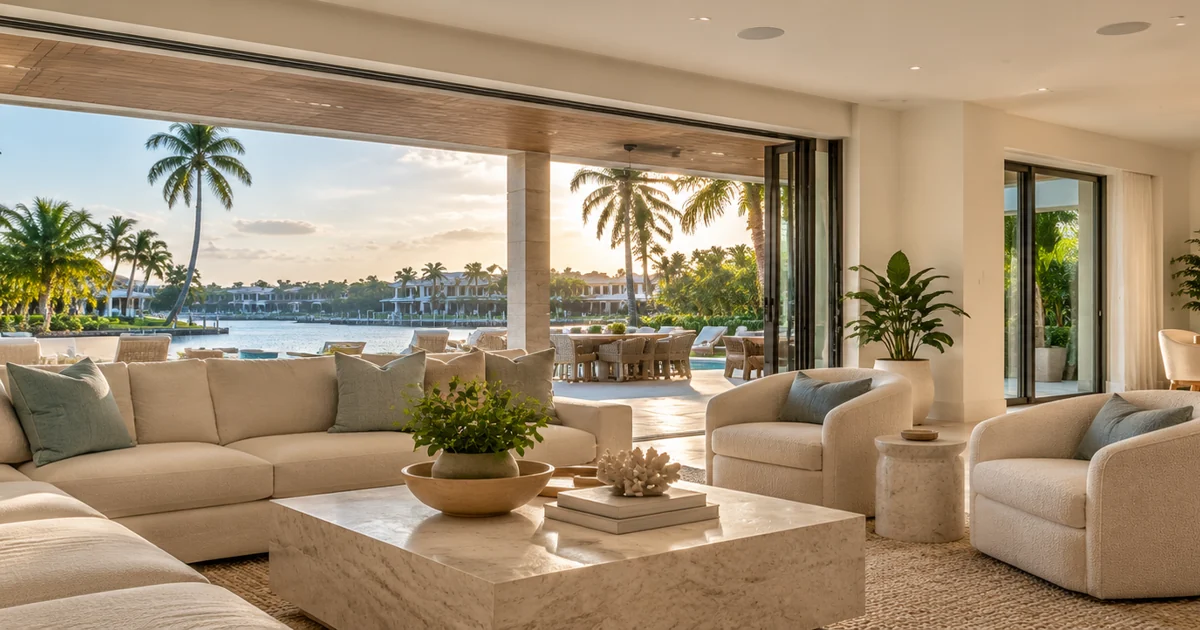
Featured image: AI-generated illustration, not a photograph of a Sentry Audio Video project.