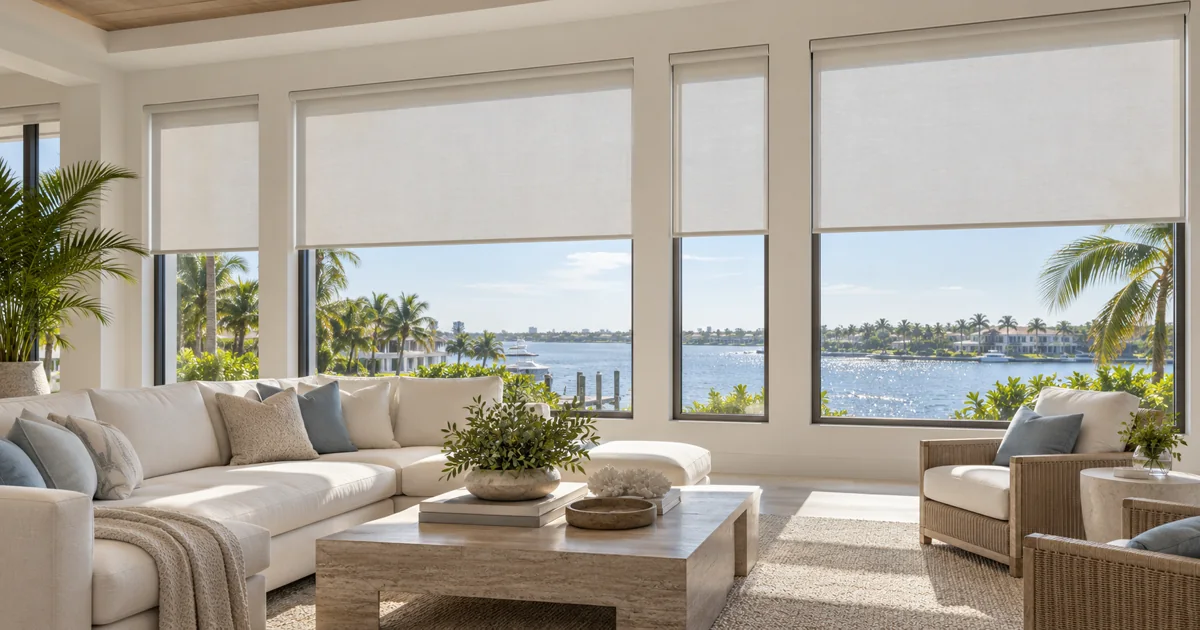
When several Lutron roller shades share a room, agree on what “aligned” means before ordering and programming. The bottom bars may need to line up across a wide glass wall, stop at a common visual height, or follow openings with different head heights. Those are related but different goals.
Plan your Lutron shades project
Share the window schedule, photographs and the visible alignment you want across the room. We can coordinate products, mounting positions and commissioning around the actual openings before ordering.
Request a Sentry Audio Video consultation Call (561) 717-3280
Lutron offers shade-alignment capabilities within supported product and system combinations, but technology does not replace a coordinated opening schedule and accurate installation. Define the visible result around the actual windows, mounting positions, fabrics and selected products.
Separate physical alignment from programmed position
A level mounting line, square installation and consistent fabric travel are physical details. A programmed shade position is a control setting. If the brackets or opening conditions differ, giving several shades the same percentage command does not necessarily create the visual line the owner expects.
Start by recording finished head heights, sill conditions, mounting details and the desired closed positions. Wide and narrow windows may sit beside terrace doors or fixed glass. The design should identify which lines the interior team wants to preserve.
Review those priorities with the owner before selecting the final assembly. A room may value a common open view line more than identical treatment coverage at every opening. That is an architectural and use decision, not simply a programming preference.
Document the shade group as one coordinated schedule
Give each opening an identifier and record its dimensions, selected shade, fabric, roll arrangement where applicable, mounting height and intended grouping. Include any different sill heights or obstructions that affect travel.
Do not assume that separate orders placed at different times will behave or appear identical. Verify the selected products, fabrics and applicable manufacturer requirements for the group. When adding shades to an existing room, identify the retained equipment and available records first.
The schedule should distinguish shades that normally move together from those that need independent operation. An operable door may need a separate control even when its shade is visually coordinated with adjacent fixed windows.
Review the exact alignment capability of the selected system
Lutron publishes information about Intelligent Hembar Alignment and an applicable shade-speed alignment process for supported installations. Confirm the requirements and capabilities for the products being supplied rather than treating one feature description as a universal promise across every shade family.
Ask the integrator how alignment will be commissioned and which reference positions will be used. Where additional setup is appropriate, include it in the programming scope and retain the final settings with the project records.
A manufacturer performance claim belongs to its stated product and conditions. It should not be expanded into a guarantee that every mixed legacy installation, mounting arrangement or custom fabric will produce an identical result without assessment.
Consider fabric and tube choices as part of the group
Different openings may require different assemblies because of their dimensions or design constraints. The product selection should account for the intended fabric, roller system and supported options before the group is approved.
Color, transparency and the visible fabric plane can influence how aligned shades appear. A common hembar height does not eliminate differences caused by mounting depth, surrounding trim or contrasting light behind the fabric.
View samples and drawings in the room where practical. The purpose of the review is to identify a coherent appearance the equipment can deliver, not to promise that a programming adjustment will hide an unresolved architectural mismatch.
Approve the useful stopping positions
Define the positions the household will use most: fully open, a daytime glare setting, privacy and fully closed where applicable. Check how each position looks across the group and whether it leaves doors and normal circulation usable.
A partly lowered scene may need a common visual line, while the closed position follows the individual opening. Record the desired result rather than assuming one numerical setting is the correct answer for every shade.
Keep local adjustment available where it is part of the plan. The homeowner should understand how an individual shade can be moved without losing the useful grouped scenes, subject to the selected system’s supported operation.
Inspect alignment in motion and at rest
At commissioning, observe the group moving through the intended range and stopping at the approved positions. Evaluate it from the normal seating area and other important viewpoints. A close inspection beside one bracket does not show the entire room’s visual result.
Check mounting, fabric travel, clearances and control behavior before attributing a mismatch to programming alone. If an adjustment is needed, follow the selected product’s documented process and verify the group again.
Include the owner in the final review and record any accepted differences arising from the architecture. Clear handoff notes help a later installer preserve the intended group when a shade or window treatment is changed.
Plan Lutron shades as a complete installation
Sentry Audio Video is an authorized Lutron dealer providing shade design, measuring, equipment sales, installation and programming. Review power, pocket and fascia coordination for construction projects. Call (561) 717-3280 for Boca Raton or Palm Beach, (954) 859-6475 for Fort Lauderdale, or request a shade consultation.
Manufacturer reference: Lutron’s shade-speed alignment guide. Verify the current requirements for the exact products and system being installed.