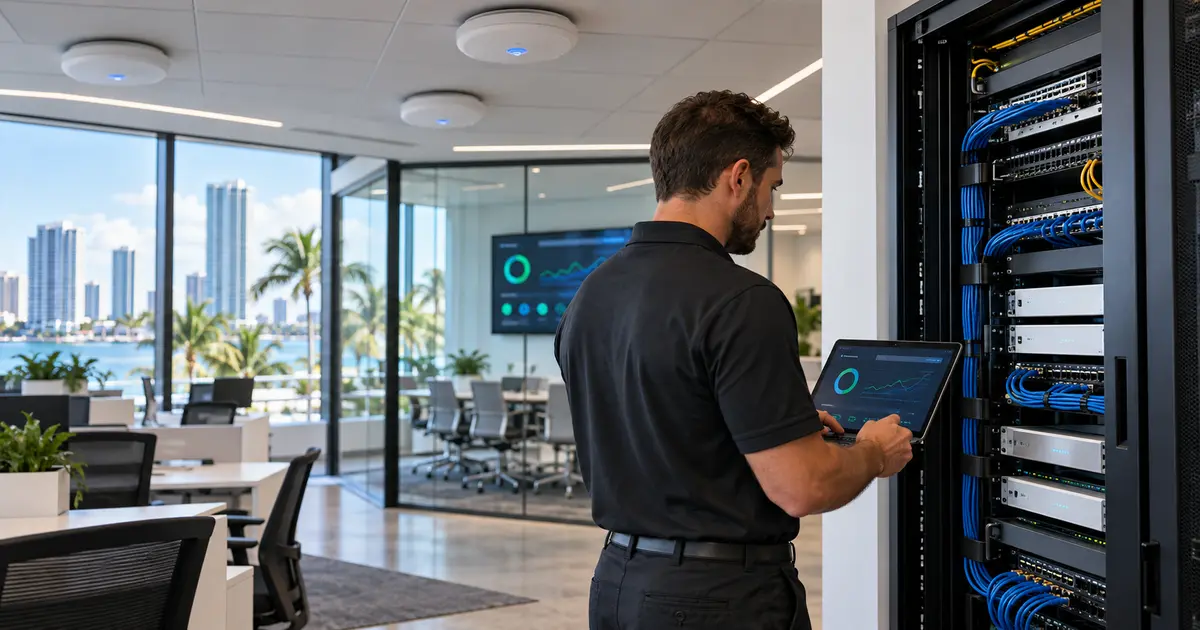
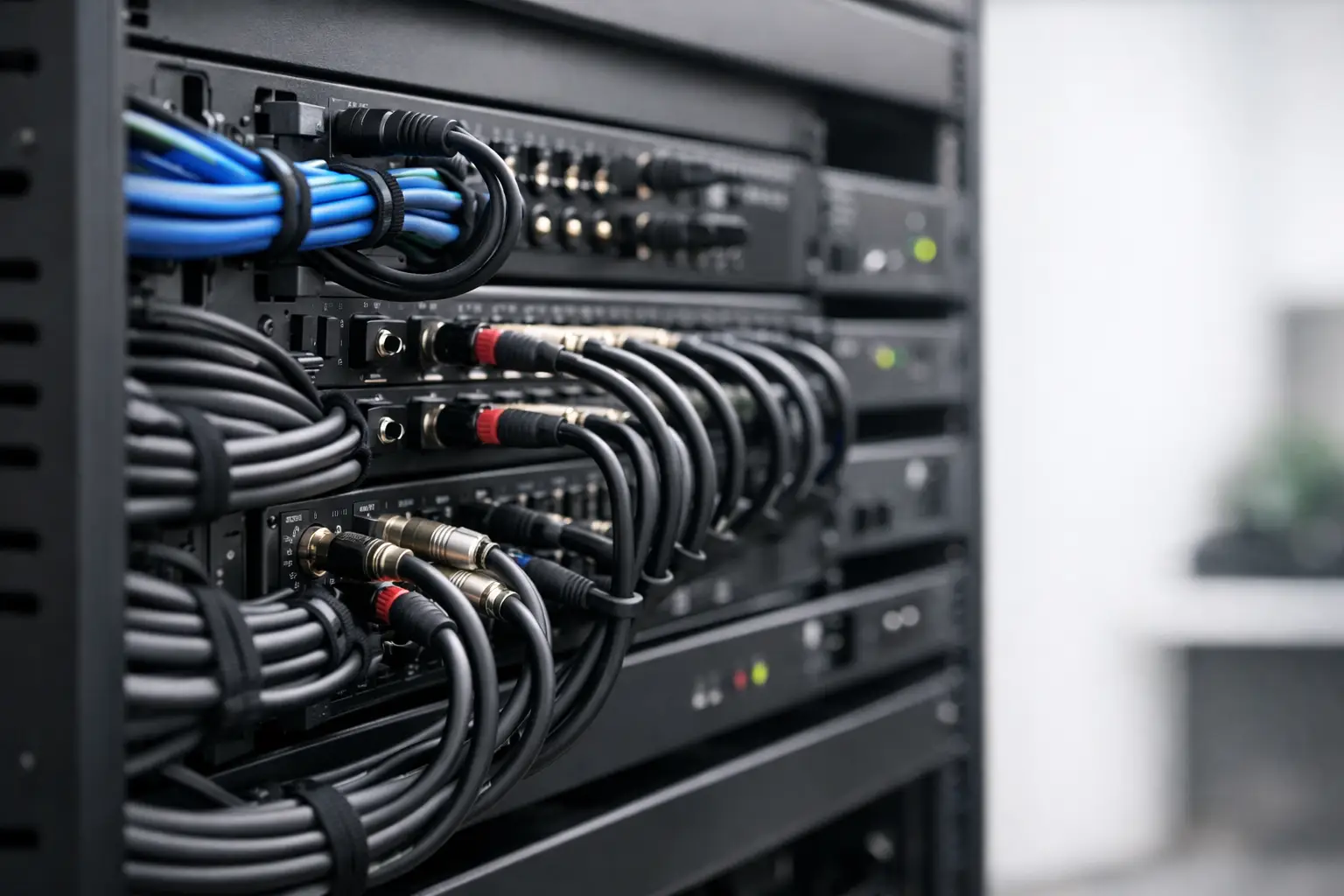
A rack can hold thousands of dollars in audio, video, networking, surveillance, and control equipment, yet its reliability often comes down to what happens behind the components. The principle behind “Clean Racks, Clean Sound: Why Professional Cable Management Matters in AV Design” is straightforward: the cables are part of the system, not an afterthought. When they are routed, labeled, supported, and separated correctly, the entire installation is easier to use, service, protect, and enjoy.
For a luxury residence, that means a home theater that performs as intended, whole-home audio that stays dependable, and a system that remains presentable long after installation day. For a business, it means fewer disruptions in conference rooms, common areas, security operations, and communications systems. A clean rack is not merely attractive workmanship. It is evidence of disciplined system design.
Clean Racks, Clean Sound Starts With System Design
Professional cable management begins before equipment reaches the rack. The integrator must account for the number of sources, displays, amplifiers, network switches, control processors, cameras, access points, and future expansion requirements. Cable pathways, rack depth, ventilation, power distribution, and service access all need to be planned as one coordinated system.
Without that planning, cables tend to accumulate wherever there is open space. Connections become strained, power and signal lines overlap unnecessarily, and a simple service visit can turn into a time-consuming troubleshooting exercise. The equipment may still operate initially, but the installation has little margin for future changes or a fast response when something needs attention.
A well-designed rack assigns a purpose to each pathway. Audio, video, data, control, and power cables are organized in a way that protects connections and makes each run easy to trace. This level of preparation is especially valuable in properties with distributed systems, where a single central rack may support multiple rooms, outdoor entertainment areas, surveillance cameras, automated shades, and networked controls.
Signal Integrity Depends on Proper Separation
The phrase “clean sound” should not be treated as a marketing shortcut. Cable organization alone cannot improve the quality of a poorly designed audio system. However, poor routing can introduce avoidable problems that compromise an otherwise excellent installation.
Power cables can generate electromagnetic interference, particularly when they run in close parallel contact with low-level analog audio, data, or control wiring. Depending on the cable type, run length, equipment grounding, and signal level, that interference may present itself as hum, buzz, noise, intermittent communication, or unstable performance. Separating power from sensitive signal pathways reduces the opportunity for those issues to occur.
Video distribution and high-bandwidth data also demand careful handling. HDMI, category cable, fiber, and other signal paths have performance limits related to length, termination quality, bend radius, and environmental conditions. A cable forced around a sharp edge or tightly compressed behind equipment may work today and fail later. Proper support and routing help preserve the cable’s physical integrity and the performance the system was designed to deliver.
The details matter. Cables should be secured without being crushed. Service loops should provide enough length for maintenance without creating tangled bundles. Connectors should be protected from side pressure. In premium AV design, those choices are not cosmetic refinements. They are part of protecting the signal path.
Serviceability Is a Major Performance Advantage
Even the most carefully selected equipment will eventually need an update, replacement, adjustment, or diagnosis. A well-managed rack makes that work faster and more precise because each cable has a clear destination and each device can be accessed safely.
Labeling is one of the most valuable disciplines in professional installation. Clear labels at both ends of a cable allow a technician to identify a zone, source, display, network connection, or camera run without relying on guesswork. Consistent labeling also helps protect the property from accidental disconnections when a system is expanded or serviced years later.
Rack layout matters just as much. Equipment that generates heat needs appropriate spacing and airflow. Components that require routine access should not be buried behind dense cabling. Patch panels, power distribution, network switches, and control hardware should be arranged so a technician can verify connections without disturbing unrelated systems.
This is where organized infrastructure supports a better ownership experience. Instead of treating service as an interruption, the system is prepared for it. Whether an owner wants to add a new display, update a network component, modify a conference room, or integrate a new outdoor zone, the existing rack provides a clear foundation for the next step.
A Professional Rack Protects Equipment and Property
Cables that hang unsupported from ports place ongoing stress on connectors. Over time, that strain can damage a port, loosen a termination, or create an intermittent issue that is difficult to diagnose. In an installation with multiple amplifiers, video sources, network devices, and control processors, one loose connection can affect far more than one room.
Organized cabling also helps maintain proper airflow. Excess cable packed around ventilation openings can trap heat where equipment needs to breathe. Heat is a common enemy of electronic components, and its effects are often gradual: shortened component life, unexpected shutdowns, or inconsistent performance during demanding use.
Power management requires the same level of attention. Professional systems use intentional power distribution and protection strategies rather than a collection of overloaded adapters and loose cords. The exact approach depends on the equipment load, location, and system requirements, but the principle remains the same: power should be accessible, secure, and clearly separated from low-voltage signal wiring where appropriate.
For commercial properties, careful organization can also support safer, more accountable maintenance practices. When surveillance, communications, audio, video, and network systems share a technology space, clear routing reduces the risk that work on one system disrupts another.
Why Appearance Still Matters
A technology rack is often located in a dedicated equipment room, utility area, closet, or office that clients and property managers may rarely see. That does not make appearance irrelevant. A clean installation communicates that every part of the project received the same care as the display, speakers, touch panels, and visible finishes.
There is a practical side to that polish. Neatly dressed cable bundles make visual inspection easier. A technician can spot an unplugged connection, a damaged cable jacket, or a misplaced patch cord more quickly. Owners also have greater confidence when they see that the infrastructure supporting their investment is orderly and intentional.
This standard is particularly meaningful in high-end homes and hospitality, retail, and corporate environments, where the technology must support the experience without creating visual clutter or operational uncertainty. The goal is not to make the rack look impressive for a photograph. The goal is to build a system that reflects the quality of the property and performs accordingly.
Not Every Cable Requires the Same Treatment
Professional cable management is not about making every run identical. The right approach depends on the system. A compact media cabinet has different needs than a full-height rack serving a large residence. A commercial installation with multiple network closets and security components requires a different documentation and routing strategy than a dedicated home theater.
Some cables can be bundled together safely; others benefit from separation. Some equipment needs generous service loops; others should use shorter, precisely measured patch cables to avoid congestion. Fiber, high-bandwidth video, analog audio, speaker cable, and network cable all have different handling requirements. The value of an experienced integrator is knowing where precision is necessary and where a simpler approach is appropriate.
Future capacity also deserves attention. A rack should not be so tightly packed that an owner has no practical path for expansion. Allowing space for additional network hardware, distribution equipment, or control components can prevent a later upgrade from becoming a complete rebuild.
The Rack Is the Foundation Behind the Experience
The visible part of an AV system gets the attention: cinematic displays, immersive sound, discreet speakers, automated lighting, and intuitive control. Yet the rack is where those experiences are coordinated. When its cabling is professionally designed and maintained, the system is more stable, easier to support, and better positioned for the future.
Sentry Audio Video approaches cable management as part of the complete integration process, not a final cleanup step. From structured wiring and network infrastructure to home theaters, commercial AV, security, and automation, every connection should have a clear purpose and a clean path.
If you are planning a new build, renovation, theater, or business technology upgrade, ask to see how the equipment rack and cable pathways will be designed. The answer will tell you a great deal about the quality, reliability, and long-term serviceability of the system you are about to own.