Sentry Audio Video is a Control4 dealer in Boca Raton. Office: 1708 Costa Del Sol, Boca Raton, FL 33432. Phone: (561) 717-3280. Florida low-voltage license: EF20001874.
Last updated: October 3, 2026.
Control4 should make a Boca Raton home easier to live in—not turn every television, light, music zone, camera and shade into a separate project. Sentry Audio Video designs, installs, programs, services and upgrades Control4 systems for custom homes, waterfront estates, condominiums, renovations and new construction throughout Boca Raton and Palm Beach County.
We also take over Control4 systems installed by other companies. That matters in South Florida, where homeowners frequently purchase a property with automation already in place, lose support from the original dealer or discover that a system was never documented or programmed correctly. Some owners call because a remote stopped controlling the television. Others need help with an older processor, unreliable audio, missing app access, weak Wi-Fi, inconsistent lighting scenes or an entire home that no longer works as one system.
Sentry Audio Video, LLC is a family-owned Boca Raton company led by Brian Zeidman. Our work includes new Control4 systems, OS 3 and X4 projects, programming, repairs, upgrades and takeovers. We also design and integrate the infrastructure around Control4: Lutron HomeWorks lighting, Ketra lighting, Palladiom keypads and shades, Josh.ai voice control, estate Wi-Fi, audio and video, theaters, cameras, gates, access control, outdoor entertainment and monitored security.
Whether the property is a year-round residence, a seasonal home managed from New York, a condominium being renovated or a waterfront estate with several structures, the goal is the same: one dependable system, simple controls and one company accountable for how the technology works together.
New Installation or Existing-System Problem?
Tell us whether you are planning a new Control4 system, need service, want an OS 3 or X4 upgrade, or need Sentry to take over a system installed by another dealer.
Request Control4 Service or a Consultation
Share the property location and what you need. Photos of the rack, remotes, touchscreens or error messages are optional but useful for existing-system calls.
What a Control4 System in a Boca Raton Home Should Actually Control
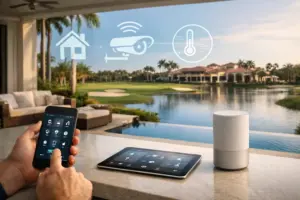
Control4 is not valuable because it puts another app on your phone. Its value is that it gives the home a consistent way to control systems that would otherwise operate separately. The homeowner should not need one app for the family-room television, another for outdoor music, another for lighting, another for shades and several more for cameras, climate and access.
Whole-home audio
Control4 can organize music across kitchens, living spaces, bedrooms, covered patios, pool decks and other entertainment areas. Owners can choose a room, select a source and adjust volume without walking to an equipment rack or using a different app in every zone.
Television and video distribution
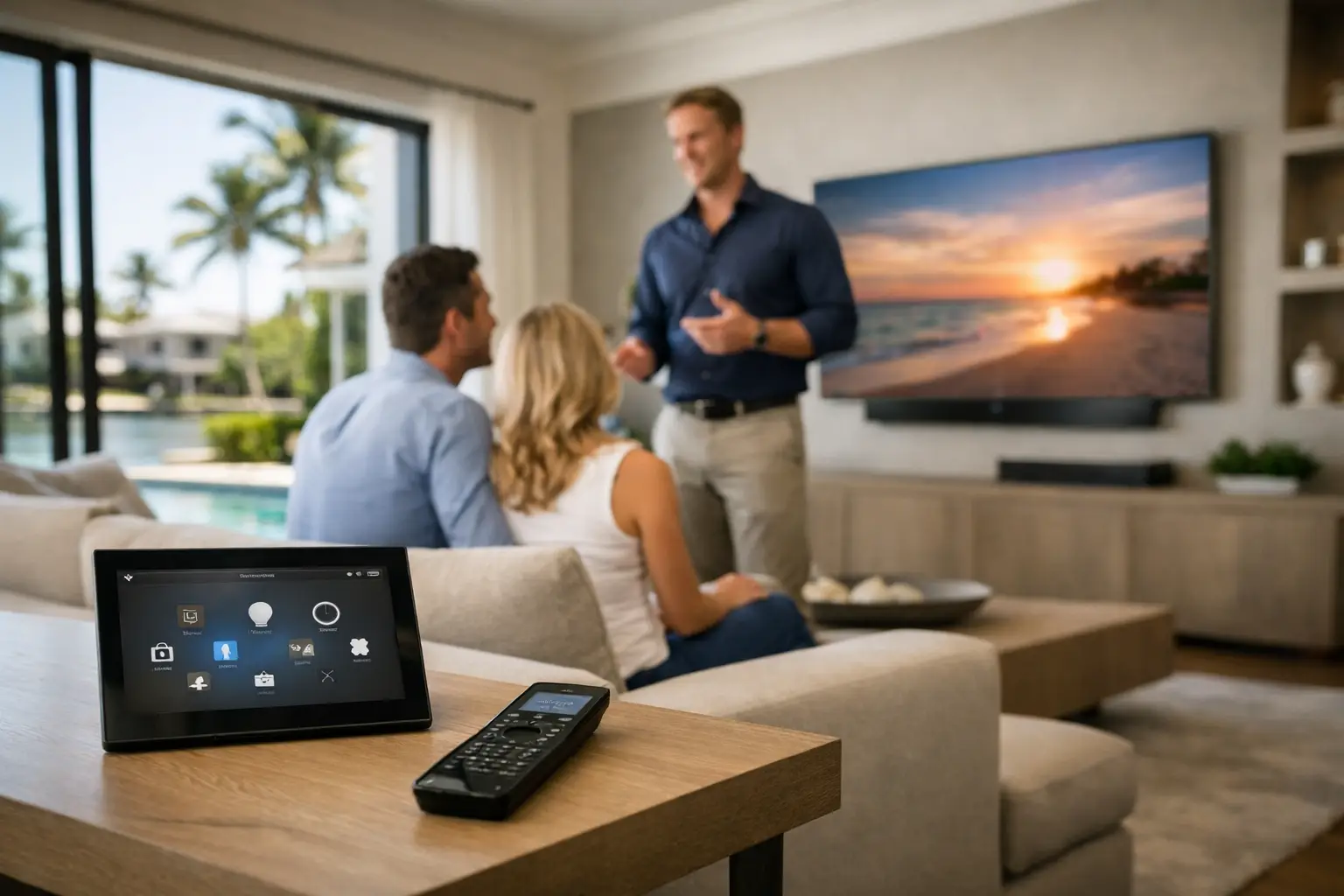
A Control4 remote should start the room correctly: display on, correct source selected, audio routed properly and the desired channel or streaming interface ready to use. The homeowner should not need four remotes or a written sequence taped inside a cabinet.
Home theater and media rooms
Control4 can make a dedicated theater or high-performance media room approachable. One command can prepare the room, select the source, set lighting, lower shades where applicable and establish the correct audio and video settings. When the movie ends, another command can return the room to normal.
Lighting control and motorized shades
Lighting is where a well-planned automation system becomes part of daily life. Scenes can prepare the home for arrival, entertaining, dinner, bedtime or departure without forcing the owner to operate a wall full of individual dimmers. Motorized shades can coordinate with those scenes to reduce glare, protect interiors and improve privacy.
For higher-end residences, we often discuss Control4 alongside Lutron HomeWorks, Ketra and Palladiom. Lutron can provide the lighting and shading foundation while Control4 presents those functions with entertainment, climate and other systems. The platforms should be coordinated from the design stage so that keypad locations, engravings, scenes, loads and programming responsibilities are clear. Learn more about how Lutron works with Control4.
Climate, pool and property modes
Control4 can place useful climate functions alongside the rest of the home, subject to the equipment and integrations selected for the project. A seasonal owner may want a clear Home, Away or Extended Away routine. Those modes can coordinate designated lighting, shades, climate settings and other connected functions without requiring the owner to remember a long departure checklist.
Cameras, gates and access
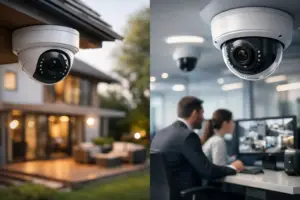
A Boca property may include perimeter cameras, a front gate, pedestrian access, door stations, vehicle entries and service entrances. Control4 can provide convenient visibility and selected control, but the surveillance and access systems still need to be designed as serious systems in their own right.
Outdoor entertainment
Outdoor living is not an accessory in Boca Raton. Covered patios, summer kitchens, pools, docks and gardens may be used throughout the year. Control4 can simplify music, televisions, lighting scenes and related entertainment functions in those areas.
Josh.ai voice control
Josh.ai can add natural voice control to a professionally integrated home. Voice is useful when hands are occupied, when a homeowner wants to adjust a scene without reaching for a keypad or when a spoken command is more convenient than navigating a screen.
Control4 Designed for South Florida Conditions
A Control4 system cannot be separated from the building. Boca Raton and Palm Beach properties present conditions that do not always appear in a generic smart-home proposal. Construction materials, property layout, outdoor living, weather exposure and seasonal occupancy can all change the system design.
Concrete, masonry and impact construction
Concrete walls, reinforced floors, masonry and impact-rated assemblies can make wireless coverage less predictable. A single consumer router may appear adequate in an open room but fail across floors, wings or exterior walls. When key devices depend on stable network communication, weak coverage becomes a Control4 problem even if the controller itself is operating correctly.
Larger properties need an engineered plan for wired network connections, access-point placement and backhaul. New construction gives the team the best opportunity to establish that foundation before ceilings and wall finishes are complete. In an existing residence, a site survey and careful retrofit plan help determine where existing cabling can be reused and where new pathways are justified.
Multi-structure properties
Guesthouses, garages, gatehouses, cabanas and detached entertainment spaces introduce distance, pathway and service challenges. Extending a network by placing a wireless extender in a window is not a reliable estate design. Fiber, copper, conduit, point-to-point links or a combination may be appropriate depending on distance, lightning exposure, available pathways and bandwidth requirements.
Salt air, heat and humidity
Coastal air and South Florida humidity are hard on connectors, mounts, displays, speakers and electronics. Equipment should not be selected solely from a feature list. Enclosures, ventilation, mounting materials, exposure ratings and service access matter.
Heat is equally important inside equipment spaces. An overloaded rack placed in an unconditioned closet can become unstable even when every component was properly programmed. We evaluate rack location, airflow, equipment density and environmental conditions because automation reliability depends on the electronics staying within a suitable operating environment.
Sunlight and glare
Large glass openings and bright outdoor spaces affect displays, projection systems and interfaces. A television that looks excellent in a controlled showroom may struggle opposite a wall of glass. A projector that performs well at night may not serve a multipurpose room during the day. Motorized shades, display brightness, screen material and viewing orientation should be discussed together.
Seasonal occupancy and remote management
Many Boca Raton and Palm Beach homes are occupied seasonally. Owners may spend part of the year in New York, Long Island, Manhattan, The Hamptons, Sag Harbor, Montauk or Greenwich. Remote access can allow an owner to check selected systems and prepare the property before arrival, depending on the installed equipment, subscriptions and configuration.
The Infrastructure Behind a Reliable Control4 System
The visible interface is only the front end. Most service failures originate in the less glamorous parts of the project: incomplete wiring, weak networks, poor rack layouts, inadequate power protection, overheating equipment, undocumented changes or devices that were never intended to work together.
Sentry treats infrastructure as part of the Control4 system, not a separate allowance to be reduced after the equipment list is chosen.
Structured cabling and pathways
New construction and major renovations should include a low-voltage plan before walls close. That plan may cover network connections, wireless access points, televisions, audio zones, touchscreens, cameras, door stations, shades, gates, control interfaces and future locations. Conduit can be valuable in areas where display standards, source requirements or future technology may change.
Enterprise-grade Wi-Fi and networking
Control4 depends on the network, as do streaming devices, televisions, mobile interfaces, cameras and many connected products. The network must be sized for the property and designed for stable roaming, adequate capacity and serviceability.
Rack layout and service access
A central rack should make the system easier to understand and maintain. Components need logical placement, correct ventilation, organized cabling, clear labels and room for service. Power supplies and network connections should be identifiable without tracing an unlabeled bundle through the back of a cabinet.
Power protection and recovery
South Florida storms and utility interruptions can expose weaknesses in connected systems. Appropriate surge protection, power conditioning and backup strategies should be considered based on the equipment and project. A system should also have a documented recovery plan. Owners should not be expected to unplug random devices in an equipment room until something starts working.
Cooling and equipment environment
Processors, amplifiers, video equipment, network switches and other rack components create heat. Cramming them into cabinetry without ventilation can shorten equipment life and cause intermittent failures that are difficult to reproduce. Rack design must account for heat load, airflow, clearances and the surrounding room.
Labeling, documentation and account ownership
Every serious system should leave the owner with a clearer property than the one we found. Labels, equipment lists, network information, system notes and account ownership help prevent the home from becoming dependent on one technician’s memory.
Control4 Service, Repair and System Takeovers
New installation is only half of the Control4 market in Boca Raton. Many homeowners already have a system. The problem is that it is unreliable, outdated, difficult to use or unsupported.
Sentry services and evaluates Control4 systems installed by other companies. You do not need to be the original client, and we do not assume that the entire system must be replaced. We begin by understanding what is installed, what still works, what the homeowner wants to keep and what is preventing the system from operating properly.
Bought a home with Control4?
Purchasing a home with Control4 can be an advantage when the wiring and equipment were planned well. It can also be confusing when the seller, prior dealer or property manager did not leave useful records.
A takeover assessment may include the processor and software generation, controllers, remotes, touchscreens, lighting, audio and video equipment, network health, rack condition, account access, available documentation and third-party integrations. We also ask practical questions: Which rooms matter most? What currently works? What fails repeatedly? Does the owner want to preserve the original design or simplify it?
The result should be a prioritized plan. Safety, network stability and core control come before cosmetic programming changes. Useful equipment can often remain when it is compatible and dependable. Unsupported, failed or limiting components may need replacement. The owner should understand why each recommendation is being made.
Need a new Control4 service company?
Homeowners change dealers for many reasons. The original company may have closed, stopped responding, shifted markets or simply no longer be a good fit. A renovation may also outgrow the capabilities of the earlier design.
Sentry can become the service partner after a proper evaluation. That process is important because accepting responsibility for a large system without understanding its condition leads to poor expectations on both sides. We identify access limitations, existing faults and undocumented work before promising a repair path.
Failed processors, remotes and touchscreens
A dead controller or failed interface can make unrelated equipment appear broken. Before replacing anything, we determine which device failed, what software and hardware dependencies exist and whether the remaining system can support the proposed replacement.
OS 3 and X4 upgrades
An upgrade to Control4 OS 3 or X4 is not simply a button press for every home. Eligibility and scope depend on the existing controller, connected devices, drivers, integrations, subscriptions and the condition of the project. Older hardware may need to be replaced. Third-party devices may require updated drivers or may no longer support the desired platform.
Before recommending an operating-system upgrade, we evaluate compatibility and the homeowner’s reason for making the change. The goal is not to chase a version number. It is to improve usability, supportability and access to appropriate features without breaking working parts of the home.
Programming cleanup
Poor programming can make good equipment frustrating. Rooms may be named inconsistently. Buttons may do different things in similar spaces. Old devices may remain in the interface. Lighting scenes may no longer match the furniture or use of the room. A single failed command may interrupt an entire sequence.
Adding rooms and systems later
A Control4 system should be able to evolve, but expansion still requires design. Adding an outdoor television may affect the network, audio distribution, rack capacity, control interfaces and power. Adding Lutron shades may require coordination of devices, scenes and keypad behavior. Adding cameras may affect recording storage, network capacity and the views available inside Control4.
Repair or replace?
We do not assume an inherited system should be demolished. The decision should consider equipment age, compatibility, reliability, replacement availability, wiring condition, current needs and the cost of supporting the old design.
For general smart-home, AV, networking or security troubleshooting, visit Sentry’s service and repair page.
Control4 for New Construction, Renovation and Retrofit
The project type changes how Control4 should be planned. A new estate offers access to framing and pathways. A condominium renovation may have strict building rules and limited routes. A finished waterfront home requires a retrofit strategy that respects millwork, stone, ceilings and occupied rooms.
New construction and pre-wire
The best time to prevent technology problems is before electrical and low-voltage rough-in. Sentry works from plans, homeowner priorities and trade coordination to develop the system infrastructure. We identify equipment locations, rack requirements, keypad and touchscreen positions, television backing, speaker locations, camera views, access points, shade requirements, gate interfaces and service pathways.
Pre-wire should be verified before insulation and drywall. Field conditions change, and plans do not always show framing conflicts, mechanical equipment or millwork details. A site review can catch missing or blocked pathways while corrections are still practical.
Major renovation
Renovation creates an opportunity to correct older infrastructure while preserving useful parts of the system. We survey existing wiring and equipment, compare it with the new floor plan and determine what can be reused. If walls and ceilings are opening, we prioritize pathways that will be difficult or expensive to add later.
Retrofit in a finished home
Not every Control4 project requires a major renovation. A focused retrofit can improve television control, audio, lighting, cameras, networking or selected rooms. The design must respect existing architecture and finishes.
Condominium projects
Boca Raton and Palm Beach condominiums introduce their own constraints: concrete construction, shared infrastructure, limited equipment space, association requirements, working-hour rules and restricted pathways between rooms. Access-point placement and cable routes need to be realistic. Rack and ventilation planning are especially important when equipment must fit within millwork or a compact utility area.
How Sentry Audio Video Runs a Control4 Project
Technology projects become difficult when design, wiring, equipment, programming and support are treated as unrelated purchases. Sentry uses a coordinated process so the system that is promised can be installed, tested and maintained.
1. Consultation and priorities
We begin with the property and the people using it. Is this a primary residence or seasonal home? Which rooms are used every day? How do you entertain? Who needs access: family, guests, staff or property management? What is frustrating about the current system? What future work is already planned?
2. Design or system survey
For a new project, we review plans and develop the system architecture. For a takeover, we inspect the installed equipment, wiring, network, software generation and connected systems. The deliverable is a clear scope—not a list of products without an explanation of how they work together.
3. Pre-wire and infrastructure
When construction is involved, low-voltage work is coordinated with framing, electrical, HVAC, millwork, shades and other trades. Cable routes and device locations are labeled and checked. Rack power, ventilation and access are confirmed before the equipment room is finished.
4. Installation
Equipment is mounted, connected and organized according to the design. Displays, speakers, interfaces, network equipment and rack components are installed with attention to service access and finished appearance.
5. Programming
Programming translates the design into daily use. Rooms, sources, lighting scenes, schedules, remotes, touchscreens and mobile access are configured around the approved scope. Similar rooms should behave consistently, and frequently used actions should be easy to find.
6. Testing
We test more than individual devices. We test the sequences that matter: turning on a room, selecting sources, adjusting volume, operating scenes, viewing cameras and moving between interfaces. For larger homes, testing includes different rooms, users and network conditions.
7. Client training
The owner should know how to use the system without being overwhelmed by the programming behind it. Training focuses on common functions, important property modes, remotes, touchscreens, mobile access and what to do when a service issue occurs. Staff or property managers can receive focused guidance for their responsibilities.
8. Ongoing support
Homes change. Streaming services update, equipment ages, rooms are renovated and owners add new technology. Local service keeps the Control4 system aligned with the property instead of allowing it to become a collection of workarounds.
Working With Builders, Architects, Designers and Electricians
A successful luxury-home project depends on coordination. Control4 touches electrical, lighting, shades, millwork, mechanical systems, network infrastructure, television locations, speaker placement, gates and security. Decisions made by one trade can limit another if they are not discussed early.
The electrician remains central to line-voltage work and lighting coordination. Interior designers help determine sightlines, finishes and how visible technology should be. Architects and builders protect structure, schedule and constructability. The integrator’s role is to make sure the technology plan can be executed without sacrificing the design or leaving the homeowner to mediate between vendors.
For owners comparing control platforms during design, our guide to Crestron versus Control4 for Boca Raton estates explains how project scale, customization and support expectations can affect the decision.
One Scope for Control4, Lighting, Voice, Security and the Network
The easiest proposal is not always the easiest home to own. Five separate vendors may each complete their part, yet the homeowner is left deciding who is responsible when a scene, camera view, gate command or audio zone does not work.
Sentry can coordinate the connected systems as one scope. Control4 may be the daily interface, Lutron HomeWorks may manage lighting and shades, Josh.ai may provide voice control, Brivo or other selected platforms may support access needs, and dedicated surveillance and network systems may handle cameras and connectivity. Each system still has a specific job, but the design, wiring, interfaces and support plan are coordinated.
One accountable integrator can diagnose the complete path. It also creates a cleaner experience for the builder and owner: one technology design, coordinated infrastructure and a service team that understands how the systems depend on one another.
Explore Sentry’s broader residential integration services for whole-home audio and video, theaters, lighting, shades, networking, surveillance, security and outdoor entertainment.
Licensed Low-Voltage Work and Local Support
Sentry Audio Video, LLC holds Florida low-voltage license EF20001874. Licensing matters because a substantial Control4 project is more than product setup. It can involve structured cabling, communications, security-related systems, surveillance, access and coordination with other licensed trades.
Sentry is based in Boca Raton and supports homes throughout Palm Beach County and South Florida. That local presence is particularly valuable for seasonal owners. When the homeowner is in New York, the service company still needs to understand the Boca property, the equipment room and the local construction conditions.
Family ownership also keeps accountability close to the work. Clients are not hiring a national call center or an unrelated company using the Sentry name. They are working with Sentry Audio Video, LLC, led by Brian Zeidman, for the design, installation and long-term support of their systems.
What Clients Say About Sentry Audio Video
Jay Rogoff — Whole-home Control4, lighting and Josh.ai
Jay Rogoff describes Sentry’s work on a whole-house Control4 system that included audio, video, indoor and outdoor lighting and Josh.ai. He specifically notes that the team was professional and responsive. His project reflects the kind of coordinated scope a large residence needs: the control platform, entertainment, lighting and voice experience planned as one system.
Michael Sarcona — Audio, video and security for a new home
Michael Sarcona describes Sentry wiring and installing the audio, video and security systems in his new home. That type of project begins before final equipment is installed. The wiring, device locations and coordination completed during construction determine whether the finished systems can perform reliably and remain serviceable.
Control4 Service Areas
Sentry provides Control4 consultation, installation, programming, repair, upgrades and takeover assessments in Boca Raton, including custom homes, waterfront properties, condominiums, renovations and seasonal residences. Our broader South Florida service area includes Delray Beach, Palm Beach, Gulf Stream, West Palm Beach, Fort Lauderdale, Miami and surrounding communities.
The New York division serves Massapequa, Long Island, Manhattan, The Hamptons, Sag Harbor and Montauk, as well as Greenwich, Connecticut. This two-market presence is especially useful for clients who divide their time between South Florida and the New York area and want technology partners who understand seasonal residences and remote property access.
Project availability and service scheduling depend on location, scope and technician availability. Call the appropriate office with the property address and a description of the system or planned work.
Frequently Asked Questions About Control4 in Boca Raton
Who installs and services Control4 in Boca Raton?
Sentry Audio Video designs, installs, programs, services and upgrades Control4 systems in Boca Raton and surrounding South Florida communities. We work on new systems and evaluate systems installed by other companies. Our scope can include the Control4 platform, whole-home audio and video, Lutron lighting and shades, Josh.ai voice control, estate networking, cameras, gates, access control, outdoor entertainment and monitored security. Sentry Audio Video, LLC is family-owned, led by Brian Zeidman and holds Florida low-voltage license EF20001874. For a new installation or consultation, call (561) 717-3280 or use our contact form.
Can you take over a Control4 system another company installed?
Yes. Sentry evaluates Control4 systems installed by other dealers and integrators. A takeover normally begins with an assessment of the processor, software version, controllers, remotes, touchscreens, network, rack, wiring, connected systems, account access and available documentation. We identify what works, what is failing and which equipment can reasonably be retained. The next step may be programming cleanup, network repair, replacement of failed or incompatible hardware, an operating-system upgrade or a phased modernization. We do not assume the entire system must be replaced simply because another company installed it. For a step-by-step homeowner explanation, read our guide to changing Control4 dealers in Boca Raton.
Do you upgrade older Control4 systems to OS 3 or X4?
Yes, when the installed system and project goals support the upgrade. Compatibility must be reviewed first. The existing processor, connected devices, drivers, third-party integrations, subscriptions and project condition can affect whether an OS 3 or X4 upgrade is appropriate and what hardware changes are required. Some older equipment may need replacement, and certain third-party products may require updated drivers or a different integration path. Sentry evaluates the system before proposing the upgrade, explains the required changes and tests the connected rooms and functions after the work is complete.
Can I control my Boca Raton home while I am in New York?
Remote access can allow an owner to view and operate selected Control4 functions from New York or another location, depending on the installed equipment, services and configuration. Common priorities include checking cameras, adjusting climate, preparing lighting, confirming property modes and getting the home ready before arrival. Reliable remote use depends on more than the app: the Boca property needs stable internet service, a properly designed network, dependable power and correctly configured accounts. Sentry serves both South Florida and New York markets and understands the support needs of seasonal residences.
Does Control4 work with Lutron and Josh.ai?
Control4 can be integrated with appropriately designed Lutron lighting and shading systems and with Josh.ai voice control. In many luxury homes, Lutron HomeWorks provides the lighting and shade foundation, Control4 brings lighting together with entertainment and other systems, and Josh.ai adds voice control. Successful integration requires coordinated device selection, programming, room names and scenes. Sentry works with Control4, Lutron HomeWorks, Ketra, Palladiom and Josh.ai so the interfaces can be planned as one experience instead of separate vendor projects.
What causes Control4 problems in concrete or waterfront homes?
Control4 problems in concrete and waterfront properties are often caused by surrounding infrastructure or environmental conditions rather than the automation platform alone. Reinforced concrete and masonry can weaken wireless coverage. Large floor plans and detached structures can expose poor network design. Salt air, heat and humidity can damage unsuitable outdoor equipment or connectors. Hot, unventilated rack spaces can cause intermittent failures. Power events, undocumented wiring and aging third-party devices can also affect the system. A proper diagnosis checks the controller, network, power, rack environment, cabling and connected equipment instead of repeatedly rebooting the processor.
Do you work on Control4 systems during new construction?
Yes. Sentry works on new construction and major renovation projects from design and pre-wire through installation, programming, testing and client training. Early involvement allows us to coordinate structured cabling, network access points, equipment racks, televisions, speakers, touchscreens, lighting control, shades, cameras, gates and outdoor entertainment before walls and ceilings close. We can coordinate requirements with the builder, architect, interior designer, electrician, millworker and other trades. This reduces last-minute compromises and creates a more serviceable finished system.
Can one company handle Control4, cameras, lighting and networking?
Yes. Sentry can design and coordinate Control4, estate Wi-Fi and networking, surveillance cameras, Lutron lighting and shades, audio-video systems, outdoor entertainment, access and gates, and monitored security as one technology scope. Each platform still performs its own specialized role, but the infrastructure, interfaces and service plan are coordinated. That gives the owner one accountable technology partner when an issue crosses system boundaries—for example, when a camera-view problem involves the network, recorder and Control4 interface.
Can you repair a Control4 system without replacing everything?
Often, yes. Whether equipment can be reused depends on its condition, age, compatibility, software support and the owner’s goals. A failing system may need a network correction, new remote, programming cleanup, repaired connection or replacement controller rather than a complete rebuild. In other cases, obsolete or repeatedly failing components make selective replacement more practical. Sentry starts with an assessment and provides a prioritized repair or upgrade plan so the owner understands what can remain and what is limiting reliability.
Can Control4 be added to an existing finished home?
Yes. A retrofit can add or improve Control4 in a finished home, but the design must account for available wiring, construction materials, equipment locations and finished surfaces. We survey existing pathways and determine where hardwired connections are practical and where compatible wireless devices may be appropriate. A retrofit may begin with television control, audio, lighting, shades, networking, cameras or selected rooms and expand over time. The objective is a reliable system with a clean finished appearance, not visible shortcuts that compromise the home.
Is Control4 appropriate for a Boca Raton condominium?
Control4 can work well in a condominium when the system is designed around the unit and building constraints. Concrete walls and floors, limited equipment space, association requirements, restricted work hours and limited cable pathways can affect the approach. A condominium system may control audio, video, lighting, shades, climate and selected security functions without the scale of a large estate. Sentry coordinates equipment location, ventilation, network coverage and renovation timing so the technology fits the space and the building rules.
How should I choose between Control4 and Crestron?
The choice depends on the property, desired customization, user experience, connected systems, project scale and long-term service expectations. Control4 can be an excellent fit for professionally integrated homes that need consistent control of entertainment, lighting, shades, climate, cameras and related functions. Crestron may be considered where the project calls for a different level or style of customization and engineering. The best decision comes from the actual plans and requirements, not a brand comparison in isolation. Read our detailed Crestron versus Control4 guide for Boca Raton estates or schedule a design consultation.
Schedule a Control4 Consultation or Service Visit
If you are building or renovating in Boca Raton, Sentry can plan the Control4 system, infrastructure, lighting and shades, network, security and entertainment before construction decisions close off your best options.
If you already own a Control4 system that is unreliable, outdated or unsupported, we can assess a system installed by another company and provide a practical repair, upgrade or takeover plan.
Contact Sentry Audio Video to discuss your property and priorities.
Florida: (561) 717-3280
New York: (516) 210-2120
Boca Raton: 1708 Costa Del Sol, Boca Raton, FL 33432
Florida low-voltage license: EF20001874