- BOCA RATON (561) 717-3280
- ORLANDO (407) 377-5360
- NEW YORK (516) 210-2120

Structured Cabling and Fiber-Optic Installation in Boca Raton
Sentry Audio Video runs, installs, tests and certifies Cat6, Cat6A and fiber-optic cabling for homes, estates, offices, restaurants and commercial properties in Boca Raton, South Florida and Orlando. Call to request a cabling site survey for new construction, retrofit or repair work.
Our work supports networking, Wi-Fi, audio, video, security cameras, access control, PoE devices and future technology from one documented infrastructure plan. Every camera and access-control project is also a wiring project.
25 Years of Experience · Florida license EF20001874 · Family-owned · Existing-system takeovers welcome
Camera and access-control brands do not remove the need for a real backbone. Ubiquiti, Continental, Brivo and every other IP device still need specified Cat6/Cat6A or fiber, PoE budget, a labeled rack and a switch that will not collapse when the cameras come online.
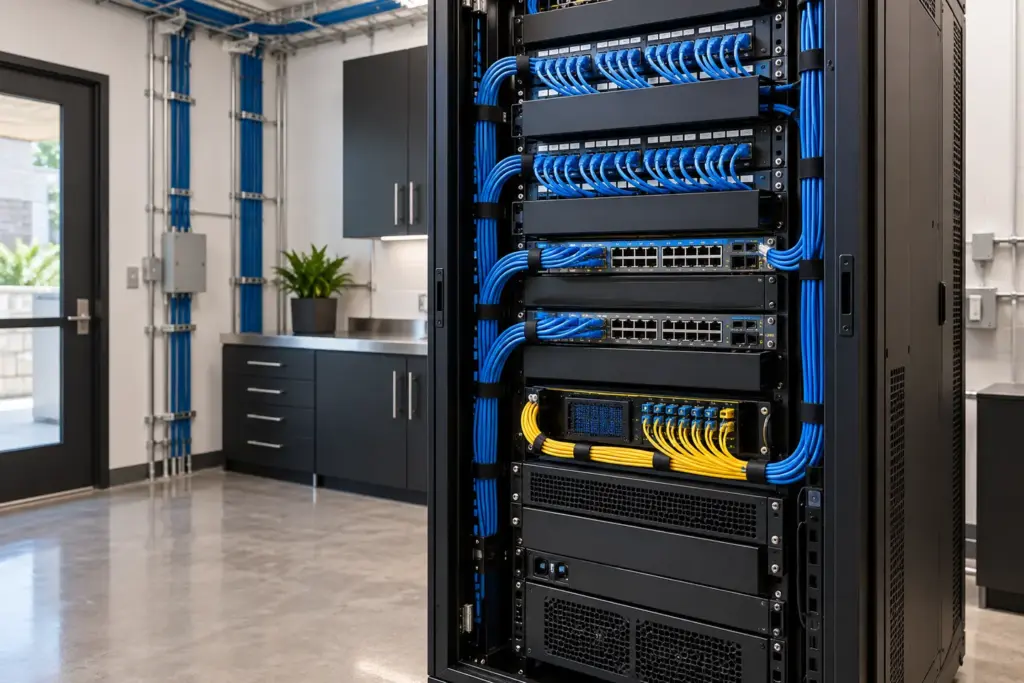
Low-Voltage Planning Before Construction
A pre-wire plan should be coordinated with the architectural drawings, electrical plan, millwork, reflected ceiling plan and equipment locations. We identify pathways, device positions, rack space, power, ventilation and service access before field conditions force compromises.
- Category cable for data, Wi-Fi, cameras and control
- Fiber for high-bandwidth and inter-building links
- Speaker and subwoofer wiring
- Coaxial and specialty video cabling
- Security, alarm and access-control wiring
- Motorized-shade and keypad infrastructure
- Conduit and future-use pathways
Fiber-Optic Cabling Installation, Testing and Certification
Sentry runs, installs, terminates, tests and certifies fiber-optic cable for high-bandwidth backbones, equipment-room links, detached buildings and other applications where copper is not the right path. The design is based on distance, environment, pathway, connector and equipment requirements, and the completed links are labeled and documented.
Network, Wi-Fi and Camera Cabling
Wireless access points and cameras perform best when cable routes, mounting locations, PoE requirements and switch capacity are planned together. We coordinate indoor, outdoor and detached-building coverage with the network design. See our security camera installation and access control services.
Audio, Video and Theater Pre-Wire
Speaker locations, television backing, projector pathways, subwoofer positions and equipment racks should be documented before drywall. A small change at the planning stage can prevent visible wiring or major reconstruction later.
Control Systems, Lighting and Shades
Control4, Savant, Crestron, Lutron HomeWorks and Josh.ai each have infrastructure requirements. We coordinate processor locations, keypads, touchscreens, lighting panels, shade power and network connections around the selected platform.
Equipment Racks and Mechanical Coordination
Centralized equipment requires adequate depth, ventilation, power, grounding, cable management and service clearance. Sentry provides rack elevations and coordinates with electricians, HVAC contractors, millwork teams and builders.
Cellular Signal and Specialty Infrastructure
Properties with weak cellular service may benefit from a professionally designed signal-booster or distributed cellular solution. Requirements depend on carrier signal, building materials, roof access and local conditions. Sound isolation, acoustic pathways and specialty wiring can also be coordinated during theater and media-room construction.
Testing, Labeling and Documentation
Every cable should be terminated, tested, labeled and documented. Photographs before drywall, as-built plans and rack schedules allow future technicians to expand or repair the system without guessing.
Retrofit Cabling
Existing properties may use attics, crawl spaces, closets, soffits, conduit and selective access openings. We survey the building before defining what can be completed cleanly and where repair work may be required.
Frequently Asked Questions
How early should the low-voltage company be involved?
Ideally during design development, before electrical and framing decisions are finalized. Early coordination gives the builder, electrician and low-voltage team time to resolve pathways, rack locations, power, device positions and access before walls and ceilings close.
Should conduit be installed for future technology?
Yes, in strategic locations where displays, projectors, racks, exterior connections or future fiber may change. Conduit does not replace a cabling plan, but it can preserve a practical service path when future equipment requirements are unknown.
Do you work with the builder and electrician?
Yes. Coordination between trades is essential for power, pathways, fire stopping, mounting, rack locations and final finishes. We can work from project drawings, mark up device and pathway requirements and coordinate field conditions with the construction team.
Do you install, test and certify fiber-optic cable?
Yes. Sentry runs, installs, terminates, tests and certifies fiber-optic cable for appropriate residential and commercial applications. The required fiber type, pathway, connectors and test documentation are defined from the distance, environment and connected equipment.
Should I use Cat6 or Cat6A?
The choice depends on link length, bandwidth, PoE load, cable density, pathway space and the equipment being supported. We specify the cable around the actual network, camera, access-control or AV requirement rather than using one category for every pathway.
Can the same cabling support cameras and access control?
Yes. Professional IP cameras, access-control panels, readers and intercoms often depend on structured cabling and PoE. We review cable paths, switch capacity, power budgets, equipment racks and network segmentation so the security system has a serviceable foundation.
Plan the Infrastructure Once
Sentry Audio Video provides structured cabling, design documentation and low-voltage installation for residences and businesses throughout South Florida and New York. Request a cabling site survey.
Sentry Audio Video offices
Boca Raton: 1708 Costa Del Sol, Boca Raton, FL 33432 · (561) 717-3280
Orlando: 5720 Argosy Court, Orlando, FL 32819 · (407) 377-5360
New York: (516) 210-2120
Florida low-voltage license EF20001874