A beautiful property should not rely on a metal key and a hope that it has not been copied. Modern access control Boca Raton property owners can depend on replaces uncertainty with a clear, manageable approach to entry. The right system gives residents, staff, visitors, and service professionals appropriate access while creating a record of who entered, where, and when.
For a waterfront residence, a private community, a medical office, or a growing commercial facility, access control is more than a security feature. It is part of how the property operates. Doors, vehicle gates, elevators, amenity areas, offices, and equipment rooms can be controlled from one thoughtfully designed system rather than managed through a collection of keys, remotes, and workarounds.
What Access Control Should Accomplish
A professionally designed access control system starts with the people who use the property, not a catalog of hardware. A family may want secure gate access, a discreet entry station, and the ability to grant temporary access to household staff. A business may need employee credentials, visitor management, restricted records rooms, and a fast way to remove access when staffing changes.
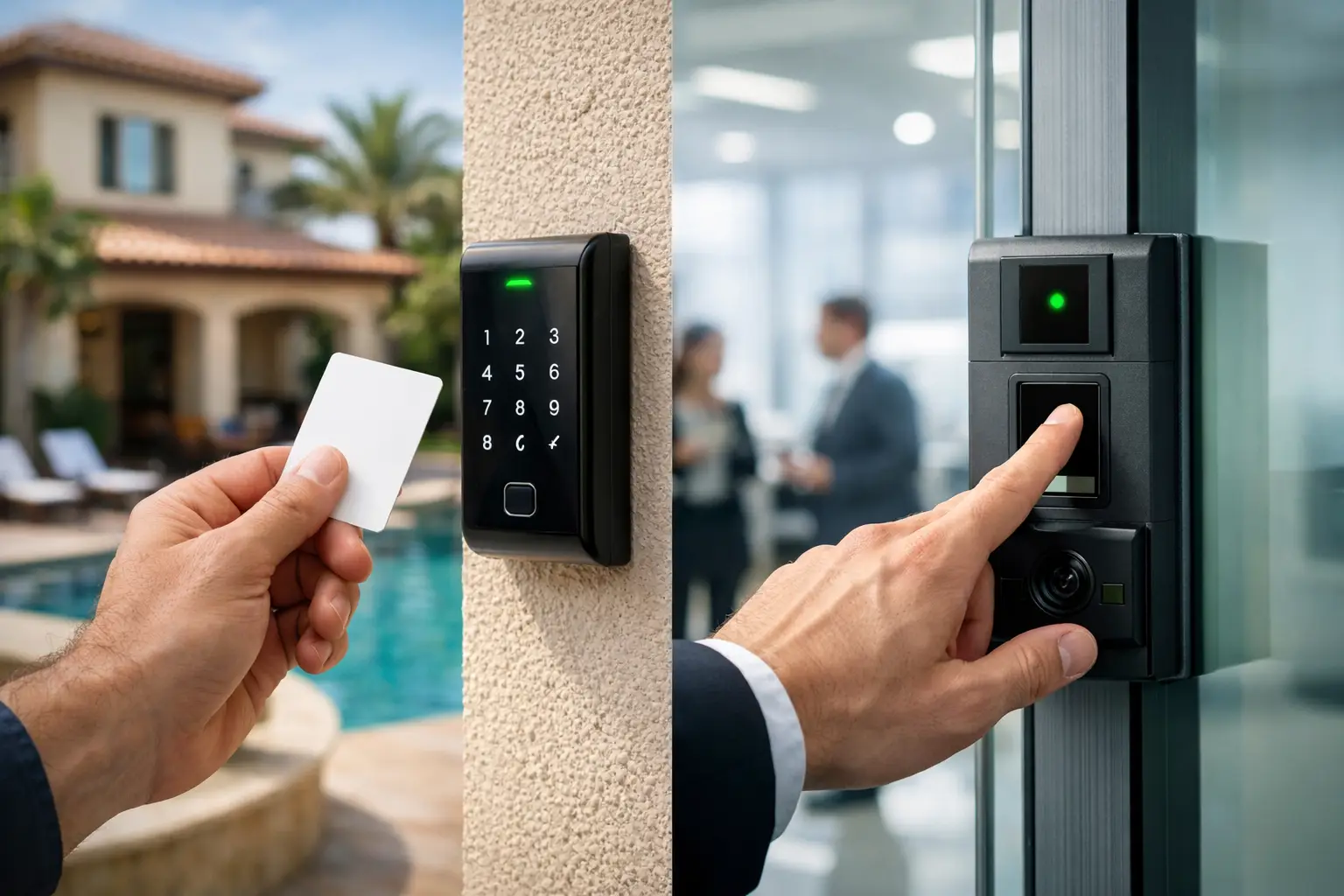
At its core, the system verifies a credential and decides whether that credential is authorized at a specific opening and time. Credentials can include key cards, fobs, mobile credentials, PIN codes, or biometric readers where appropriate. The system then releases an electronically controlled door, gate, or other entry point and logs the event.
That sounds straightforward, but the planning behind it matters. An access point has to work reliably during busy arrival times, after hours, and during a power interruption. It has to match the architecture of the space and remain intuitive for the people using it every day. A premium result is not simply a reader mounted beside a door. It is a coordinated entry experience that performs consistently without detracting from the property.
Access Control Boca Raton Properties Need to Plan Around
Boca Raton properties often have a combination of conditions that make careful design especially valuable: gated entries, detached guest spaces, pool or outdoor living areas, waterfront exposure, seasonal occupancy, vendors, and high-value assets. Commercial properties may also have multiple suites, employee turnover, deliveries, shared entrances, and compliance-related access needs.
The first decision is not which reader looks best. It is identifying which spaces need controlled access and what level of verification makes sense for each one. The front gate may need video confirmation and remote release. A private office might require a mobile credential and an audit trail. A pool equipment room could be limited to authorized service personnel during scheduled hours.
There are trade-offs. A higher-security opening may call for two-factor authentication or stricter schedules, but that can add friction for users. Mobile credentials are convenient and reduce the need to issue physical cards, yet a property may still want fobs available for guests, vendors, or team members who prefer them. Cloud-managed platforms can simplify administration across multiple locations, while an on-premises approach may be preferred for certain operational requirements. The correct choice depends on the property, the people, and how much control the owner wants to retain.
Residential entry should feel effortless, not exposed
In a luxury home, access control should support daily life without making every arrival feel like a checkpoint. A homeowner may enter through a vehicle gate, disarm an entry point, and allow a trusted visitor through an intercom call, all from a single control interface. The system can be configured so household staff have access only during approved times and only at the doors they need.
Temporary credentials are particularly useful for visitors, property managers, dog walkers, and recurring service appointments. Rather than handing out keys that remain in circulation, the homeowner can create, modify, or revoke access as circumstances change. For second homes and seasonal residences, remote visibility into entry activity offers added confidence when the property is unoccupied.
A clean installation is essential. Readers, keypads, door hardware, cameras, and entry stations should be selected and placed with the home’s finishes, sightlines, and use patterns in mind. The technology should feel intentional, not added as an afterthought.
Businesses need control without creating bottlenecks
For business owners, access control brings accountability to the physical workplace. Employees can use credentials assigned to them individually instead of sharing keys. Administrators can set permissions by role, department, location, door, or schedule. When a credential is lost or an employee leaves, access can be changed promptly without the disruption and expense of rekeying multiple doors.
The operational value becomes clearer as a facility grows. A manager can identify who entered an office after hours, restrict a warehouse area to authorized personnel, provide scheduled access to cleaning crews, or keep a sensitive storage room separate from general employee traffic. If a business has multiple locations, centralized management can reduce the time required to maintain consistent policies.
Visitor access deserves equal attention. Reception areas, gated parking, delivery entrances, and conference spaces each have different requirements. Some organizations need a simple video intercom and remote release. Others benefit from pre-registered visitor credentials and access schedules. The objective is not to make guests feel unwelcome. It is to make entry organized, professional, and verifiable.
Why Integration Changes the Value of the System
Access control delivers greater value when it is designed alongside video surveillance, communications, structured cabling, and smart property controls. When an entry event occurs, the system can be paired with video from the relevant camera so an owner or manager has context, not just a timestamp. A video intercom can allow a resident or receptionist to see and speak with a visitor before releasing a gate or door.
Integration also reduces clutter. Rather than separate apps and controls for gates, cameras, doors, and intercoms, a properly planned system can present the most important functions through a coordinated interface. This is especially useful for properties with several entry points or owners who manage residences and businesses in more than one location.
That does not mean every system should include every available feature. Adding complexity without a clear purpose can make administration harder. The strongest design focuses on the functions the owner will genuinely use, then leaves room for future expansion through appropriate infrastructure and wiring.
The Details That Protect Long-Term Performance
A reliable system depends on the components people rarely see. Door strikes, magnetic locks, request-to-exit devices, power supplies, battery backup, network connections, and cabling must be selected and installed as part of one complete design. An attractive reader is of little value if the door hardware is misaligned, the gate controller is not properly coordinated, or the network connection drops when access is needed.
For exterior openings in South Florida, equipment selection and installation methods should account for heat, humidity, rain, salt air in coastal areas, and frequent use. Outdoor devices need proper protection, and wiring routes need to be planned for long-term serviceability. These are not details to leave until the end of a renovation or construction project.
The administration side matters as well. Property owners should understand who can add or remove users, how credentials are issued, where activity records are retained, and what happens if the internet connection or power is interrupted. Training should be clear enough that a designated manager can handle everyday tasks, while experienced support remains available for system changes, expansion, or troubleshooting.
A Better Starting Point for Your Project
The most useful access control conversation begins with a walkthrough of the property and a practical discussion of daily routines. Which doors are used most often? Who needs access after hours? Where do deliveries arrive? What happens when a visitor calls from the gate? Which areas need an entry record, and which simply need convenient control?
Sentry Audio Video designs access control as part of a complete property technology strategy, coordinating security, surveillance, communications, and infrastructure from the proposal through installation and ongoing support. That single-point responsibility helps prevent the gaps that appear when several disconnected systems are expected to work together.
Whether the project is a new Boca Raton residence, a major renovation, or a commercial facility upgrade, the right entry system should make the property easier to manage while quietly raising its level of protection. Start with the way the space is actually used, and the technology will have a clear job to do.