A well-appointed Boca Raton property should not require a collection of remotes, disconnected apps, and service calls to make its technology work. The real value of Boca Tech and Automation is not adding more devices. It is bringing entertainment, security, lighting, shades, outdoor spaces, and network infrastructure into one dependable system that responds exactly as the property owner expects.
For homeowners and business owners, professional integration replaces daily friction with purposeful control. A single command can prepare a theater for movie night, illuminate an entry path, lower shades for privacy, or secure a property at closing time. Behind that simple experience is a carefully engineered system designed around the building, the people using it, and the level of performance they expect.
Technology Should Follow the Way You Live
A custom automation system begins with a practical question: what should happen automatically, and what should remain under your control? The answer is different for every property. A waterfront home may prioritize exterior surveillance, lighting scenes, motorized shades, and distributed audio for outdoor entertaining. A condominium may need discreet equipment placement, reliable Wi-Fi coverage, and simple centralized control. A restaurant, office, or hospitality space may focus on AV distribution, communications, surveillance, and dependable network access.
The strongest installations are planned around routines rather than products. For example, a “Good Morning” scene might raise selected shades, turn on kitchen and landscape lighting, and begin soft audio in common areas. An “Away” scene can turn off designated systems, secure doors, adjust shades, and confirm that security monitoring is active. Those actions should feel natural, not theatrical. If a control system is complicated, it will not be used to its full potential.
This is why professional system design matters. Automation should reduce decisions, not create another interface to manage.
What a Complete Boca Tech and Automation System Includes
Technology integration is often misunderstood as a single smart-home feature. In reality, it is the coordination of several systems that must communicate reliably while still being intuitive for the owner, family members, guests, or staff.
Centralized control without the clutter
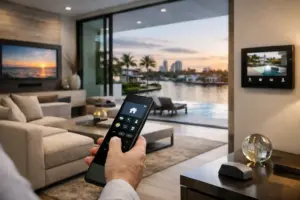
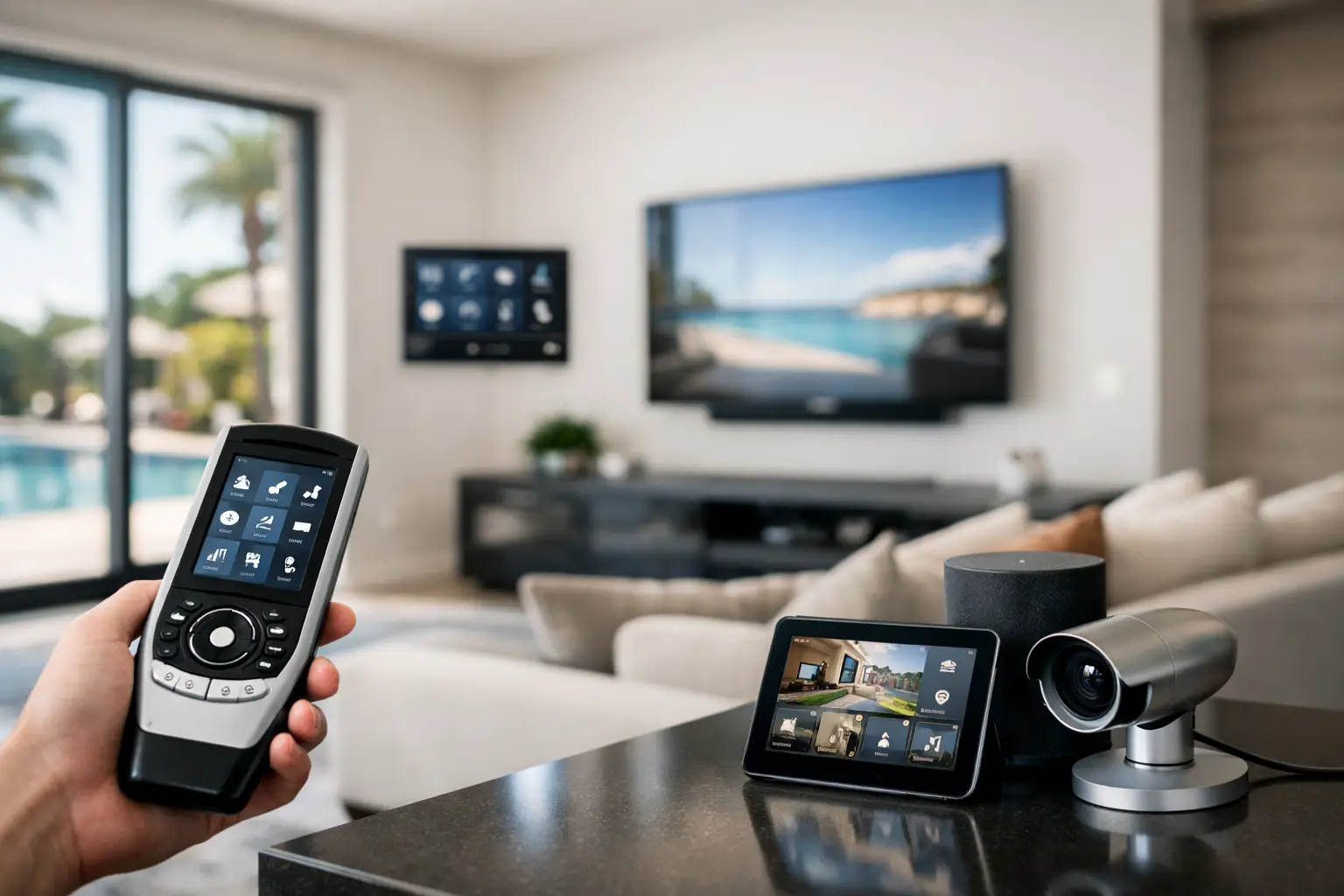
A professionally integrated control platform can bring multiple spaces and systems into a clean, consistent interface. Instead of using a separate app for audio, shades, cameras, and lighting, users can access essential functions from a wall keypad, touchscreen, mobile device, or handheld remote.
The goal is not to put every setting on one screen. It is to provide the right controls in the right place. A theater remote should prioritize source selection, lighting, sound, and playback. An entry keypad should provide immediate access to security and arrival scenes. In a business setting, staff should be able to operate a meeting room or public-area audio system without navigating technical menus.
Entertainment that works in every space
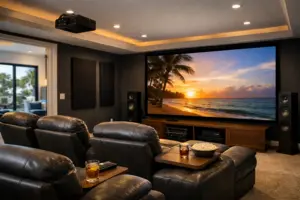
Whole-home audio and video systems create a more polished experience indoors and out. Music can follow the family from the kitchen to the patio without manually reconnecting speakers. A dedicated theater can be configured for powerful, balanced performance while preserving the room’s design. Outdoor entertainment can be engineered to withstand South Florida conditions and provide coverage where people actually gather.
Performance depends on much more than selecting premium components. Speaker placement, equipment ventilation, acoustic considerations, wiring pathways, and control programming all affect the final result. A beautiful room with poorly planned technology rarely delivers the experience the owner had in mind.
Security designed as part of the property
Security is more effective when it is integrated into the larger technology plan. High-quality video surveillance, access control, communications, and alarm-related systems can be organized so that homeowners and authorized staff have meaningful visibility without unnecessary complexity.
Camera placement is a good example. It should address actual property conditions such as entry points, gate access, driveways, waterfront exposure, package areas, and low-visibility zones. The design must also account for night performance, lighting changes, recording requirements, privacy considerations, and reliable network capacity. Adding cameras after a project is complete may be possible, but coordinated planning usually produces a cleaner and more capable result.
The network is the foundation
Every connected system depends on a properly designed network. Audio streaming, video distribution, remote monitoring, cameras, control interfaces, and communications all require stable wired and wireless coverage. When the network is treated as an afterthought, the visible systems suffer first: video buffers, cameras drop offline, controls respond slowly, and coverage becomes inconsistent from room to room.
A professional infrastructure plan considers the size and construction of the building, device density, outdoor coverage, equipment locations, and future expansion. Structured cabling provides the backbone for systems that need consistent performance, while professionally positioned wireless access points support dependable mobile connectivity throughout the property.
Why Preconstruction Planning Protects the Finish
The ideal time to plan automation is before walls are closed and before finish selections limit equipment locations. That does not mean a finished home cannot be upgraded. It means early coordination gives the project team more options for concealed wiring, speaker placement, display locations, rack design, shade pockets, camera pathways, and keypad placement.
For a renovation or new construction project, technology planning should be coordinated with the architect, interior designer, builder, and other relevant trades. This protects the visual integrity of the space while ensuring that functional details are addressed before they become costly compromises. Equipment should not appear as an afterthought in a premium property.
There are trade-offs. Fully hidden solutions can require more planning, specialized materials, and careful access provisions for future service. In some rooms, a visible design element may provide better sound or easier control. The right answer depends on how the room will be used, the architecture, and the client’s priorities. A qualified integrator should explain those choices clearly rather than forcing a one-size-fits-all package.
Reliable Automation Requires Ongoing Ownership
Installation day is not the finish line. A technology system must be tested as a complete environment, not as a group of individual devices. That includes checking control responses, audio zones, video sources, camera views, network coverage, remote access, programmed scenes, and the behavior of systems during power interruptions or network changes.
It also requires accountable support after the project is complete. Properties evolve. Families add spaces, businesses change operational needs, and software platforms receive updates. A service-led technology partner can document the system, maintain its performance, and make thoughtful changes without creating confusion for the people who depend on it.
This is particularly valuable for seasonal residences, managed properties, and busy commercial environments. When an issue arises, clients need a team that understands how the system was designed, what equipment is installed, and how each component affects the rest of the property.
Questions to Ask Before Selecting an Integrator
Before committing to an automation project, ask how the system will be designed around your routine, not just which brands will be installed. Ask who will coordinate with your construction and design teams, where equipment will be housed, how network performance will be validated, and what support looks like after installation.
You should also ask about scalability. A well-designed system does not need every capability on day one, but it should allow for logical additions as the property changes. Planning conduits, cabling, rack space, and network capacity early can preserve options without disrupting finished spaces later.
Finally, look for clear accountability. The provider should take responsibility for system performance across AV, automation, security, and infrastructure, rather than leaving the client to determine which vendor to call when something does not work.
A More Controlled, More Enjoyable Property
Boca Tech and Automation is most successful when the technology fades into the background. The home feels more comfortable, the property is easier to monitor, entertainment is ready when it is wanted, and staff or family members can operate essential features with confidence.
Sentry Audio Video approaches each project as a complete integration, with clean execution, thoughtful design, and ongoing support built into the process. Whether you are planning a new residence, renovating a luxury space, or improving a commercial property, the right technology partner can turn a complex collection of systems into one dependable experience.